

A late VAT return in the UAE triggers a fixed administrative penalty of AED 1,000 for the first offence and AED 2,000 for a repeat within 24 months. If you also pay the VAT late, the Federal Tax Authority adds a separate charge of 14% per annum on the unsettled amount, applied monthly for each month or part of a month until you clear it. Filing and payment are two distinct obligations, and missing both means you pay both penalties.
Most UAE business owners discover the real cost of a missed VAT deadline only after the penalty lands in EmaraTax. By then the arithmetic has already started running. This guide sets out exactly what you owe, how the FTA calculates it under the rules in force since 14 April 2026, and what you can still do to cut the damage.
Two Penalties, Two Different Clocks
The single most expensive misunderstanding in UAE VAT compliance is treating “filing” and “paying” as one event.
Under Article 64 of the VAT Executive Regulation, you must submit your VAT return and settle the net VAT due within 28 days of the end of your tax period. Article 62 sets the standard tax period at three calendar months, and the FTA assigns monthly periods to larger businesses in practice, those with annual taxable supplies of AED 150 million or more. Your assigned period sits on your VAT certificate and in your EmaraTax dashboard, so treat that as the authority, not a generic calendar.
If the 28th falls on a weekend or a UAE public holiday, the deadline rolls to the first business day afterwards.
Miss the filing deadline and you incur a fixed fine. Miss the payment deadline and you incur a percentage charge that keeps accruing. File on time but pay late, and you still pay the percentage charge. The two clocks run independently.
Late VAT Filing Penalty: AED 1,000, Then AED 2,000
The FTA charges AED 1,000 the moment a VAT return passes its deadline unsubmitted. Commit the same violation again within 24 months of the last one and the fine rises to AED 2,000.
Three points businesses routinely get wrong:
- A nil return still counts. Zero sales and zero VAT do not excuse you from filing. The penalty applies to the failure to submit, not to the amount owed.
- The fine does not scale with delay. One day late and thirty days late both cost AED 1,000 on the filing side. The cost of the delay itself sits in the payment penalty.
- The 24-month window is rolling. It runs from the date of your last violation, not from the start of a calendar or financial year.
Late VAT Payment Penalty: 14% Per Annum, Charged Monthly
This is the figure that changed, and the reason so much published guidance is now wrong.
Cabinet Decision No. 129 of 2025 amended the penalty tables under Cabinet Decision No. 40 of 2017 with effect from 14 April 2026. The old structure 2% immediately, a further 4% after seven days, then 1% per day up to a ceiling of 300% of the tax no longer applies to violations from that date.
The current rule reads as follows: a monthly penalty at 14% per annum, for each month or part thereof, imposed on the unsettled Payable Tax from the day following the payment due date, and on the same date monthly thereafter.
In practical terms:
- Each charge equals 14% ÷ 12, or roughly 1.1667% of the outstanding tax.
- The first charge lands the day after the deadline, not after a grace period. One day late costs a full month.
- The charge is non-compounding; each month’s penalty applies to the unsettled tax, not to tax plus accrued penalties.
- The penalty table sets no percentage ceiling on this charge, so a long-unpaid balance keeps accruing.
Where the liability arises from a Voluntary Disclosure or a Tax Assessment, the payment due date becomes 20 business days from the date you submit the disclosure, or 20 business days from the date you receive the assessment.
What the delay actually costs
Take a net VAT liability of AED 100,000 on a return filed and paid late for the first time.
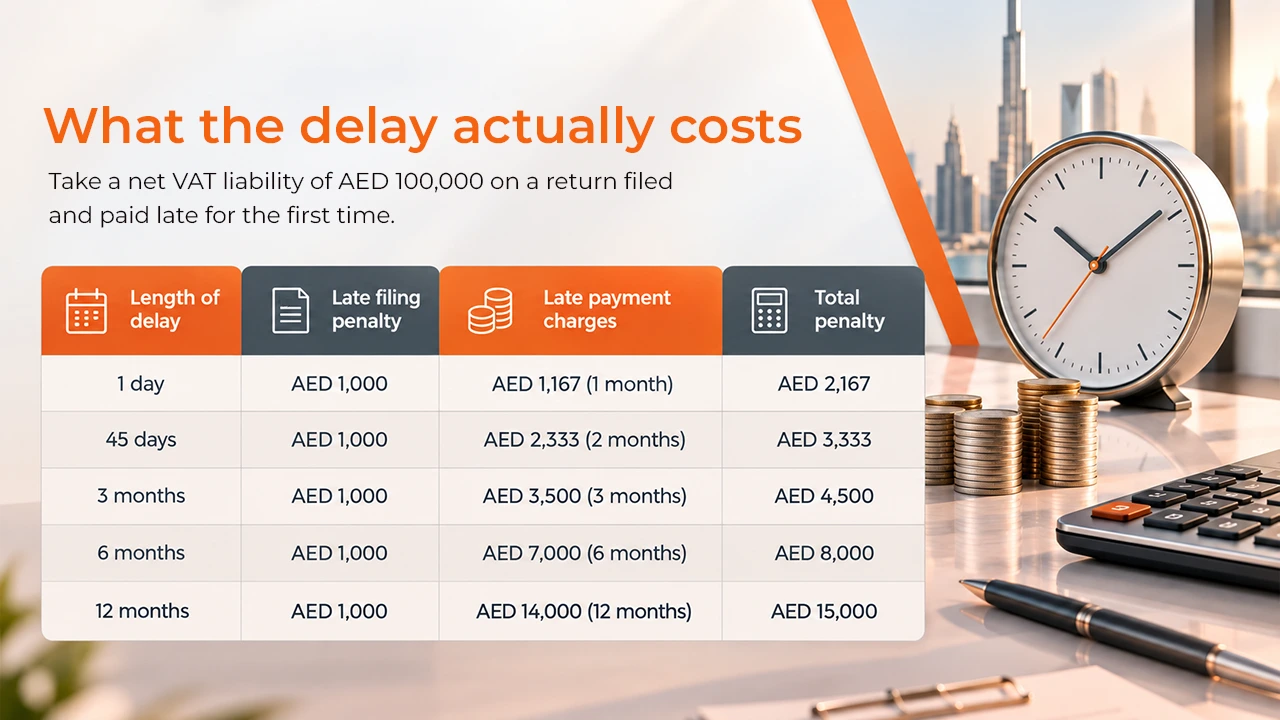
Illustrative calculation on AED 100,000 of unsettled Payable Tax under the penalty tables in force from 14 April 2026. Your figures depend on your assigned tax period, your payment date and your violation history.
The headline reads as relief compared with the old regime, and for short delays it is. But notice what happens at the twelve-month mark: AED 15,000 of pure penalty on a liability you always owed anyway, before anyone has looked at whether the return itself was correct.
The Penalties That Stack On Top
Late filing rarely arrives alone. A missed return usually signals a wider control gap, and the FTA’s schedule covers each failure separately. These are the amounts in force from 14 April 2026.
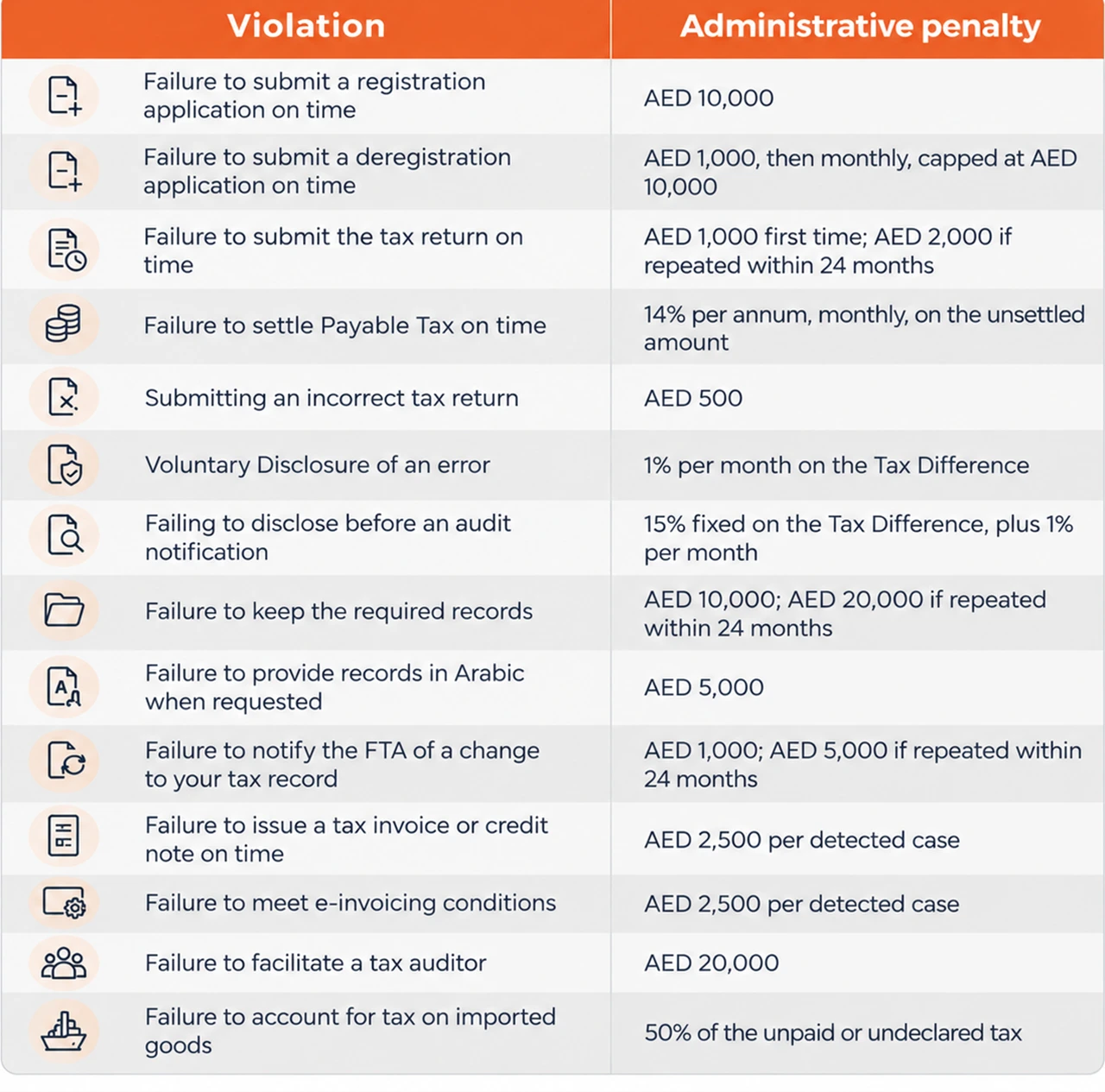
The AED 500 penalty for an incorrect return falls away if you correct the return before the filing deadline, or if you file a Voluntary Disclosure that produces no difference in Due Tax.
Voluntary Disclosure: Why Timing Decides the Bill
If a late return also contains an error, the order in which you act changes the number materially.
Disclose the error yourself, before the FTA notifies you of an audit, and you pay 1% per month on the Tax Difference, running from the day after the return’s due date until you submit the disclosure. Wait until an audit notice arrives, or fail to disclose at all, and the FTA adds a fixed 15% of the Tax Difference on top of that monthly charge.
On a Tax Difference of AED 200,000, that fixed element alone is AED 30,000 — a cost you remove entirely by moving first.
One threshold worth knowing: where an error changes the tax due by AED 10,000 or less, you can correct it in your next return. Above that, a Voluntary Disclosure is mandatory.
Why Half the Advice Online Is Now Out of Date
Search “VAT penalty UAE” today and you will find well-ranked pages from established UAE advisory firms still quoting figures the Cabinet retired. Common examples:
- 2% immediate, 4% after seven days, 1% daily, capped at 300% — superseded by the flat 14% per annum from 14 April 2026.
- AED 20,000 for failing to submit records in Arabic — now AED 5,000.
- AED 50,000 for repeat record-keeping failures — now AED 20,000.
- AED 3,000 / AED 5,000 for an incorrect return — now AED 500, with conditions that remove it entirely.
- AED 5,000 per non-compliant tax invoice — now AED 2,500 per detected case.
Some of those errors understate your exposure and some overstate it. Either way, a compliance decision built on a retired penalty table is a decision built on nothing. Verify any figure against the consolidated Cabinet Decision text on the Ministry of Finance portal, or ask a registered tax agent to do it for you.
You Have Already Missed a Deadline. What Now?
Act in this order.
- File the overdue return immediately. The fixed penalty does not grow, but the payment charge accrues every month the tax sits unsettled. Log into EmaraTax, open the return flagged as overdue, and submit.
- Pay the net VAT in full, not just the penalty. Partial payment leaves the balance accruing at 14% per annum.
- Check the return for errors before you rely on it. If you find a material error, a Voluntary Disclosure filed now costs far less than one filed after an audit notice.
- Consider a reconsideration request. You can ask the FTA to reconsider a penalty decision within 40 business days of being notified, giving reasoned grounds and documentary evidence. The FTA must decide within 40 business days. If the outcome disappoints, the Tax Disputes Resolution Committee is the next step, then the federal courts.
- Explore installments or a waiver. Cabinet Decision No. 105 of 2021 sets out procedures for paying administrative penalties in installments or applying for a waiver in defined circumstances. Conditions are strict and the FTA applies them narrowly, so prepare the file properly.
Stop the Next One Before It Happens
Penalties are a symptom. The cause is almost always processed.
- Own the calendar. Assign one named person and one named backup to every VAT deadline, with an internal cut-off three business days before the FTA date.
- Reconcile before you file, not after. Match output VAT to revenue and input VAT to the purchase ledger each month, so the return becomes a report rather than a reconstruction.
- Separate the payment task. GIBAN transfers take time to land. A return submitted on day 28 with the money still in transit leaves you exposed.
- Keep records audit-ready. Five years for general records, fifteen for real estate. Poor records turn a routine query into a AED 10,000 finding.
- Reconcile your VAT position to your corporate tax figures. Divergence between the two is a visible flag.
Free VAT Compliance Check from KGRN
KGRN’s tax team reviews your last four VAT returns against the current FTA penalty tables and tells you, in plain terms, where your exposure sits. The review covers your filing and payment history, output and input VAT reconciliation, tax invoice and credit note compliance, record-keeping adequacy, and any errors that warrant a Voluntary Disclosure before the FTA finds them.
No obligation, no charge. Request your free VAT compliance check and we will come back to you within one business day.
Frequently Asked Questions
- What is the penalty for late VAT filing in the UAE?
AED 1,000 for a first offence, and AED 2,000 for a repeat within 24 months. The penalty applies even where no VAT is due, so a nil return filed late still costs AED 1,000.
- How does the FTA calculate the VAT late payment penalty in 2026?
At 14% per annum on the unsettled Payable Tax, imposed monthly for each month or part of a month, starting the day after the payment due date. That works out to roughly 1.1667% per charge, applied on a non-compounding basis.
- Does the old 300% penalty cap still apply?
No. Cabinet Decision No. 129 of 2025 replaced the compounding structure 2%, then 4%, then 1% daily up to 300% with the flat annual rate, effective 14 April 2026.
- Can the FTA waive a VAT penalty?
In defined circumstances. Cabinet Decision No. 105 of 2021 provides for instalments and waivers subject to conditions, and you can separately request reconsideration of a penalty decision within 40 business days of notification.
- What is the VAT return deadline in the UAE?
28 days after the end of your tax period, for both the return and the payment. If that date falls on a weekend or public holiday, it moves to the next business day.
- Is late filing the same as late payment?
No. They are separate violations with separate penalties, and both can apply to the same tax period.
- How far back can the FTA go?
The general limitation period is five years, extending to fifteen years in cases involving tax evasion or a failure to register.