


Value Added Tax (VAT) was introduced in the UAE on January 1, 2018, as part of a broader economic diversification strategy across the Gulf Cooperation Council (GCC) countries. For businesses operating in the UAE, understanding and complying with VAT regulations is crucial for avoiding penalties and maintaining good standing with the Federal Tax Authority (FTA). This guide provides a beginner-friendly overview of VAT compliance, eligibility, and the step-by-step process of filing VAT returns.
Importance of VAT Compliance
VAT compliance in the UAE goes beyond being a legal requirement—it is a cornerstone of responsible business practice. Failure to comply can expose companies to hefty financial penalties, damage their reputation, and even trigger legal consequences.
The Federal Tax Authority (FTA) has set out clear rules and sanctions for late filing, inaccurate submissions, and delayed payments. For example, missing a tax return deadline results in a penalty of AED 1,000 for the first occurrence and AED 2,000 for repeated instances within 24 months. In cases of late tax payment, businesses face a 2% penalty on the outstanding amount immediately, an additional 4% after seven days, and a 1% daily charge after one month capped at 300% of the unpaid tax.
By staying compliant with VAT regulations, businesses not only avoid unnecessary financial strain but also ensure transparency, build credibility, and contribute to the sustainable growth of the UAE economy.
Eligibility Criteria for Filing VAT Returns
Not all businesses are required to register for VAT. The eligibility criteria are based on a business’s taxable supplies and imports. Businesses are mandatorily required to register for VAT if the value of their taxable supplies and imports exceeds AED 375,000 in a 12-month period, or if they anticipate exceeding this threshold in the next 30 days. This threshold applies to all taxable supplies, including goods and services, and imports into the UAE.
Businesses may also voluntarily register for VAT if the value of their taxable supplies and imports exceeds AED 187,500 in a 12-month period, or if they anticipate exceeding this threshold in the next 30 days. Voluntary registration can be beneficial for businesses that primarily make zero-rated supplies or wish to recover input VAT on their expenses.
Certain entities are exempt from VAT registration, such as government entities, charities, and businesses dealing exclusively in exempt supplies (e.g., certain financial services, bare land, and local passenger transport). It is crucial for businesses to regularly assess their turnover against these thresholds to determine their VAT registration obligations.
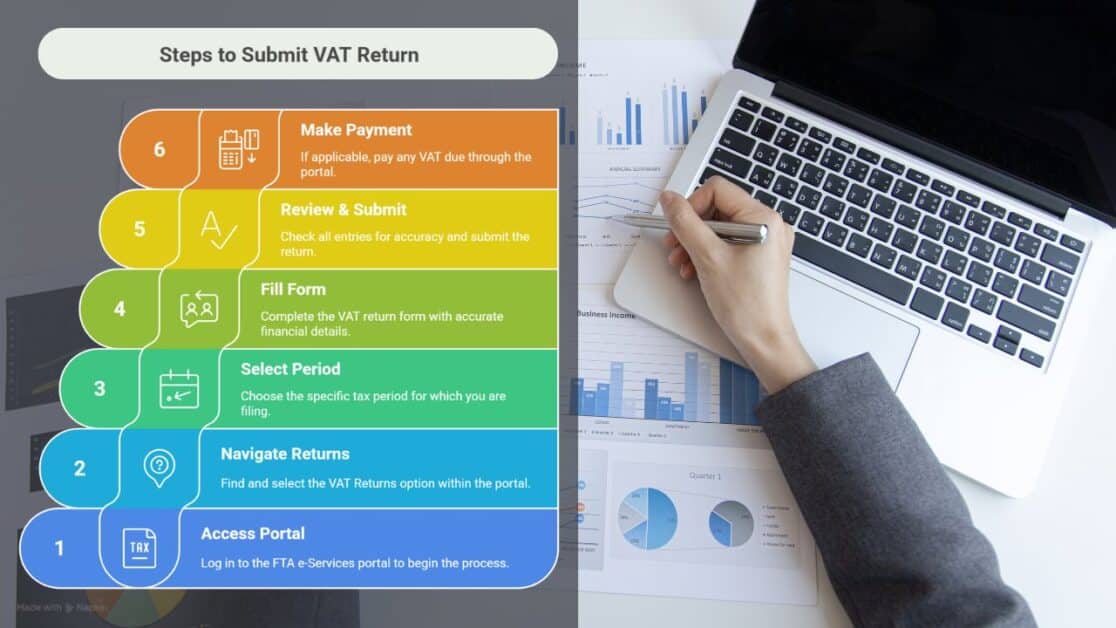
Step-by-Step Process of Submitting VAT Returns through the FTA e-Services Portal
The process of filing VAT returns in the UAE is primarily conducted through the Federal Tax Authority (FTA) e-Services portal. This online platform is designed to streamline the submission process and ensure accuracy.
Step 1: Register on the FTA e-Services Portal
Before filing a VAT return, businesses must first be registered for VAT with the FTA and have an active account on the e-Services portal. This involves creating an EmaraTax account, which serves as the central hub for all tax-related interactions with the FTA. During registration, businesses will provide details about their entity, activities, and appoint a tax agent if applicable.
Step 2: Gather Necessary Information and Documents
Accurate record-keeping is paramount for VAT compliance. Before initiating the return process, businesses should compile all relevant financial data for the tax period. This includes:
- Sales records: Details of all taxable supplies (standard-rated, zero-rated, and deemed supplies).
- Purchase records: Invoices for all business expenses, especially those with input VAT.
- Import and export documentation: Records of goods and services imported into and exported from the UAE.
- Adjustments: Any adjustments for bad debts, discounts, or other changes to previous transactions.
- VAT account reconciliation: A summary of output VAT collected and input VAT paid.
Step 3: Log in to the FTA e-Services Portal
Once all information is gathered, log in to your EmaraTax account on the FTA website (www.tax.gov.ae). Navigate to the VAT section to access the VAT return filing interface.
Step 4: Complete the VAT Return Form
The VAT return form on the FTA portal is structured to capture various aspects of a business’s financial activities during the tax period. The form typically includes sections for:
- Sales and all other outputs:
- Standard rated supplies in UAE: This includes the value of goods and services sold at the standard VAT rate of 5%.
- Zero-rated supplies: Value of supplies subject to 0% VAT (e.g., certain exports, international transport).
- Exempt supplies: Value of supplies not subject to VAT (e.g., bare land, certain financial services).
- Supplies subject to reverse charge mechanism: Value of imported services or goods where the recipient is liable for VAT.
- Purchases and all other inputs:
- Standard rated expenses: Value of purchases subject to 5% VAT.
- Imports subject to reverse charge mechanism: Value of imported goods and services where the recipient accounts for VAT.
- Net VAT due: The system automatically calculates the net VAT payable or refundable based on the input data. The formula for Net VAT Due is:
Net VAT Due = Output VAT − Input VAT - Adjustments: Any corrections or adjustments to previous periods or specific transactions.
- Declaration and authorized signatory: A section where the authorized person declares the accuracy of the information.
Carefully enter all required data into the respective fields. Double-check all figures to ensure accuracy, as errors can lead to penalties. The FTA provides detailed guides and tutorials on how to fill out each section of the VAT return form.
Step 5: Review and Submit the VAT Return
Before final submission, thoroughly review the entire VAT return form. Ensure that all figures are correct, and there are no discrepancies. The FTA portal often provides a summary of the return, allowing for a final check. Once confident in the accuracy of the information, click the “Submit” button. Upon successful submission, a confirmation message will be displayed, and a copy of the submitted return will be available in your EmaraTax account.
Step 6: Make Payment (if applicable)
If the VAT return indicates a net VAT payable, the payment must be made by the due date. The FTA offers various payment methods, including e-Dirham, credit card, and bank transfer. The payment deadline is typically the 28th day following the end of the tax period. Failure to pay on time will result in penalties.
Step 7: Keep Records
Maintain comprehensive records of all VAT-related transactions and submitted returns for a minimum of five years, as required by UAE tax law. These records are essential for potential audits by the FTA.
By following these steps, businesses can effectively manage their VAT obligations and ensure compliance with UAE tax laws.
Conclusion
Filing VAT returns in the UAE may seem complex for beginners, but with accurate records, timely preparation, and the FTA’s EmaraTax portal, the process becomes straightforward. Compliance not only helps you avoid penalties but also strengthens your business credibility.
If you are unsure about VAT registration, eligibility, or filing, consulting a professional VAT consultant in UAE can save time, reduce risks, and ensure accuracy.
At KGRN, we provide comprehensive VAT services and expert support tailored to your business needs. Whether it’s VAT registration, return filing, or compliance advisory, our team ensures you stay compliant with UAE tax laws. Contact KGRN today for professional assistance in filing your VAT returns with confidence.
Top 5 Frequently Asked Questions (FAQs)
1. Who is required to file VAT returns in the UAE?
Any business registered with the Federal Tax Authority (FTA) must file VAT returns. Companies with taxable supplies and imports exceeding AED 375,000 annually are required to register, while those above AED 187,500 may register voluntarily.
2. How often do businesses need to file VAT returns in the UAE?
Most businesses file quarterly VAT returns, while some large businesses may be required to file monthly returns. The FTA decides the filing frequency during registration.
3. What is the deadline for filing VAT returns in the UAE?
VAT returns and payments are due by the 28th day following the end of the tax period (monthly or quarterly). If the date falls on a weekend or holiday, the deadline shifts to the next working day.
4. Can I amend my VAT return after submission?
Yes. Small errors under AED 10,000 can be corrected in the next return. Larger errors must be corrected immediately using the Voluntary Disclosure Form through the FTA portal.
5. Do I need a VAT consultant to file returns?
While filing can be done directly via the FTA EmaraTax portal, many businesses prefer hiring a VAT consultant in UAE for accuracy, compliance, and avoiding penalties. Firms like KGRN provide expert support for VAT registration, filing, and advisory services.
Authoritative Sources
- Tax Penalties. [Federal Tax Authority]
- VAT Registration. [Federal Tax Authority]
- VAT Exemptions. [Federal Tax Authority]
- VAT Guides. [Federal Tax Authority]
- Tax Procedures Law. [Federal Tax Authority]