

For a UAE business with annual revenue of AED 50 million or more, 1 January 2027 is not a planning date. It is the date from which mandatory eInvoicing must be operational.
The deadline to appoint an Accredited Service Provider, or ASP, has moved from 31 July to 30 October 2026 under Ministerial Decision No. 66 of 2026. The mandatory go-live date has not moved. A business that waits until 30 October to start implementation will have only about two months to complete onboarding, integration, data correction, testing and training.
This guide is therefore not another explanation of what eInvoicing means. KGRN’s complete UAE eInvoicing guide covers that foundation. This article focuses on the 10 issues Phase 1 businesses should fix before the first mandatory go-live.
Who must be ready by 1 January 2027?
An in-scope person conducting business in the UAE must implement the Electronic Invoicing System by 1 January 2027 if its revenue is equal to or exceeds AED 50 million.
For this purpose, revenue means gross income earned during the most recent Accounting Period, based on financial statements prepared under applicable UAE legislation. If those statements are unavailable, the Federal Tax Authority may accept other documentation. The threshold is not limited to VAT-registered businesses.
The legal framework is mainly set by Ministerial Decision No. 243 of 2025, which defines the scope, exclusions and operating obligations, and Ministerial Decision No. 244 of 2025, which establishes the phased rollout. Ministerial Decision No. 66 of 2026 later moved the first ASP appointment deadline to 30 October 2026. The UAE Electronic Invoicing Guidelines, Version 1.1 explains how these requirements work in practice.
| Category | ASP Appointment Deadline | Mandatory Implementation |
| In-scope business with revenue of AED 50 million or more | 30 October 2026 | 1 January 2027 |
| In-scope business with revenue below AED 50 million | 31 March 2027 | 1 July 2027 |
| In-scope government entity | 31 March 2027 | 1 October 2027 |
The first date does not apply to every business. Businesses below the threshold have a later rollout date, although voluntary implementation has been available since 1 July 2026. For a fuller explanation of the first cohort, see KGRN’s UAE eInvoicing Phase 1 guide.
Why a PDF invoice is not enough
Under the UAE framework, an e-invoice is structured invoice data that can be processed automatically. The Ministry of Finance eInvoicing portal expressly states that PDFs, Word documents, images, scanned copies and emails are not e-invoices.
The UAE model uses structured XML and the PINT-AE specification. The supplier sends invoice data to its ASP, which validates and converts it where required, transmits it to the buyer’s ASP and reports the required tax data to the FTA. Confirmation messages then show whether exchange and reporting succeeded or failed.
That means a clean-looking PDF is not evidence of readiness. Readiness depends on the data behind the invoice, the connection to an ASP, the ability to receive invoices and the controls that deal with failures and corrections.
The 10-point UAE eInvoicing readiness checklist
1. Confirm scope, revenue and every legal entity that must comply
Start with a legal-entity scope assessment, not a group-level assumption.
First, calculate revenue for the most recent Accounting Period using the definition in Ministerial Decision No. 244 of 2025. Then identify every UAE legal entity conducting business, including mainland and free-zone entities. For each entity, separate B2B, B2G and B2C flows and identify the entity that legally issues the invoice, especially where the group uses shared services or central billing.
The assessment should also document any transaction treated as excluded under Article 4 of Ministerial Decision No. 243 of 2025. Where an entity is not registered for a UAE tax type, confirm whether it must register with the FTA to obtain a TIN before onboarding.
The main exclusions include qualifying sovereign government activities, certain airline transactions and VAT-exempt or zero-rated financial services covered by the stated provision. B2C transactions are not currently subject to mandatory eInvoicing until a later decision brings them into scope.
Do not convert a transaction-level exclusion into an entity-wide exemption. A financial institution, airline, retailer or free-zone company may have a mix of in-scope and excluded transactions.
Fix before moving on: Produce a signed scope memo listing every entity, transaction flow, applicable phase, statutory deadline and exclusion relied on. Record the legal source for every exclusion.
2. Appoint the right ASP and complete EmaraTax onboarding
Phase 1 businesses must appoint an ASP by 30 October 2026. Use the Ministry of Finance’s live list of accredited eInvoicing service providers rather than an old presentation or vendor claim.
Accreditation is only the minimum entry requirement. The ASP must work with every ERP, billing, POS and industry system that produces invoice data. It should support both outgoing and incoming flows, PINT-AE validation and conversion, peak transaction volumes and the complexity of multi-entity groups or multiple ERPs.
The evaluation should also test the provider’s response to rejected and failed invoices, data-security model, hosting and retention arrangements, audit access, implementation responsibilities, service levels, pricing and exit terms. These operational differences will matter long after the appointment deadline has passed.
The Ministry’s Guidelines state that the commercial contract should be completed before onboarding through EmaraTax. Each person should onboard with only one ASP for its eInvoicing requirements. Each member of a tax group must be onboarded separately using its own TIN, although different group members may appoint different ASPs.
Use KGRN’s practical framework for choosing an ASP to structure the evaluation.
Fix before moving on: Keep the signed contract, written responsibilities, implementation plan, service levels, security terms and evidence of onboarding through EmaraTax.
3. Correct TINs, Peppol Participant Identifiers and EmaraTax data
The UAE Participant Identifier is based on the entity’s TIN. For entities already registered for a UAE tax type, the TIN is the first 10 digits of the 15-digit TRN. The Participant Identifier uses scheme code 0235 followed by that 10-digit TIN.
This is an entity-level identifier. A member of a VAT group must use its own TIN, not the VAT group representative’s TIN.
Before onboarding, reconcile the entity’s legal name, trade-licence information, registered address, operating address and contact details with EmaraTax. Confirm that all tax registrations, deregistrations and tax-group memberships are current. The same review must extend to the TIN and TRN stored in every source system and the Participant Identifiers used for regular customers and suppliers.
Ministerial Decision No. 243 of 2025 also requires the appointed ASP to be notified in writing of changes to data registered with the FTA within five business days after the Authority confirms the amendment.
Fix before moving on: Build a controlled identifier register. Do not leave TINs, TRNs or Participant Identifiers as unvalidated free-text fields.
4. Map every invoice source and transaction scenario
Large businesses rarely generate all invoices from one place. Invoice data may begin in an ERP, CRM, warehouse system, project-management platform, e-commerce tool, POS, subscription engine or spreadsheet.
The transaction map should include normal domestic B2B sales and supplies to government entities, but it cannot stop there. It must also capture exports, foreign-currency invoices, intercompany charges, VAT-group transactions, advance payments, prepayments, retention billing and progress invoices.
Less frequent scenarios are just as important because they are often missed during implementation. These may include self-billing, invoices issued by agents, deemed supplies, domestic reverse-charge transactions, credit notes, cancellations, refunds, price corrections and sales to buyers that have not yet joined the Peppol network.
For each scenario, record the issuing entity, source system, approval trigger, tax point, invoice type, required reference, ASP route and accounting entry.
Fix before moving on: Approve one end-to-end transaction map that Finance, Tax, IT and Operations all recognise. If a flow is absent from the map, it will probably be absent from testing.
5. Map the mandatory fields and clean the source data
The Ministry has published mandatory field requirements and the PINT-AE specification defines how the fields are structured. Do not start by asking whether the ERP has an “eInvoicing module.” Start by asking whether the source systems hold accurate values for every required field.
Typical gaps include incomplete legal names and addresses, invalid TINs or TRNs, incorrect units of measure and product descriptions that are too generic for structured processing. Tax categories, exemption reasons, payment terms, due dates and bank details may also be missing or inconsistent.
Foreign-currency invoices need correct AED VAT values, while credit notes and advance-payment adjustments need the appropriate preceding-invoice references. Duplicate customer or supplier records should be resolved before integration, not carried into the new system.
KGRN’s guide to common e-invoice rejection causes explains why identifier and mapping issues fail automated validation.
Fix before moving on: Create a field-level mapping that shows the required PINT-AE field, source system, source field, data owner, validation rule, transformation and fallback procedure. Close all mandatory-field gaps before integration testing.
6. Fix VAT treatment and invoice timing rules
A structurally valid XML invoice can still carry the wrong VAT treatment. Technical validation does not replace a tax review.
Build a tax-rule matrix covering standard-rated, zero-rated, exempt and out-of-scope transactions, together with exports, domestic reverse-charge categories and foreign-currency reporting. It should explain how the system handles discounts, rebates, allowances, document-level charges, advance payments, prepayments and final settlement invoices.
The same matrix should address partial and multi-invoice credit notes, self-billing, agent arrangements and industry-specific matters such as retentions and levies. The objective is to remove recurring tax decisions from manual invoice preparation wherever possible.
Timing matters as well. Where the issuer is VAT registered, the electronic invoice or credit note must follow the timelines prescribed by the VAT Law. Subject to that rule, Ministerial Decision No. 243 of 2025 requires issuance and transmission within 14 days from the Date of Business Transaction. That date is defined as the earlier of the transaction date and receipt of payment.
For a detailed review of tax codes and invoice treatment, link implementation work to KGRN’s VAT consultancy services.
Fix before moving on: Obtain Tax sign-off on the complete rule matrix and configure those rules in the source systems. Do not leave recurring VAT decisions to manual judgement after go-live.
7. Integrate every issuing and receiving system with the ASP
EInvoicing affects accounts receivable and accounts payable. The business must be able to issue, transmit, receive and process structured documents.
The integration design must show how data moves from each source system to the ASP and who converts it into compliant XML when the source system uses another format. Buyer identifiers should be validated before transmission, while confirmations from the buyer’s ASP and the FTA reporting corner must return to the ERP as clear accepted, rejected or pending statuses.
On the purchase side, incoming e-invoices should be matched to purchase orders and goods or service receipt records. The design must also prevent duplicate UUIDs and repeated transmissions, while defining how peak volumes, downtime and automated retries will be managed.
The compliance obligation remains with the business even when the ASP performs validation, transmission and reporting activities.
Fix before moving on: Demonstrate that every source system can send the required data and every receiving process can capture the returned document and status without relying on email or manual re-entry.
8. Build procedures for credit notes, rejections and system failures
The live process will not contain only successful invoices. Businesses need controlled procedures for corrections and failures.
Ministerial Decision No. 243 of 2025 requires an electronic credit note when a transaction is cancelled, consideration is reduced, consideration is refunded in full or in part, or an administrative or numerical error occurs.
The procedure should identify who can initiate and approve a credit note, how the original invoice is referenced and how partial or multi-invoice adjustments are processed. It should also explain how rejected documents are corrected, how pending invoices are tracked to a final status and how duplicates are prevented.
Two situations need separate treatment: a buyer that has not yet onboarded to the network, and an outage affecting the ASP, ERP or network. Finance and IT should know the approved fallback, escalation and recovery steps before either situation occurs.
An issuer or recipient must notify the FTA of a system failure within two business days from the date it occurs, using the mechanism prescribed by the Authority. After service resumes, pending documents should be exchanged and reported promptly.
Fix before moving on: Approve an exception runbook with named owners, escalation times, notification steps, accounting treatment and evidence-retention rules.
9. Test complete business scenarios, not one sample invoice
A successful demo proves only that one prepared invoice can pass. It does not prove that the operating model is ready.
Testing should begin with standard domestic invoices, then expand to zero-rated, exempt, out-of-scope and foreign-currency scenarios. It should include advance and final invoices, partial and full credit notes, multiple preceding-invoice references and B2G transactions.
Businesses should also test VAT-group and intercompany flows, self-billing or agent scenarios where relevant, non-onboarded buyers, incoming supplier invoices and every rejection or resubmission path. Finally, run duplicate-prevention, system-failure, recovery, backlog and peak-volume tests using realistic data volumes rather than one prepared sample.
For every test, reconcile four records: the source ERP, the supplier’s ASP status, the buyer-side exchange status and the tax-data reporting confirmation.
Fix before moving on: Maintain signed test scripts, expected results, actual outputs, defect logs and evidence that every critical defect was retested and closed.
10. Put governance, storage, reconciliation and training in place
Go-live is the start of a continuous control process. The business remains responsible for compliant data, complete records and prompt action on errors.
The operating model needs a senior accountable owner and a clear split of responsibilities across Finance, Tax, IT, Procurement and Operations. Daily monitoring should identify failed, rejected and pending invoices, while periodic reconciliation should compare ERP records, ASP records and VAT reporting.
Formal change control is also needed for ERP releases, tax-code updates and new invoice scenarios. AR, AP, Tax, customer service and system-support teams should be trained on their roles, with regular reviews of customer and supplier onboarding status and regulatory updates from the MoF, FTA and PINT-AE framework.
Version 1.1 of the Ministry’s Guidelines states that e-invoice data must generally be retained for five years, with seven years for real-estate records and possible extensions in specified audit, dispute or disclosure cases. It also clarifies that storage infrastructure may be inside or outside the UAE if records are securely retained and can be produced promptly to the FTA in complete and readable form.
KGRN’s accounting and bookkeeping services can support the reconciliations and control discipline that continue after technical go-live.
Fix before moving on: Finalise the control matrix, record-retention policy, daily dashboard, reconciliation procedure, incident register, change log and role-based training records.
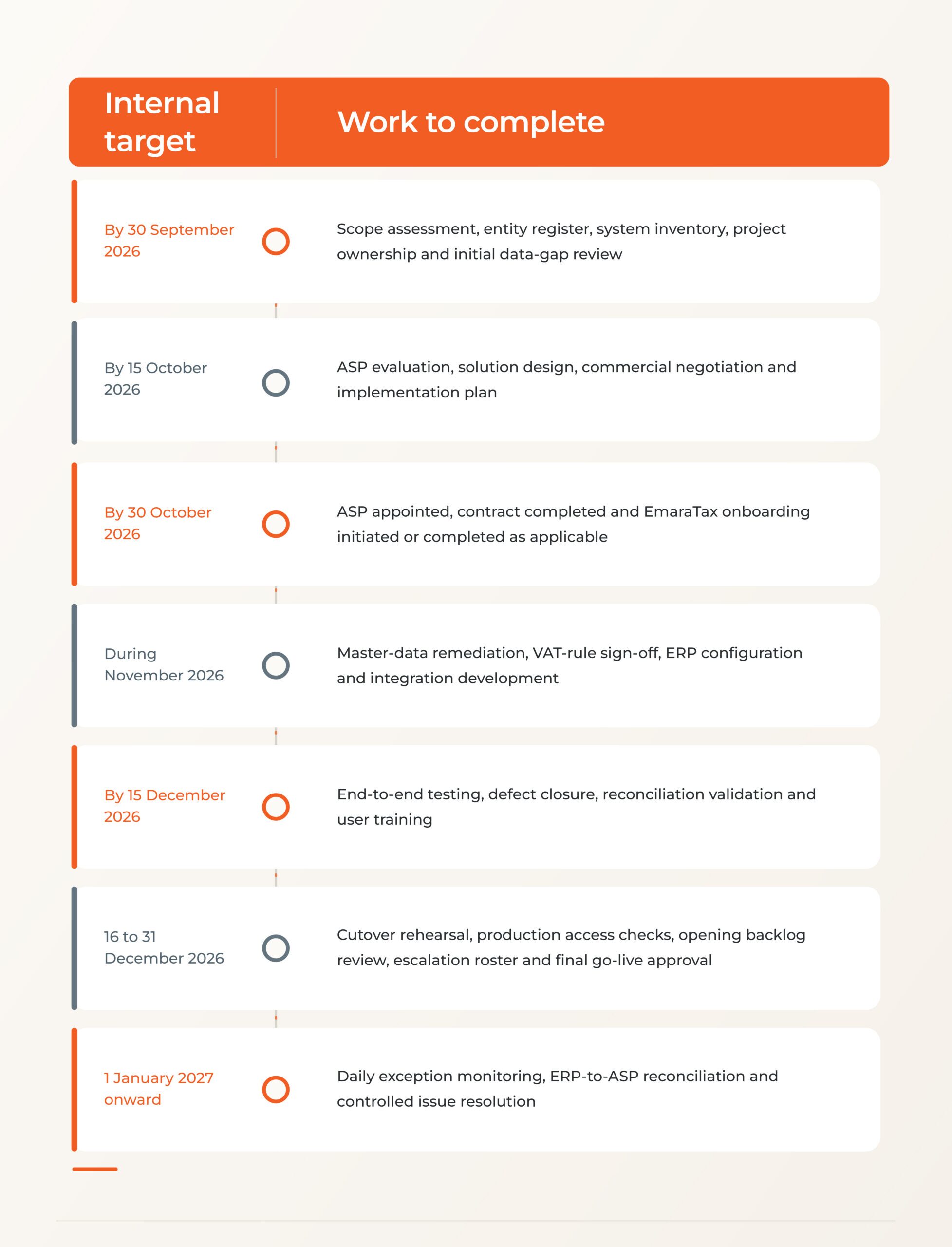
A practical Phase 1 project timetable
The dates below are recommended internal milestones, not statutory deadlines. They are designed to protect the fixed 1 January 2027 go-live.
How KGRN can support Phase 1 readiness
KGRN is listed by the Ministry of Finance as an accredited eInvoicing service provider under Accreditation No. 120915. KGRN combines the ASP connection with accounting and UAE tax review, so implementation covers the invoice’s technical structure and the VAT logic behind it.
Our experts can support the full process, beginning with phase and scope assessment, invoice-flow mapping, mandatory-field review and master-data remediation. The implementation can then move through VAT-code validation, ERP and billing-system integration, EmaraTax onboarding, scenario testing and rejection remediation. User training, SOPs, go-live support and post-go-live reconciliation complete the operating model rather than leaving the engagement at technical transmission.
If your business is in Phase 1, start with a documented gap assessment against the 10 points above. Review KGRN’s UAE eInvoicing services or use the broader readiness checklist for an organisation-wide self-assessment.

Related posts:
 UAE eInvoicing Testing: What Finance Teams Should Validate Before January 2027
 UAE eInvoicing for Construction Companies: 7 Systems to Fix Before the 2027 Deadline
 Credit Notes and Invoice Adjustments Under UAE eInvoicing
 The Role of Pre-Approved ASP in UAE eInvoicing
 UAE E-Invoicing: Regulatory Clarifications & Practical Compliance Insights