

eInvoicing UAE compliance is not an optional software upgrade businesses and CFOs can push to next quarter’s. It’s a legal; mandate with fixed official deadlines, penalties and a phased rollout that has already started moving faster. If your finance team is still issuing PDF invoices or paper documents, it needs to be issued in structured XML format and sent through Accredited Service Provider (ASP) and becomes mandatory from January 2027.
This guide from KGRN, an approved eInvoicing ASP, breaks down everything CFOs, finance managers, business owners, and VAT-registered entities in the UAE need to know about the new eInvoicing system: what it is, who it affects, the confirmed 2026–2027 deadlines, the technical framework behind it (Peppol, PINT AE, the 5-corner model), and a practical roadmap for getting ready without last-minute hassle.
Key Takeaways You Should Consider:
- Phase 1 Deadline: Businesses with revenue exceeding 50 million or above must appoint an ASP by 30 October 2026.
- Non-compliance can trigger administrative penalties up to AED 5,000/month for certain violations.
- Only structured PINT AE XML invoices transmitted via an ASP count as compliant. PDFs, scans, and emailed invoices have zero compliance value under the mandate.
- eInvoicing UAE readiness is not just about appointing an ASP, it requires ERP readiness, VAT logic reconciliation and platform configuration.
What is eInvoicing in the UAE?
eInvoicing in the UAE is a structured, machine-readable invoice not a PDF.
An electronic invoice under the UAE eInvoicing solution is not the same thing as a digital invoice you’ve used to sending today. A valid eInvoice is a structured data file in PINT AE (XML) format which has 51 mandatory fields, generated by your accounting or ERP system, validated and transmitted machine-to-machine through Accredited Service Provider (ASP) to both your buyer and the Federal Tax Authority (FTA).
Why is the UAE introducing eInvoicing?
The new eInvoicing system is designed to standardize invoice exchange, improve tax-data visibility, and support interoperable digital trade.
The shift to a mandatory eInvoicing framework is part of a broader move toward a digital, real-time tax administration model, similar to what Saudi Arabia (ZATCA), the EU (ViDA), and Egypt have already rolled out. The UAE’s objectives are straightforward:
- VAT transparency: The FTA receives invoice-level tax data in near real time instead of relying on periodic VAT returns alone.
- Fraud and error reduction: Structured, validated data closes the gap for manipulated or missing invoices.
- Digital economy alignment: The UAE has positioned itself as a global digital trade hub, and a Peppol-based eInvoicing system keeps UAE businesses interoperable with international trading partners already using the same network.
Three Pillars of UAE eInvoicing:
- Federal Decree-Law No. 16 of 2024, which amended the UAE VAT Law to formally recognize electronic invoices as valid tax documents.
- Ministerial Decision No. 243 of 2025, which sets out the Electronic Invoicing System (EIS) scope, definitions, and exclusions.
- Ministerial Decision No. 244 of 2025, which governs the accreditation and appointment of Accredited Service Providers (ASPs).
How the eInvoicing UAE System Works (eInvoicing 5-corner model UAE)
The Decentralised Continuous Transaction Control and Exchange (DCTCE) model
The UAE has adopted what’s called a 5-corner model, built on the global Peppol network. If you’re familiar with eInvoicing in Europe, you may know the 4-corner model: supplier, supplier’s service provider, buyer’s service provider, buyer. The UAE’s continuous transaction control framework DCTCE adds a fifth corner: the FTA itself.
Here’s how an invoice actually moves through the system:
- Corner 1 (Supplier): generates the e-invoice inside their ERP or accounting system in PINT AE format.
- Corner 2 (Supplier’s Accredited Service Provider (ASP): validates the invoice data against business and technical rules, checks the buyer’s identity via the Peppol directory, and transmits it.
- Corner 3 (Peppol network / directory services): confirms routing and endpoint details between the two ASPs.
- Corner 4 (Buyer’s ASP): performs additional validation and delivers the invoice to the buyer’s system.
- Corner 5 (The FTA): receives the tax-relevant invoice data in near real time, reported in parallel by the supplier’s ASP not as a bottleneck in the exchange, but as a silent recipient of compliance data.
The role of the 5th corner (the FTA)
This is what makes the UAE’s eInvoicing system a genuine continuous transaction control framework rather than just a digital exchange standard. The Federal Tax Authority doesn’t sit in the middle of every transaction; invoices still flow directly between supplier and buyer ASPs but it receives a parallel, real-time copy of the tax data. That’s a structural shift from “file your VAT return quarterly” to “your invoice data is visible almost as it’s created.”
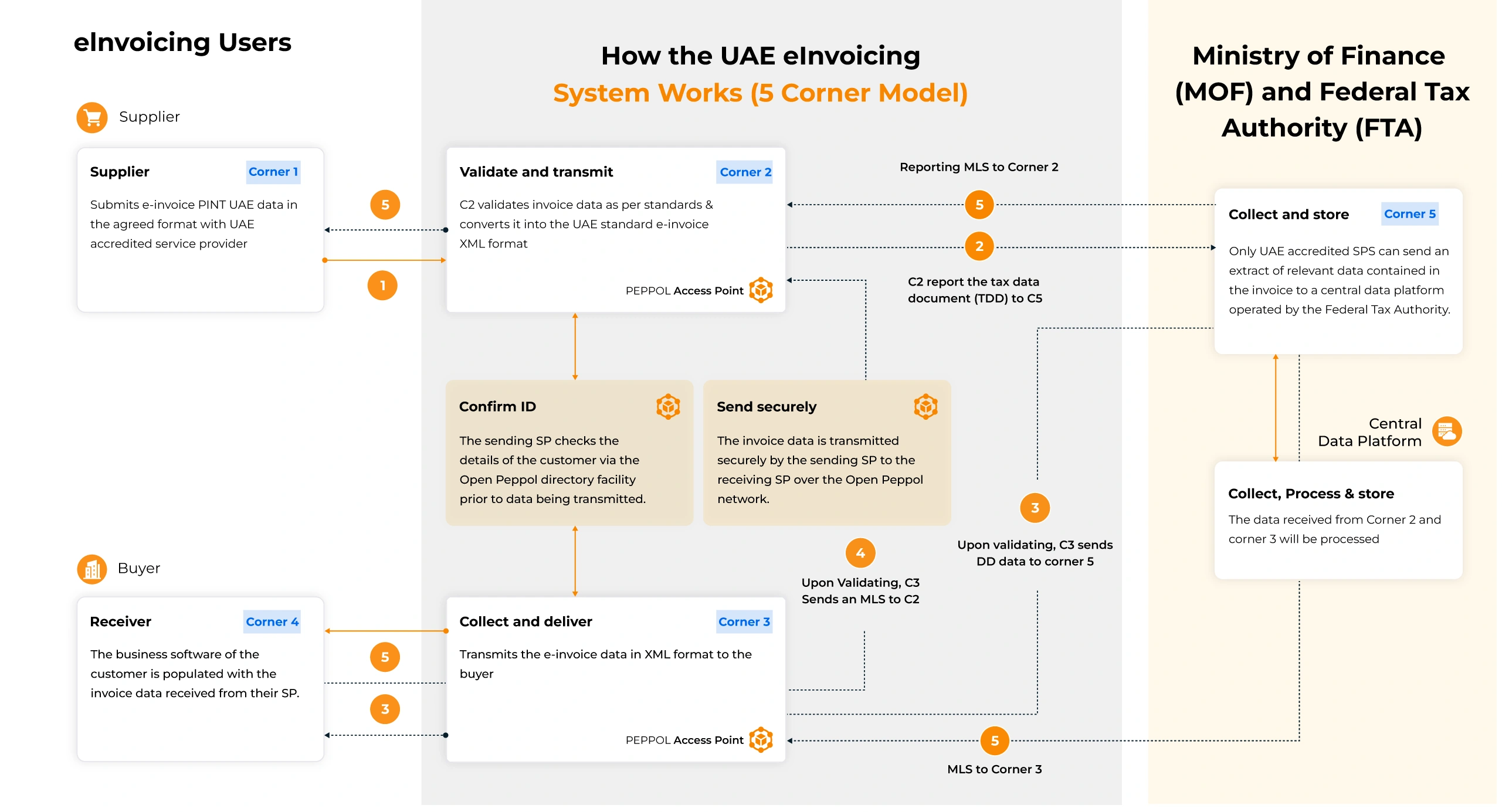
How the UAE eInvoicing System Works 5 Corner Model
Not ready to talk yet? Start with the readiness eBook.
Get KGRN’s UAE eInvoicing Readiness eBook, a practical breakdown of where most businesses actually stand versus where they think they stand, plus the exact steps to close the gap before your deadline hits.
Download the Free Readiness eBook
Who Needs to Comply with eInvoicing UAE?
In-scope businesses
The eInvoicing mandate applies broadly more broadly than many businesses assume. It covers:
- B2B (business-to-business) transactions
- B2G (business-to-government) transactions
- Both mainland and free zone entities, where the transaction is in scope
- Non-resident businesses registered for UAE VAT who are required to issue UAE tax invoices
Importantly, applicability is not strictly tied to VAT registration. Because the system uses a Tax Identification Number (TIN) , the first 10 digits of a corporate tax registration number as the Peppol participant identifier, certain non-VAT-registered businesses conducting in-scope B2B/B2G transactions can still fall under the mandate. This is one of the most frequently misunderstood parts of the framework, so if you’re unsure whether who needs to comply with UAE eInvoicing applies to your business, don’t assume VAT status alone settles it.
UAE eInvoicing deadline for businesses: Timeline & Key Deadlines (2026 – 2027)
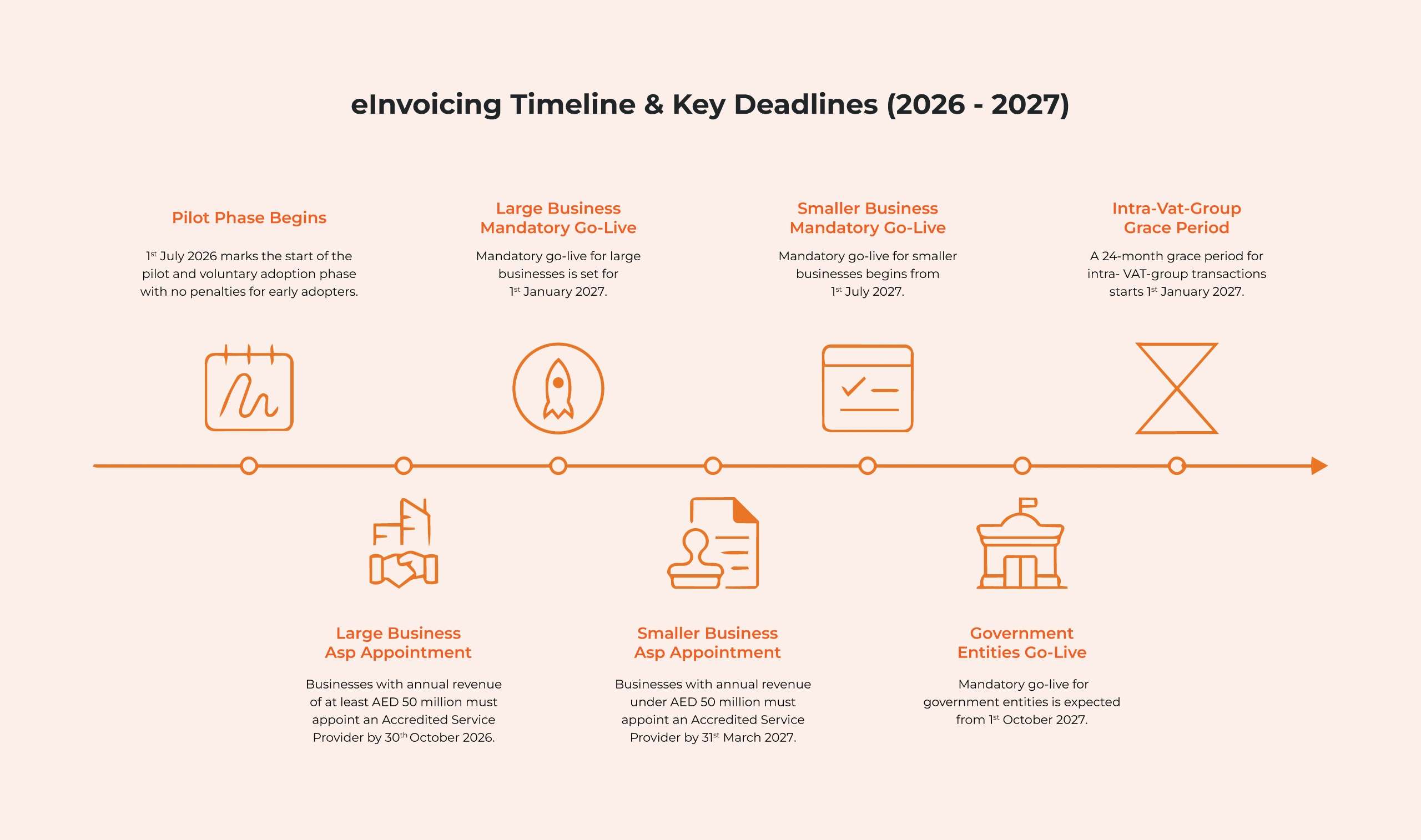
eInvoicing Timeline & Key Deadlines (2026 – 2027)
This is the section most likely to go out of date, so treat every date below as current as of writing and always confirm against the latest Ministry of Finance and FTA publications before making a compliance decision based on it.
1 July 2026 Pilot and voluntary adoption phase begins. Businesses that go live voluntarily during this window are not subject to penalties for that period, making early adoption a genuinely low-risk way to test your systems.
Large businesses (annual revenue ≥ AED 50 million): must appoint an Accredited Service Provider (ASP) by 30 October 2026 — this deadline was extended from the original 31 July 2026 date following Ministry review of market readiness and ASP availability. Mandatory go-live remains 1 January 2027, unchanged by the extension.
Smaller businesses (annual revenue < AED 50 million): must appoint an ASP by 31 March 2027, with mandatory go-live from 1 July 2027.
Government entities: follow a separate timeline, with mandatory go-live expected from 1 October 2027.
Intra-VAT-group transactions: benefit from a 24-month grace period starting 1 January 2027, giving businesses operating within a VAT group additional runway before intra-group eInvoicing becomes mandatory.
What is Peppol and PINT AE Format?
Peppol (Pan-European Public Procurement On-Line) is a globally recognized network and standard for exchanging structured business documents, invoices, purchase orders, credit notes without requiring a single centralized government portal.
It was originally built for European public procurement and has since been adopted well beyond Europe, including across the Middle East and Asia-Pacific, as the backbone for national eInvoicing mandates.
This makes peppol e invoicing a core part of the UAE framework and a key consideration when comparing e invoicing solutions.
The UAE Ministry of Finance formally adopted the Peppol network for its Electronic Invoicing System, meaning UAE businesses connect to a globally interoperable exchange rather than a country-specific silo.
PINT AE: the UAE’s structured invoice format
PINT AE (Peppol International Invoice UAE) is the UAE’s localized adaptation of the global Peppol BIS Billing 3.0 standard. It incorporates UAE-specific mandatory fields, tax treatment rules, and invoicing scenarios defined by the MoF and FTA built on Peppol, but not identical to the generic international version. Every compliant e Invoicing solution or ASP integration in the UAE has to generate invoices that match this schema exactly, field for field.
Version 1.1 of the UAE eInvoicing Guidelines
The MoF released Version 1.1 of the Electronic Invoicing Guidelines, adding practical clarifications that the original framework left open, including:
- Advance payments: How to reflect an advance payment amount in the “Paid Amount” field and cross-reference it against the final invoice using the “Preceding Invoice Reference” field.
- Retention billing: Relevant to contracting and real estate development sectors, where the guidelines now specify that an e-invoice must reflect only the net amount actually payable at that billing event, with VAT applied to that net figure.
- Data storage flexibility: Offshore or cloud hosting of e-invoice data is permitted, provided it remains retrievable by the FTA on request.
If your business operates in construction, contracting, or real estate sectors where retention billing is standard practice this update is worth a dedicated conversation with your ASP or advisor before go-live.
Accredited Service Providers (ASP) – What Businesses Need to Know
What an ASP actually does:
An Accredited Service Provider is the intermediary every in-scope business must appoint to participate in the eInvoicing system. An ASP:
- Validates invoice data for structural accuracy and compliance with UAE business rules
- Converts invoice data into the PINT AE format if it isn’t generated natively in that structure
- Transmits the invoice across the Peppol network to the buyer’s ASP
- Reports the required tax data to the Federal Tax Authority in near real time
You cannot legally transmit an in-scope e-invoice without going through an approved eInvoicing service provider; this isn’t optional infrastructure, it’s the only compliant channel.
How to Select an eInvoicing Service Provider
Not every provider offers the same depth of support. When evaluating an e invoicing provider, look for:
FTA accreditation status
Confirm the provider actually appears on the official MoF-published list, not just a claim on their website.
Native ERP integration
A provider with a tested connector for your existing accounting or ERP system (SAP, Oracle, Microsoft, Tally, or your cloud accounting platform) saves months of custom integration work.
Validation depth
Stronger ASPs catch errors against UAE business rules before submission, rather than letting rejections surface only after transmission.
Data security posture
Look for providers offering zero data retention, encryption, and audit-ready logging rather than storing your invoice data indefinitely on third-party servers.
Advisory capability
A provider that can also interpret ambiguous tax scenarios (retention billing, advance payments, free zone treatment) is worth more than a pure technology vendor, especially during a first-time implementation.
Tax judgment behind the pipe
A pure software ASP can connect you to the network, but it can’t advise you on VAT treatment, fix your master data, or defend your position in an FTA audit. Structured invoicing still sits on top of tax law, so a perfectly formatted file built on the wrong tax logic is still wrong. What’s actually at stake here isn’t just the transmission, it’s your customers’ VAT input recovery, your position in an audit, and your commercial relationships.
One accountable partner across the whole journey
Look for a provider that owns every stage (business readiness assessment, ERP integration, configuration, onboarding and UAT, and ongoing support) rather than one you have to coordinate between a software vendor on one side and a separate tax advisor on the other.
Support that scales after go-live
Your needs the month after go-live are rarely the same as your needs a year in. A provider offering tiered support from reactive issue resolution, to proactive monitoring, to a fully managed service lets you start where you are and move up as volume and complexity grow, instead of renegotiating a new contract every time your requirements change.
Value that extends beyond the invoice itself
The strongest providers don’t stop at moving invoices across the network. Look for added support such as VAT reconciliation, master data cleaning, PO-and-invoice matching, and VAT return filing the finance work that sits around eInvoicing, not just the compliance layer on top of it.
eInvoicing penalties UAE FTA: Penalties for Non-Compliance
Penalties under the UAE eInvoicing framework only apply after the mandatory go-live date for your business category, not during the voluntary pilot phase that opens 1 July 2026. Businesses that adopt eInvoicing early, before their mandated date, are not exposed to these fines during the voluntary window.
The general penalty framework is set out under Cabinet Decision No. 106 of 2025. Reported penalty categories include monthly fines for failing to implement the system or appoint an ASP by the required deadline, a per-invoice fine for late or missing e-invoices (capped monthly), and daily fines for unreported system failures or unauthorized data changes.
Beyond the direct fines, there’s a secondary business risk worth flagging to customers: non-compliant invoicing can affect a buyer’s ability to recover input VAT, which means the commercial cost of falling behind on eInvoicing compliance can ripple into your customer relationships even before the FTA issues a single penalty.
How to prepare for eInvoicing in UAE – KGRN-led Approach
Step 1: eInvoicing readiness checklist UAE: Gap Assessment & Readiness ((Finance, tax, ERP & invoice data readiness review)
ERP and invoicing infrastructure review against PINT AE mandatory requirements. Legal and regulatory review against Ministerial Decisions No. 243 and No. 244 of 2025. Confirming your compliance phase based on annual revenue (large business vs. SME), which sets your ASP appointment and go-live dates
Step 2: Data Readiness & Remediation (Master data cleansing & PINT AE conformance)
Cleaning TRNs, addresses, product and service codes, and buyer identifiers so invoices conform to the PINT AE schema. This is consistently the step that takes longer than businesses expect: mismatched customer records and inconsistent tax treatment are the most common cause of invoice validation failures.
Step 3: Standard Entity Onboarding (ASP registration & EmaraTax linkage)
Registering your business with KGRN’s ASP pipeline and linking it to EmaraTax, including Peppol participant identifier setup.
Step 4: Standard Implementation (Fixed-scope, fixed-fee delivery from kickoff to go-live)
A defined implementation scope and fee from project kickoff through to go-live no open-ended timelines or scope creep.
Step 5: API Integration (AR/AP) (ERP-to-ASP pipeline for accounts receivable & payable)
Connecting your ERP or accounting system directly to the ASP pipeline for both invoice issuance and receipt.
Step 6: Standard Support (Business-hours coverage after go-live)
Business-hours support once you’re live, covering day-to-day issue resolution and platform updates.
Step 7: Extended Support ((24×7 coverage with named owners & SLA commitments)
For businesses that need it, round-the-clock coverage with a named account owner and defined SLA commitments.
Ongoing Plans: Beyond Go-Live
Once your business is live and compliant, two ongoing commercial plans keep your eInvoicing operation running alongside, not after, the seven-step process above.
Annual ASP Subscription (Ongoing Peppol network access & pipeline operations)
- Continuous access to the KGRN ASP pipeline for FTA-compliant invoice transmission
- Choice of direct ERP integration or portal-based submission
- Pipeline maintenance, FTA reporting, and release updates included
- Scalable to your invoice volumes and entity structure
Managed Services (Fully outsourced or co-managed eInvoicing operations)
- KGRN takes operational ownership of your eInvoicing function
- Available for businesses of all sizes, from SMEs to enterprise groups
- Multi-ERP, multi-entity, and multi-emirate operations supported
- Your finance team focuses on decisions; KGRN handles the day-to-day
eInvoicing Solution and VAT Compliance – How They Connect
eInvoicing is best understood as an extension of VAT reporting, not a replacement for it. VAT returns continue as before; what changes is the level of real-time visibility the FTA has into the underlying invoice data that feeds those returns.
This has two practical implications. First, the FTA gains real-time data visibility into transactions as they happen, rather than relying solely on periodic filings which raises the bar for accuracy at the point of invoice creation rather than at quarter-end reconciliation.
Second, audits and record-keeping shift in nature: with structured, timestamped invoice data already sitting with the FTA, discrepancies between your reported VAT position and your invoice trail become far easier to detect and far harder to explain away after the fact.
Common Mistakes Business Should Avoid:
Assuming PDFs qualify
They don’t, regardless of how complete or “official” they look. Only structured PINT AE XML transmitted via an ASP counts.
Leaving ASP selection until the deadline
Onboarding, integration, and testing all take real time, starting the shortlisting process late is the single biggest cause of last-minute compliance risk.
Ignoring master data cleanup
Messy customer records, inconsistent TRNs, and non-standardized product codes are the most common reason invoices fail validation once testing begins.
Treating this as an IT-only project
eInvoicing touches tax, finance, IT, procurement, accounts payable, and accounts receivable. Missing the process and change-management side of the rollout, not just the technical integration is where otherwise well-prepared businesses stumble.
How KGRN can Support UAE Businesses to Prepare for eInvoicing
KGRN is a UAE FTA-approved solution provider and a certified Peppol Access Point meaning we offer direct connection to the UAE’s eInvoicing infrastructure rather than operating as a reseller layered on top of someone else’s platform. With 17+ years of UAE compliance expertise and support for 2,000+ UAE businesses across audit, tax, and advisory services, our approach to eInvoicing combines platform delivery with genuine regulatory depth.
What that looks like in practice:
Impact assessments: Map your current invoicing workflows ERP, POS, legacy systems against PINT AE requirements
ASP selection and onboarding support: Including Peppol participant identifier registration and integration testing.
Seamless ERP integration: Across SAP, Oracle, Microsoft, Tally, and PoS systems, supporting XML, JSON, CSV, and XLSX formats via APIs, SFTP, and webhooks
CFO-ready dashboards and compliance risk logs: eInvoicing solution readiness is visible at a leadership level, not buried in an IT ticket queue.
Security by design: Zero data retention, PKI, hash chaining, and digital signatures at every stage.
Future-ready architecture: Built to accommodate FTA Phase 2 and cross-border eInvoicing requirements as they’re announced.
eInvoicing readiness isn’t a task you delegate to a single deadline on the calendar; it’s a business-wide programme that touches tax, IT, procurement, and finance operations alike. The earlier you start, the more of that programme happens on your terms rather than under deadline pressure.
Book a Readiness Consultation with KGRN
Frequently Asked Questions
1. What is eInvoicing in the UAE?
eInvoicing in the UAE is a mandatory system requiring businesses to generate, exchange, and report invoices as structured, machine-readable data (PINT AE XML format) rather than PDFs or paper, transmitted through an Accredited Service Provider and reported to the Federal Tax Authority in near real time.
2. Is eInvoicing solution mandatory in the UAE?
Yes. Following a voluntary pilot phase starting 1 July 2026, eInvoicing becomes mandatory in stages: large businesses (AED 50 million+ revenue) from 1 January 2027, and SMEs from 1 July 2027, with government entities following from 1 October 2027.
3. Who needs to comply with UAE eInvoicing rules?
Any business conducting in-scope B2B or B2G transactions in the UAE, including mainland, free zone, and certain non-resident VAT-registered entities. Compliance is tied to the transaction type and TIN, not VAT registration status alone.
4. Can I still send PDF invoices under the new system?
No. PDF, scanned, or emailed invoices have no compliance value under the mandate, regardless of the information they contain. Only structured PINT AE data transmitted via an ASP qualifies as a valid e-invoice.
5. What is Peppol and how does it apply in the UAE?
Peppol is a globally recognized network for exchanging structured business documents. The UAE has adopted it as the backbone of its Electronic Invoicing System, using a localized data format called PINT AE built on the international Peppol standard.
6. What happens if my business doesn’t comply on time?
Once your mandatory go-live date passes, non-compliance can trigger administrative penalties under Cabinet Decision No. 106 of 2025, along with broader compliance and audit risk though exact figures should be confirmed against the latest FTA publication.
7. How should my business start preparing?
Confirm which compliance phase applies to you based on annual revenue, then work through KGRN’s structured readiness process gap assessment, master data cleansing, ASP onboarding, and integration well ahead of your deadline, testing during the voluntary window opening 1 July 2026.
8. Does eInvoicing change my VAT obligations?
eInvoicing doesn’t replace VAT returns, it extends them. The FTA gains real-time visibility into invoice-level data, which raises the importance of accuracy at the point of invoice creation and strengthens audit scrutiny of your existing VAT position.
If you’re ready to find out exactly where your business stands, KGRN’s readiness consultation is the fastest way to get a clear answer.
Book Your Free eInvoicing Readiness Consultation
Related posts:
 How to Choose an ASP for eInvoicing in the UAE: A Practical Framework for CFOs & Finance Teams
 UAE eInvoicing Rejection Causes and How to Fix Common Errors
 UAE eInvoicing Phase 1: A Practitioner’s Perspective on Business Readiness
 The Role of Pre-Approved ASP in UAE eInvoicing
 UAE E-Invoicing: Regulatory Clarifications & Practical Compliance Insights