

UAE eInvoicing applies to business activity generally, and the official definition of Business expressly includes industrial activity. A manufacturer does not receive a separate deadline simply because it operates a factory. Its mandatory date is determined mainly by the revenue of the relevant legal entity. For entities with revenue of at least AED 50 million, the current deadline to appoint an Accredited Service Provider is 30 October 2026 and mandatory implementation begins on 1 January 2027.
For manufacturers, the legal rule is only the starting point. The practical work usually crosses sales, finance, procurement, accounts payable, warehouse operations, IT and tax. An invoice may be triggered by an ERP, a warehouse dispatch, a billing application or a group service centre. Those sources must produce consistent, valid data and connect to an accredited service provider before go-live.
Does UAE eInvoicing apply to manufacturers
Yes. Ministerial Decision No. 243 of 2025 defines Business to include industrial activity and applies the Electronic Invoicing System to a person conducting Business in the UAE for every Business Transaction, unless a stated exclusion applies. Manufacturing is therefore within the general framework. There is no separate manufacturing threshold or factory-specific implementation date in the current decisions.
The present exclusions include certain sovereign government activities, specified airline passenger transactions, qualifying air cargo transactions for a temporary period, and specified exempt or zero-rated financial services. Business-to-consumer transactions are currently outside the implementation timetable until a later decision is issued. A manufacturer should not assume that its normal business-to-business sales or purchases are excluded merely because the goods are produced in the UAE, exported, sold from a Free Zone or invoiced by a non-VAT-registered entity. The facts and the official scope rules must be checked for each legal entity and transaction flow.
Related KGRN guide: UAE eInvoicing solution and compliance model
UAE eInvoicing deadlines for manufacturing companies
The mandatory timetable is revenue-based, not sector-based. Revenue for this purpose is gross income for the most recent accounting period, based on the entity’s financial statements. If financial statements are unavailable, other documentation acceptable to the FTA may be used. Each legal entity should document its own threshold assessment rather than applying one group-wide date without analysis.
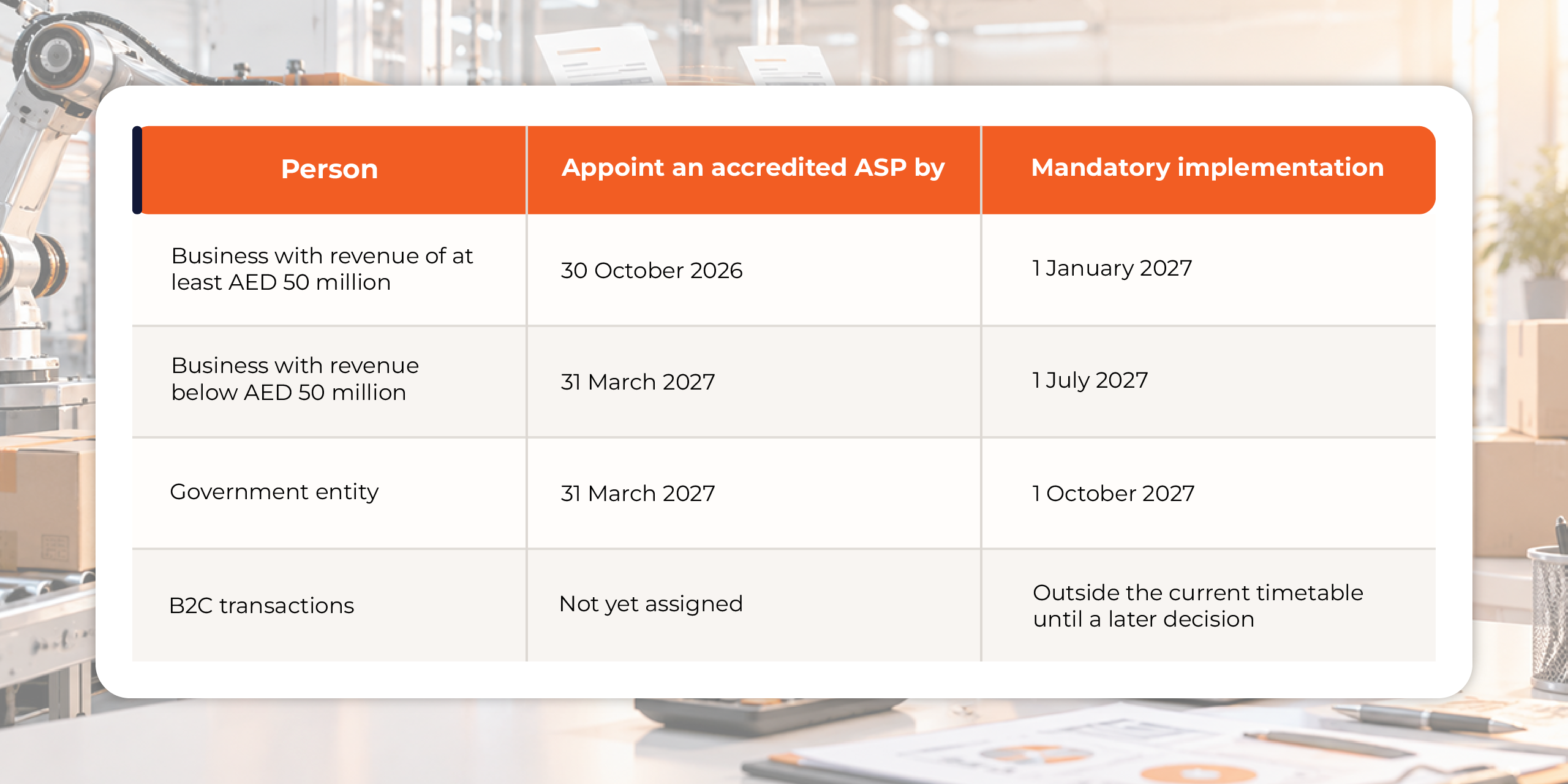
The pilot and voluntary phase began on 1 July 2026. Ministerial Resolution No. 66 of 2026 amended the first ASP appointment date from 31 July 2026 to 30 October 2026. It did not move the 1 January 2027 mandatory implementation date. The remaining dates above continue to apply under the published timetable as of this guide’s review date.
For a broader deadline explanation, read KGRN’s UAE eInvoicing Phase 1 readiness guide.
What changes from today’s invoice process
An emailed PDF, Word document, image or scanned invoice is not an eInvoice under the UAE framework. The invoice data must be created and exchanged in a structured electronic form and reported electronically to the FTA. The UAE model uses the Peppol-based five-corner structure and the PINT AE specification.
In simplified terms, the supplier sends invoice data to its accredited service provider. That provider validates the data, converts it to the UAE-standard XML format when necessary, sends the eInvoice to the buyer’s provider and reports the Tax Data Document to the FTA platform. The buyer’s provider validates and delivers the invoice to the buyer. Message Level Status responses show whether exchange and reporting were successful or unsuccessful.
A readable invoice can still be created for people and commercial use, but it does not replace the structured exchange. The implementation project must therefore address source data, validation, connectivity, status messages, error handling and retention, not just the visual invoice template.
Why manufacturing readiness is operationally demanding
The law does not impose a special manufacturing architecture, but factories often have more invoice touchpoints than a single-office service business. Sales invoices may depend on customer orders, dispatch confirmation, delivery terms, price lists, rebates or contract milestones. Purchase invoices may need to match a purchase order, goods receipt and quality or quantity acceptance before payment. Returns, scrapped goods, warranty replacements and retrospective price adjustments can also lead to credit notes or revised commercial records.
The risk is not that every operational data item becomes a statutory eInvoice field. The risk is that incomplete or inconsistent operational data prevents the mandatory invoice data from being produced accurately, causes the ASP validation to fail, or leaves finance unable to reconcile the structured invoice with the underlying sale or purchase. The readiness programme should follow the real order-to-cash and purchase-to-pay processes instead of treating eInvoicing as a tax-team upload exercise.
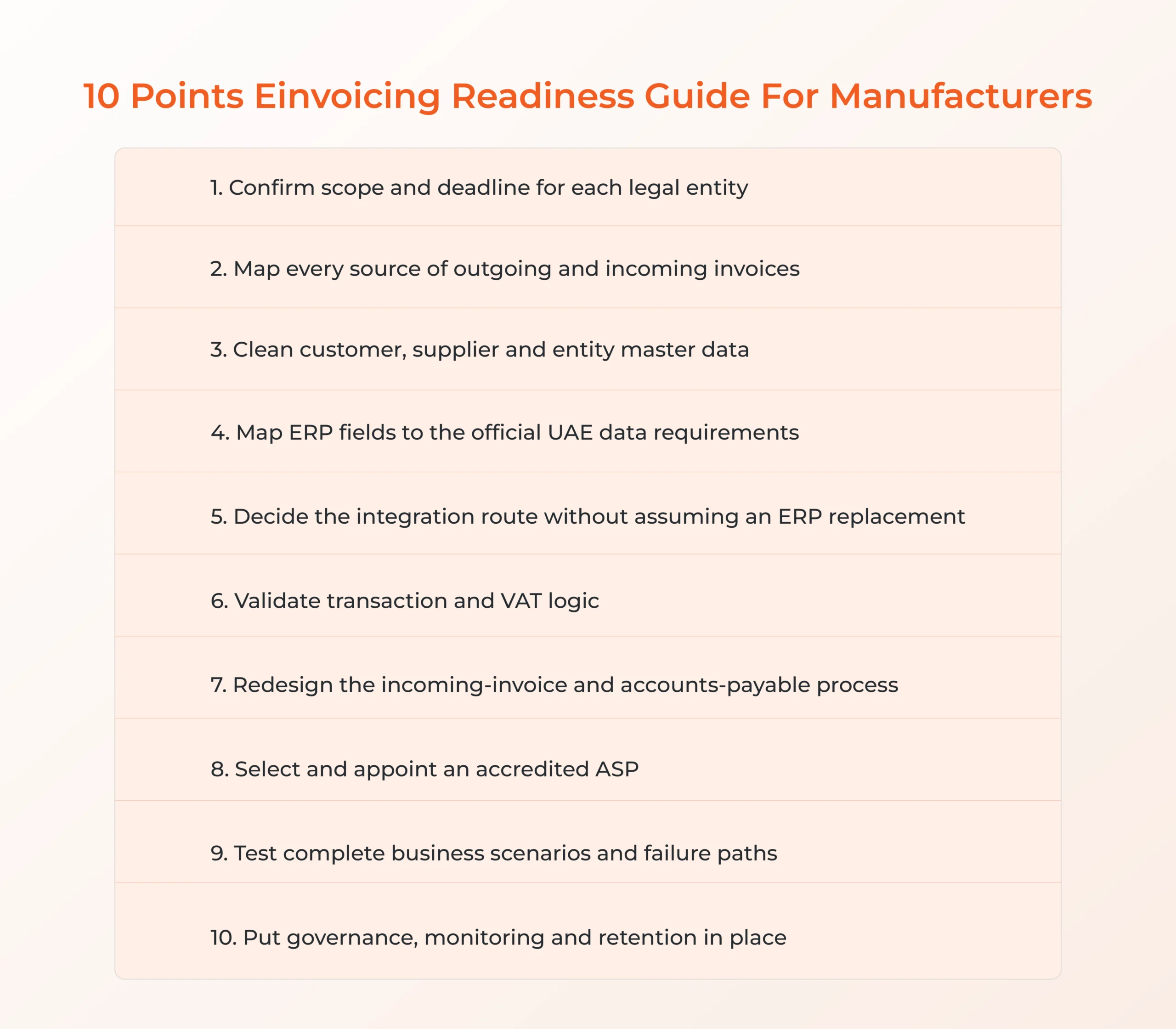
Ten-point eInvoicing readiness guide for manufacturers
1. Confirm scope and deadline for each legal entity
List every UAE legal entity, branch structure, registration position, accounting period and revenue figure. Identify which entities cross the AED 50 million threshold and which are below it. Map B2B, B2G and B2C flows separately. A group with one large manufacturing entity and several smaller trading or service entities may have different appointment and implementation dates. Free Zone location does not by itself create a different timetable.
2. Map every source of outgoing and incoming invoices
Document where sales invoices, purchase invoices and credit notes originate and where they are posted. Include the core ERP, warehouse or dispatch application, billing tools, e-commerce or customer portals, shared service centres and manual journals that affect invoicing. The map should show the legal issuer or recipient, system of record, approval point and responsible owner. This prevents a secondary plant, depot or manual billing stream from being missed.
3. Clean customer, supplier and entity master data
Validation is only as reliable as the source records. Review legal names, addresses, tax registration details, entity identifiers, customer and supplier classifications and other fields required by the official UAE specification. Establish who can create or change master data and how changes are approved. Duplicate or outdated records should be resolved before integration testing, not during cutover.
4. Map ERP fields to the official UAE data requirements
Use the Ministry of Finance mandatory field requirements and the current PINT AE specification as the source of truth. For every required element, record the source system, field, format, transformation rule, validation rule and owner. Operational references such as purchase orders, delivery records, item codes and units of measure may support matching and control, but the team should not label a field as legally mandatory unless the official specification does so.
5. Decide the integration route without assuming an ERP replacement
A manufacturer does not automatically need to replace its ERP. The appropriate route may be native ERP capability, an API connection, middleware, a managed connector or another interface agreed with the ASP. The decision should account for invoice volume, plants and entities, security, data ownership, status-message handling, support coverage and the ability to deploy changes when PINT AE or UAE rules are updated.
6. Validate transaction and VAT logic
Build a transaction matrix for the manufacturer’s real scenarios. It may include domestic sales, exports, Free Zone movements, intercompany supplies, advances, discounts, rebates, returns, cancellations, credit notes and self-billing where the legal conditions are met. eInvoicing does not determine the correct VAT treatment. The ERP and tax rules must already produce the correct classification and values for the facts of each transaction.
7. Redesign the incoming-invoice and accounts-payable process
The recipient must be able to process eInvoices through the Electronic Invoicing System. Accounts payable should define how structured invoices are received, validated, matched, approved and posted, and what happens when commercial information is disputed even though the technical exchange succeeded. The process should preserve the link between the eInvoice, purchase order, goods receipt, approval and payment record where those documents exist.
8. Select and appoint an accredited ASP
Both issuer and recipient obligations depend on an accredited service provider. Evaluate current accreditation, ERP and API capability, implementation capacity, security, service levels, pricing, support, data export, business continuity and exit arrangements. Confirm the contracting entity and onboarding plan. For first-phase manufacturers, the legal appointment deadline is 30 October 2026, so vendor selection cannot remain a general market review.
9. Test complete business scenarios and failure paths
Unit testing is not enough. Run invoices from the originating event through the ASP, recipient flow, status messages, accounting entry and reconciliation. Test credit notes, corrections, duplicate prevention, rejected messages, unavailable master data, high-volume periods and system outages. Use anonymised or controlled test data and obtain sign-off from finance, tax, IT and the relevant business process owner.
10. Put governance, monitoring and retention in place
Define who monitors message statuses, owns errors, approves corrections and reconciles ERP records to ASP and FTA reporting outcomes. MD 243 requires eInvoice and credit-note data to be stored in the UAE for the retention period under the Tax Procedures Law. A system failure must be notified to the FTA within two business days of occurrence. The procedure should therefore include incident escalation, evidence, recovery and post-recovery reconciliation.
Integration resources: custom ERP eInvoicing integration and SAP eInvoicing and ASP integration.
Manufacturing scenarios to test before go-live
Testing should reflect the manufacturer’s actual commercial and tax profile. At minimum, the test catalogue should cover a standard domestic B2B sale, a purchase invoice, a valid credit note and the most common exception path. Where relevant to the business, add export sales, advance payments, returns, retrospective discounts or rebates, intercompany transactions, self-billing arrangements and periods with peak invoice volume.
The tax result for each scenario depends on the underlying facts and UAE VAT rules. A readiness guide cannot determine the rate or place-of-supply outcome from a scenario name alone. Finance should approve the expected accounting and tax treatment before IT uses it as a test case. KGRN’s UAE VAT consultancy team can review transaction logic where the treatment is uncertain.
Review KGRN’s UAE VAT consultancy services.
Related posts:
 UAE eInvoicing Rejection Causes and How to Fix Common Errors
  UAE eInvoicing Phase 1: A Practitioner’s Perspective on Business Readiness
  UAE eInvoicing Guide 2026 – Everything Businesses, CFOs & ERP Teams Need to Know.
  The Role of Pre-Approved ASP in UAE eInvoicing
  UAE E-Invoicing: Regulatory Clarifications & Practical Compliance Insights