
An ADGM company is not automatically exempt from UAE Corporate Tax. An ADGM company that meets every Qualifying Free Zone Person (QFZP) condition can apply 0% to its Qualifying Income and 9% to Taxable Income that is not Qualifying Income. Every QFZP must prepare and maintain audited financial statements, regardless of revenue. Separately, ADGM’s company rules may allow an eligible small company to file an unaudited balance sheet. That ADGM exemption does not remove the Corporate Tax audit condition where QFZP status is claimed.
That is the core point for directors and finance teams. ADGM status answers where the company is registered. It does not, by itself, answer whether the company qualifies for the Free Zone 0% rate, which income receives that rate, or whether an audit is mandatory. Those conclusions require separate tests under UAE Corporate Tax law and ADGM company regulations.
Is an ADGM Company Automatically Tax-Free?
No. Abu Dhabi Global Market is a financial free zone, and a juridical person incorporated, established or otherwise registered in a Free Zone is a Free Zone Person under the Corporate Tax Law. A Free Zone Person is still a Taxable Person unless a specific exemption applies. It must register for Corporate Tax, keep appropriate records and file a Corporate Tax return within the applicable deadline.
The Free Zone regime is a preferential rate framework, not a blanket exemption. Article 3 of the Corporate Tax Law gives a QFZP a 0% rate on Qualifying Income and a 9% rate on Taxable Income that is not Qualifying Income. The label ‘ADGM company’ therefore does not settle the tax result. The company must first pass the QFZP conditions and then analyse its revenue by counterparty, activity and income type.
For the legal rate wording, see the UAE Corporate Tax Law, particularly Articles 3 and 18.
What Makes an ADGM Company a QFZP?
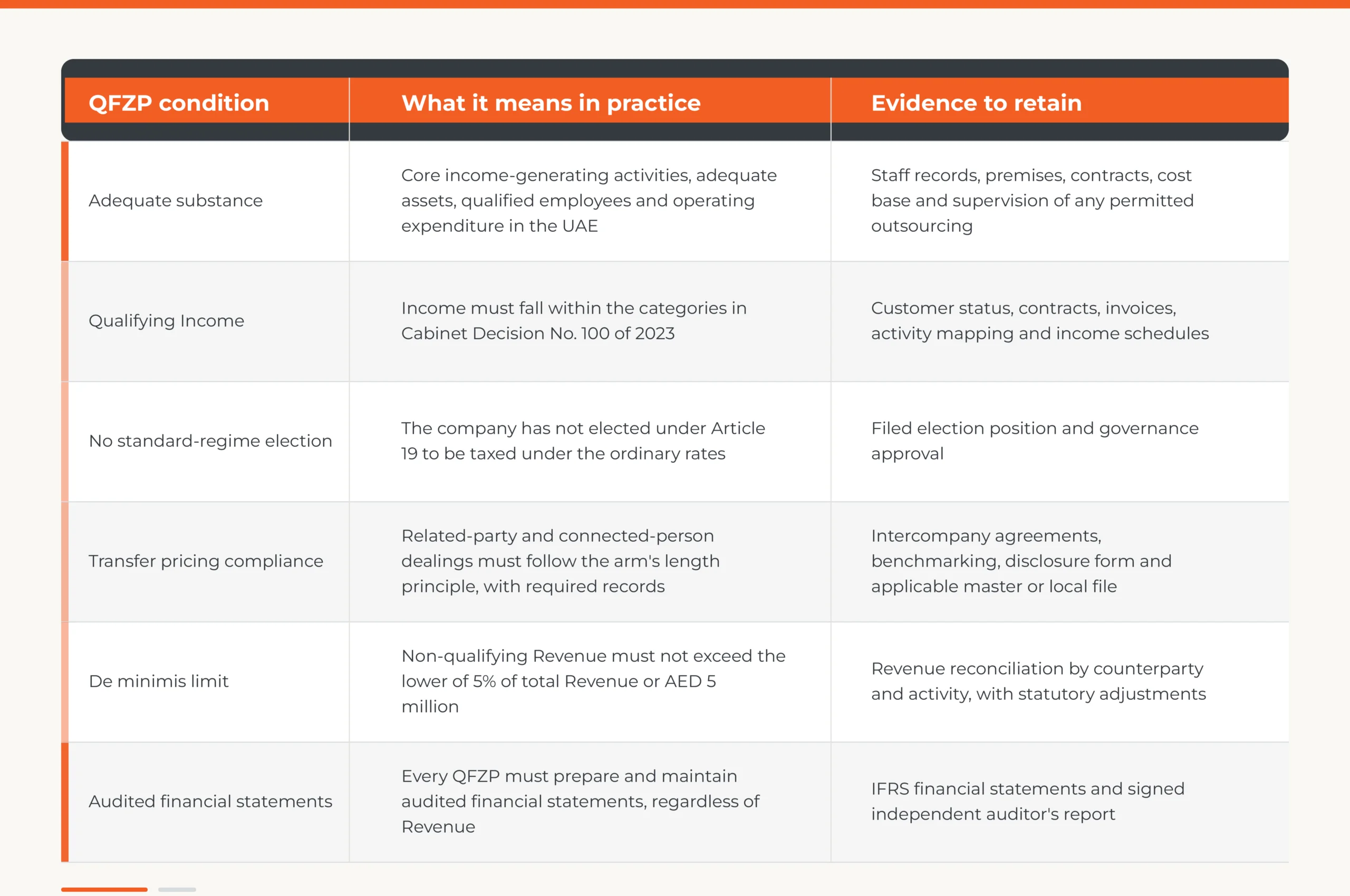
QFZP status is conditional and must be maintained throughout the Tax Period. The Corporate Tax Law requires the Free Zone Person to maintain adequate substance in the UAE, derive Qualifying Income, avoid electing into the ordinary Corporate Tax regime, comply with the arm’s length and transfer-pricing documentation rules, and meet the additional conditions prescribed by the Minister.
Ministerial Decision No. 229 of 2025 adds two practical conditions: non-qualifying Revenue must remain within the de minimis limit, and audited financial statements must be prepared in accordance with Ministerial Decision No. 84 of 2025. The result is an all-conditions test. Meeting one or two elements does not protect the 0% position if another fails.
Which ADGM Income Can Be Taxed at 0%?
The 0% rate applies to Qualifying Income, not automatically to all accounting profit. Cabinet Decision No. 100 of 2023 divides the analysis into four broad routes. Income from transactions with another Free Zone Person may qualify if the income is not from an Excluded Activity and the counterparty is the beneficial recipient. Income from a non-Free Zone Person qualifies only when it is derived from a listed Qualifying Activity and is not an Excluded Activity. Qualifying intellectual-property income is tested under its own nexus formula. Other income may be treated as qualifying only while the de minimis requirement is satisfied.
This distinction matters in ADGM because two companies with the same licence description can produce different tax outcomes. The outcome may change with the customer, the actual service, where core activities are performed, and whether the income falls within an excluded category. The contract and invoice trail should therefore match the tax classification.
Qualifying activities relevant to common ADGM structures
Ministerial Decision No. 229 of 2025 lists the current Qualifying Activities. Those most likely to be relevant in ADGM include holding shares and other securities for investment purposes, reinsurance, regulated fund management, regulated wealth and investment management, headquarters services to Related Parties, and treasury and financing services to Related Parties or for the company’s own account. The decision also covers manufacturing, processing, qualifying commodities, ships, aircraft finance and leasing, distribution from a Designated Zone, logistics and activities ancillary to a Qualifying Activity.
For an ADGM holding company, shares and other securities are deemed held for investment purposes when held for an uninterrupted period of at least 12 months. Fund-management and wealth or investment-management services must be subject to the regulatory oversight of a UAE Competent Authority, which includes the ADGM Financial Services Regulatory Authority.
Excluded activities that can change the answer
Excluded Activities include banking, most insurance activities, most finance and leasing activities, specified transactions with natural persons, and the ownership or exploitation of immovable property other than a qualifying transaction involving commercial property located in a Free Zone and a Free Zone Person. Each category contains defined exceptions, so a licence title alone is not enough. For example, reinsurance can be a Qualifying Activity even though insurance is generally excluded, and certain regulated fund or wealth-management services can fall within the natural-person exception.
Review the current statutory list in Ministerial Decision No. 229 of 2025.
ADGM Examples: How the 0% and 9% Analysis Works
| ADGM scenario | Likely starting analysis | What must be checked |
| Holding company owns long-term shares | Holding shares and securities for investment can be a Qualifying Activity | At least 12 months’ uninterrupted holding, substance, income type, participation exemption interaction and transfer pricing |
| FSRA-regulated fund manager | Regulated fund-management services can be a Qualifying Activity | Regulatory permissions, actual services, customer and income mapping, substance and related-party pricing |
| ADGM consultancy serves a mainland customer | General consultancy is not itself on the Qualifying Activity list for non-Free Zone customers | Whether the revenue is non-qualifying, its effect on de minimis, and whether the standard regime is more appropriate |
| Service company invoices another Free Zone Person | Income may qualify if the recipient is a Free Zone Person, the beneficial-recipient test is met and the activity is not excluded | Counterparty status, beneficial recipient, contract, delivery and Excluded Activity test |
| ADGM bank earns banking income | Banking is an Excluded Activity | Whether any separate income category receives different treatment and whether QFZP status is viable |
| ADGM SPV receives property income | Immovable-property income has specific rules and may be taxed outside the 0% pool | Property type, location, counterparty, legal interest and whether it is commercial property in a Free Zone |
These examples are issue-spotters, not conclusions for a specific taxpayer. A defensible answer requires the actual agreements, counterparties, licences, revenue ledger and substance evidence.
0% vs 9%: The Rate Depends on the Regime
The phrase ‘0% versus 9%’ can refer to two different rate structures. Under the QFZP regime, 0% applies to Qualifying Income and 9% applies to Taxable Income that is not Qualifying Income. Under the ordinary regime, 0% applies to the first AED 375,000 of Taxable Income and 9% applies above AED 375,000.
| Tax position | 0% treatment | 9% treatment |
| ADGM company that qualifies as a QFZP | Qualifying Income | Taxable Income that is not Qualifying Income |
| ADGM company under the ordinary regime | Taxable Income up to AED 375,000 | Taxable Income above AED 375,000 |
Common error. The AED 375,000 ordinary-rate threshold should not be inserted into the QFZP calculation for non-qualifying Taxable Income. Article 3(2) separately applies 9% to a QFZP’s Taxable Income that is not Qualifying Income.
An ADGM company can elect under Article 19 to be subject to the ordinary Corporate Tax rates. The election can take effect from the beginning of the Tax Period in which it is made or the following Tax Period. This may be commercially sensible where the company’s activity and customer mix make QFZP compliance unrealistic, but the consequences should be modelled before the election is made.
The ordinary AED 375,000 threshold is set by Cabinet Decision No. 116 of 2022.
How the De Minimis Limit Can Remove QFZP Status
A QFZP’s non-qualifying Revenue for a Tax Period must not exceed the lower of 5% of total Revenue or AED 5 million. This is a limit, not a 5% tax rate and not a general allowance that makes every small non-qualifying stream harmless. If the relevant limit is breached, the company fails a QFZP condition. Under the current decision, the consequence begins at the start of that Tax Period and extends through the next four Tax Periods.
The calculation should not be performed by simply dividing an account called ‘mainland sales’ by total turnover. Cabinet Decision No. 100 of 2023 contains special treatment for attributable income of domestic and foreign permanent establishments, immovable-property income and intellectual-property income. Finance teams should reconcile the statutory calculation to the general ledger and retain the supporting classification for each material revenue stream.
The qualifying-income framework and special categories appear in Cabinet Decision No. 100 of 2023.
The ADGM annual-accounts test
ADGM states that every ADGM company and Limited Liability Partnership generally files annual accounts with the Registration Authority. The usual filing package includes audited annual accounts audited by an ADGM Recognised Auditor, the auditor’s report, the directors’ report and the board resolution approving the accounts.
An eligible small company or LLP may file an unaudited balance sheet. ADGM currently states that turnover must not be more than USD 13.5 million and the entity must have no more than 35 employees. Public-interest entities and firms providing financial services are not eligible for the small-company regime. A Restricted Scope Company generally does not have to file annual accounts unless the Registrar gives notice. Branches and Foundations must maintain accounting records but are not required to file them annually with the Registrar. Entity-specific rules and regulatory permissions still need to be checked.
For a private company or LLP, subsequent annual accounts are generally due within nine months of the Accounting Reference Date. A public company’s period is six months. The first-year deadline depends on whether the first financial year is 12 months or less or exceeds 12 months. Directors should use the entity’s actual Accounting Reference Date rather than assuming that every ADGM company has a 30 September deadline.
Check the current rules and 2026 filing checklist on the ADGM Annual Accounts page.
Must the Auditor Be Registered in ADGM?
Where an ADGM entity is required to have its annual financial statements audited, the audit should be performed by an ADGM Registered Auditor. In November 2024, the ADGM Registration Authority also clarified that ADGM Registered Auditors are eligible to audit the financial statements of ADGM Taxable Persons for UAE Corporate Tax purposes.
The practical approach is to appoint an auditor that can satisfy both workstreams where both apply. That reduces duplication between the IFRS accounts, the ADGM filing package and the Corporate Tax evidence. Directors should still confirm the firm’s current status on ADGM’s public register and ensure that the appointment and report wording match the entity’s legal and regulatory position.
See ADGM’s official Registered Auditor clarification and KGRN’s external audit services in ADGM.
A Practical ADGM QFZP Review
A defensible review starts with the company’s actual revenue and operating model, not its licence description. The finance team should map each material income stream to the counterparty, activity, contract, place of performance and relevant Corporate Tax category. The same schedule should reconcile to the audited financial statements and the return.
Confirm the entity and regime
Identify the ADGM legal form, Tax Period, Accounting Reference Date, regulatory status and whether the company intends to claim QFZP treatment or elect into the ordinary regime.
Classify revenue
Separate Free Zone counterparties, non-Free Zone counterparts, Excluded Activities, permanent-establishment income, immovable-property income and intellectual-property income.
Test the QFZP conditions
Document substance, the de minimis calculation, transfer-pricing compliance and the audited-financial-statement requirement.
Reconcile the two audit rules
Check ADGM annual-accounts obligations separately from Ministerial Decision No. 84 of 2025, then appoint an appropriately registered auditor.
Build a filing calendar
Track the ADGM annual-accounts deadline, the Corporate Tax return deadline and any additional sector or FTA reporting, including the 2026 AUP report where applicable.
The review should be repeated when the business adds a new service, starts invoicing natural persons, signs a mainland customer, acquires property, changes its operating footprint or restructures related-party financing. A QFZP position that was supportable last year can change when the facts change.
KGRN can support the registration and return work through its UAE Corporate Tax registration and filing service, and related-party pricing through its UAE transfer pricing service.