
The UAE eInvoicing came from awareness to consideration for businesses with annual revenue exceeding 50 million and above. As an MoF Approved eInvoicing ASP we’ve sat across the table with enough finance teams preparing for Phase 1 to notice a pattern: almost every conversation starts the same way.
Most have already read the mandate, know the dates, and have shortlisted an ASP. What they haven’t worked out is who’s responsible when the content of an invoice is wrong, not just its delivery.
That question is where this guide from KGRN Chartered Accountants starts, because it’s the one the standard checklists skip. What follows covers where Phase 1 actually stands today, what real vendor due diligence looks like beyond “are they accredited,” what non-compliance costs, and why tax accuracy needs to sit alongside ASP transmission rather than be assumed as part of it.
Phase 1 UAE eInvoicing Mandate:
Phase 1 of the UAE e-invoicing mandate applies to businesses with annual revenue of AED 50 million or more, under Ministerial Decisions No. 243 and 244 of 2025. They must appoint an Accredited Service Provider (ASP) by 30 October 2026 and go live with structured e-invoicing by 1 January 2027. An ASP makes you technically capable of compliance. It does not make your invoices correct and that distinction is where most Phase 1 preparation goes wrong.
ASP liability in UAE eInvoicing: what’s actually covered
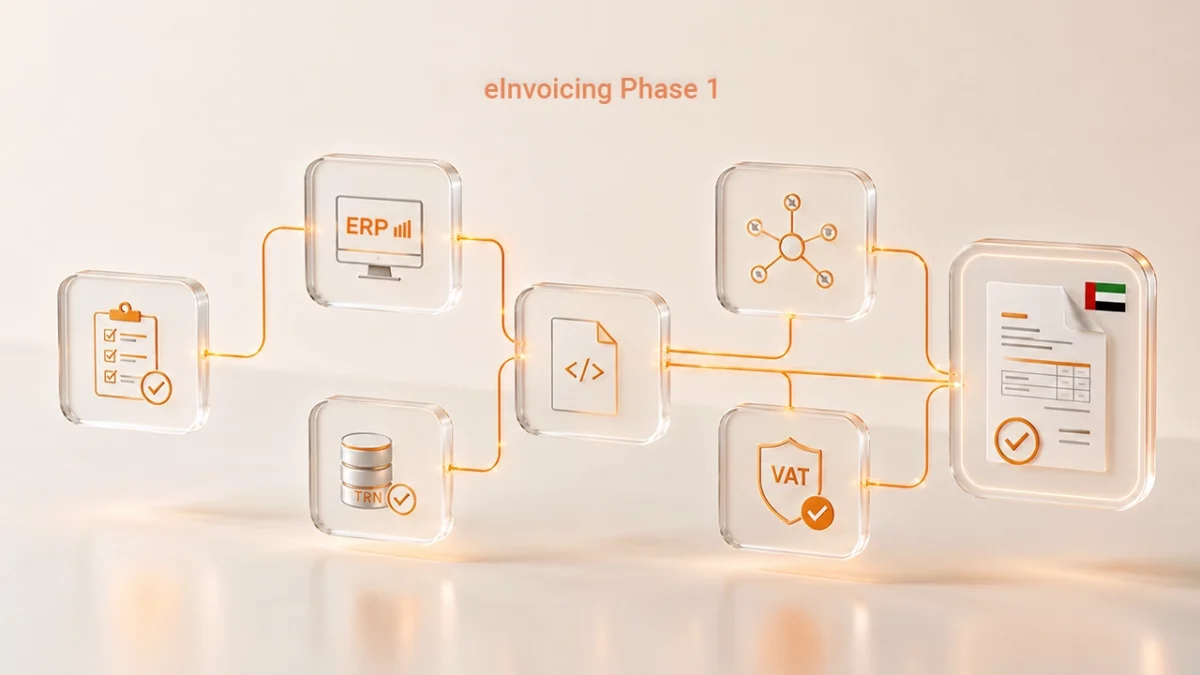
An ASP’s job is mechanical: validate invoice structure, convert it to XML in the PINT-AE format, transmit it across Peppol, report the transaction to the FTA. Every UAE e-invoicing guide covers that part.
What they skip is the liability line running underneath it. A standard ASP agreement covers the provider’s own platform failures, downtime, transmission faults. It excludes penalties caused by inaccurate source data, wrong VAT treatment, or a misapplied reverse charge mechanism (RCM) entry. The ASP guarantees delivery, not correctness.
Before this mandate, a VAT coding error might surface months later in an audit. Under continuous transaction control, the FTA sees it invoice by invoice, in near real time. The compliance risk hasn’t moved from you to your ASP, it’s just become visible faster. That’s the reason we treat tax accuracy as a separate discipline from transmission, not a feature bundled into either.
UAE eInvoicing Phase 1 Readiness: What Businesses Should Consider
Generic readiness checklists compress vendor selection into one line: “appoint an ASP.” In the engagements we run, that’s rarely where the time goes. Three things consistently do:
ASP due diligence, done properly:
Not “are they accredited,” but SLA response times by severity, what happens contractually if the ASP fails versus if your data was wrong, security certifications (ISO 27001, ISO 22301), and how invoice data is exported if you switch providers later. Businesses that skip this find out the hard way what their contract doesn’t cover.
Multi-entity structure:
A group rarely goes live in one motion. Each entity needs its own read on ERP readiness and data quality before deciding whether a single-phase rollout or a staged one carries less risk and any entity outside the UAE sits under entirely different rules, as its own workstream.
Data quality, not integration:
The technical build is rarely what stalls a project. Incomplete TRNs, inconsistent tax codes, and duplicate master records are what stretch a six-week timeline into three months and they’re invisible until testing starts.
On timeline: with clean data and a cooperative IT team, six to eight weeks from mobilization to go-live is realistic. Every week of avoidable data cleanup adds directly to that number.
Why tax intelligence is the missing layer
This is the part standard ASP scope doesn’t touch, and it’s the actual difference between being compliant and being exposed:
- Reconciling ERP records against what’s accepted, rejected, or pending before mismatches become an FTA finding
- Validating VAT category and RCM treatment at line-item level, not just invoice total
- Flagging incomplete TRNs and inconsistent tax codes before transmission, not after rejection
An ASP that only checks structure will transmit a perfectly formatted invoice with the wrong VAT code on it without blinking. Structure and tax accuracy are different checks. Treating them as one is how a technically compliant business ends up with real exposure the FTA can now see instantly.
This is also the direction the market is moving. Reconciliation and anomaly detection are becoming standard expectations of an e-invoicing platform, not premium add-ons.
What non-compliance actually costs
Cabinet Decision No. 106 of 2025 sets fixed penalties, and they apply as soon as a business is formally in scope, not before:
- Violation: Failure to appoint an ASP within the prescribed timeline
Penalty: AED 5,000 per month (or part thereof)
- Violation: Failure to issue or transmit an e-invoice
Penalty: AED 100 per invoice, up to AED 5,000 per calendar month
UAE eInvoicing Phase 1 checklist: what to prioritize this quarter
Gap assessment first. ASP due diligence second — using the categories above, not just the accreditation list. ERP integration and tax-logic validation together, not sequentially. Then testing, then go-live. If your group spans multiple entities or an unusual ERP, weigh your time toward the gap assessment — that’s where the real complexity lives, not the ASP contract.
KGRN runs this as one engagement readiness assessment, ASP transmission, and tax intelligence together rather than treating a certified ASP as the finish line. If you want to see what a gap assessment actually surfaces before committing to a provider, that’s the conversation to start with.
Frequently Asked Questions:
- What is compliance-as-a-service in UAE e-invoicing?
It combines standard ASP functions validation, XML conversion, Peppol transmission, FTA reporting with tax intelligence that checks VAT and RCM accuracy before an invoice is transmitted, rather than relying on the ASP to catch errors afterward. - Is an ASP liable if my business gets an FTA penalty?
Generally no. Standard ASP agreements cover the provider’s own platform and transmission failures, and typically exclude penalties caused by inaccurate source data or incorrect tax treatment supplied by the business. - How long does Phase 1 implementation take?
Six to eight weeks from mobilization to go-live, for a business with clean master data. Multiple entities or significant data cleanup extend that. - Does my ASP already cover tax accuracy?
Usually not. Most ASPs validate structure and transmission only. VAT and RCM accuracy checks need to be confirmed as a separate capability, not assumed from ASP accreditation.
Related posts:
 UAE eInvoicing for Construction Companies: 7 Systems to Fix Before the 2027 Deadline
 UAE eInvoicing Rejection Causes and How to Fix Common Errors
 UAE eInvoicing Guide 2026 – Everything Businesses, CFOs & ERP Teams Need to Know.
 The Role of Pre-Approved ASP in UAE eInvoicing
 UAE E-Invoicing: Regulatory Clarifications & Practical Compliance Insights