

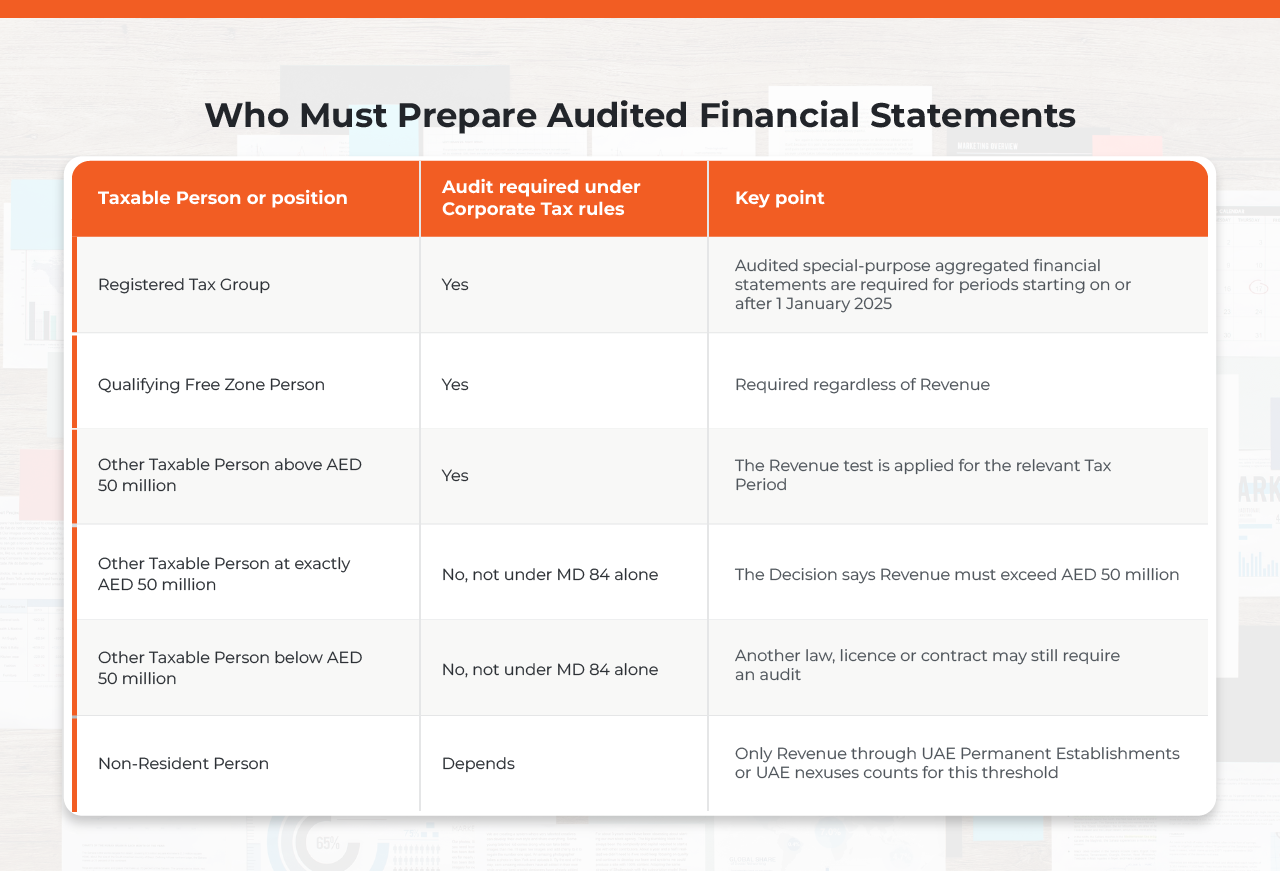
For Tax Periods starting on or after 1 January 2025, audited financial statements are required under UAE Corporate Tax rules if a Taxable Person that is not a Tax Group earns Revenue exceeding AED 50 million during the relevant Tax Period, or if it is a Qualifying Free Zone Person. Every registered Tax Group must prepare audited special-purpose financial statements. Revenue of exactly AED 50 million does not cross the threshold.
That does not mean every business below AED 50 million is automatically exempt from an audit. The UAE Commercial Companies Law, a Free Zone authority, a regulator, a bank facility or the company’s constitutional documents may create a separate audit obligation. The correct answer therefore depends on both Corporate Tax law and the rules governing the entity.
Legal basis. The current threshold rules are set by Ministerial Decision No. 84 of 2025 under Article 54 of the UAE Corporate Tax Law. MD 84 applies to Tax Periods beginning on or after 1 January 2025. Ministerial Decision No. 82 of 2023 continues to apply to Tax Periods that began before that date.
Who must prepare audited financial statements
What changed from 1 January 2025
MD 84 replaced MD 82 for Tax Periods starting on or after 1 January 2025. The two headline categories remain businesses above the AED 50 million Revenue threshold and QFZPs, but the new Decision gives Tax Groups a separate rule. All Tax Groups must now prepare and maintain audited special-purpose financial statements, regardless of the group’s Revenue.
For earlier Tax Periods beginning before 1 January 2025, the previous MD 82 threshold rule continues to apply. A Tax Group was required to prepare audited financial statements when its consolidated Revenue exceeded AED 50 million. Businesses reviewing an older return should therefore check the start date of the relevant Tax Period before applying the current rule.
What Revenue means for the AED 50 million test
The threshold is based on Revenue, not taxable income, net profit, cash receipts or the amount subject to the 9% Corporate Tax rate. Revenue is the gross amount of income derived during the Tax Period as recognised under the accounting standards accepted for UAE Corporate Tax. Expenses are not deducted before applying the threshold.
This distinction matters. A business can report a modest net profit and still exceed AED 50 million in Revenue. Exempt income or income later adjusted in the Corporate Tax computation may still be part of accounting Revenue. The assessment should therefore start with the complete Revenue population in the financial statements, supported by contracts, invoices, delivery evidence and year-end cut-off records.
Does exactly AED 50 million trigger the audit requirement
No. MD 84 uses the word exceeding. Revenue of AED 50,000,000 does not trigger the audit requirement under this Decision by itself; Revenue above that amount does. This is a legal threshold, not a reason to alter the timing of revenue recognition. The company must continue to recognise Revenue consistently under the applicable accounting standard.
Does the threshold apply to each company or the whole group
For a Taxable Person that is not a registered Tax Group, the test is applied to that Taxable Person for the relevant Tax Period. A UAE branch is generally part of the same legal person as its head office rather than a separate Taxable Person, so the entity-level analysis should include all relevant branches of that person.
A registered Tax Group is different. It is treated as one Taxable Person for Corporate Tax and follows the special-purpose aggregated financial statement rules explained below.
Qualifying Free Zone Persons need an audit at every Revenue level
A QFZP must prepare and maintain audited financial statements even when its Revenue is far below AED 50 million, it has no taxable profit, or most of its income qualifies for the 0% rate. Maintaining audited financial statements is one of the conditions connected with QFZP status.
A Free Zone Person is not automatically a QFZP. A company that does not claim or qualify for QFZP treatment may not need an audit under MD 84 if its Revenue remains at or below AED 50 million. However, the relevant Free Zone authority may independently require audited accounts for annual filing, licence renewal or regulatory purposes.
For jurisdiction-specific examples, read KGRN’s ADGM Corporate Tax and QFZP guide and the DMCC and JAFZA audit deadline guide.
Tax Groups must prepare audited special-purpose statements
For Tax Periods starting on or after 1 January 2025, every registered Tax Group must prepare audited special-purpose aggregated financial statements. This requirement applies regardless of Revenue. The framework is set out in FTA Decision No. 7 of 2025 and explained in the FTA’s Public Clarification CTP007.
These are not ordinary IFRS consolidated accounts prepared for shareholders. They begin with the standalone financial statements of the Parent Company and each Subsidiary in the Tax Group, aggregate the relevant figures line by line, apply uniform accounting policies and eliminate the transactions and balances specified by the FTA. The resulting statements must undergo a special-purpose audit under the relevant International Standards on Auditing.
Tax Group members are not required to maintain separately audited standalone financial statements solely for Corporate Tax, even when a member’s Revenue exceeds AED 50 million. A separate statutory, Free Zone, regulatory or contractual obligation may still require a member-level audit. The FTA clarification also states that the audited aggregated statements must be submitted when the Tax Group files its Corporate Tax return.
Being below AED 50 million does not end the audit analysis
MD 84 answers only the Corporate Tax question. A company can remain outside its Revenue threshold and still need audited financial statements for another reason. Mainland limited liability companies and joint stock companies may have annual audit duties under the UAE Commercial Companies Law. Free Zones and financial regulators apply their own rules, while lenders, investors and shareholders may also require audited accounts under contracts or constitutional documents.
KGRN’s statutory audit and assurance services page explains how these jurisdiction-specific obligations differ from the Corporate Tax threshold.
Financial statement audit and FTA tax audit are not the same
An external financial statement audit is performed by an independent auditor who expresses an opinion on the financial statements. An FTA tax audit is an examination by the Federal Tax Authority of a person’s tax position, records and compliance. Having audited financial statements does not prevent an FTA tax audit, and an FTA tax audit does not replace the company’s obligation to obtain an external audit when required.
Which accounting standards apply
Ministerial Decision No. 114 of 2023 requires Taxable Persons to use International Financial Reporting Standards for UAE Corporate Tax. A Taxable Person with Revenue not exceeding AED 50 million may use IFRS for SMEs. The same AED 50 million figure appears in both the accounting-standard and audit rules, but the tests serve different purposes.
A QFZP with Revenue below AED 50 million may be permitted to use IFRS for SMEs and still be required to obtain an audit. A business above AED 50 million cannot use the IFRS for SMEs option under MD 114 and also falls within the audited financial statement requirement under MD 84, unless it is dealt with under the separate Tax Group rules.
The accrual basis is the normal accounting basis. A Person with Revenue not exceeding AED 3 million may use the cash basis, while an exceptional case requires an application to the FTA. The AED 3 million cash-basis rule should not be confused with either the AED 50 million audit threshold or the Corporate Tax rate threshold.
Must audited statements be uploaded with the Corporate Tax return
MD 84 requires in-scope persons to prepare and maintain audited financial statements. The Corporate Tax return captures information about whether the statements were audited, the audit opinion and the auditor. For ordinary Taxable Persons and QFZPs, the full report should be retained and supplied whenever the EmaraTax workflow or the FTA requires it; businesses should not assume that every return profile always requires the same attachment.
Tax Groups have a specific rule. CTP007 states that audited aggregated financial statements must be submitted to the FTA at the time the Tax Group files its return.
How long must the statements and records be retained
Corporate Tax records generally must be retained for at least seven years after the end of the Tax Period to which they relate. The file should include the signed financial statements, audit report, ledgers, reconciliations, invoices, contracts and the evidence used to support both the accounting figures and Corporate Tax adjustments.
When should the audit process start
The Corporate Tax return is generally due within nine months after the end of the Tax Period. The law does not provide a universal shorter audit deadline for every entity, but the audit must be completed early enough to support an accurate return and any required submission. Waiting until the filing month creates avoidable pressure around bank confirmations, inventory evidence, related-party balances, revenue cut-off and tax adjustments.
A business forecasting Revenue close to AED 50 million should assess the threshold before year-end and appoint its auditor early. A QFZP or Tax Group already knows that an audit is required and should build the audit timetable into the year-end close from the start.
Practical audit readiness steps
- Confirm the Taxable Person, Tax Period and applicable Revenue figure before testing the threshold.
- Document whether the entity is a QFZP, an ordinary Free Zone Person, a Tax Group member or a standalone Taxable Person.
- Engage a properly licensed and, where required, authority-approved UAE auditor before the year-end workload peaks.
- Close the ledger and reconcile bank accounts, receivables, payables, inventory, fixed assets, payroll, VAT and related-party balances.
- Align the financial statements with the Corporate Tax computation, transfer pricing positions and return disclosures.
- Retain the signed audit report and the supporting evidence for the required period.
Use KGRN’s statutory audit document checklist to organise the core records before fieldwork begins, or review KGRN’s external audit services in the UAE for engagement support.

Related posts:
 Late Corporate Tax Filing in the UAE: Penalties and How to Fix It
 IFRS 18 Classification Guide for UAE Companies: Operating, Investing and Financing Income
 UAE Corporate Tax Deadline 2026: 12 Filing Dates & Guide CEOs Cannot Afford to Miss
 Audited Financial Statements for UAE Corporate Tax: MD 84 Rules Explained
 UAE Valuation Rules in 2026: Business Valuation, Property and Transfer Pricing