
Start audit preparation 90 days before your confirmed filing or renewal-linked deadline. That is an operational countdown, not a universal legal deadline. DMCC currently gives companies six months after the end of the financial year to complete and submit the required audit package. JAFZA’s current onboarding guidance also says six months, while JAFZA rules make annual audited financial reporting part of licence renewal compliance.
For a company with a 31 December year end, the practical pressure usually builds long before the end of June. That is when finance teams are closing the same year, banks are processing confirmation requests, boards are approving accounts and approved audit firms are allocating a finite number of managers and signing partners across many clients.
The result is predictable. A company that starts early can choose an auditor, resolve accounting gaps and control the timetable. A company that starts in the final weeks may still find a firm, but it has less room for missing records, audit adjustments, stock issues, related-party questions or portal rejection.
First, Correct the 90-Day Misconception
The phrase 90-day countdown is useful only when it describes an internal project plan. It should not be published as a blanket statutory deadline for both free zones. Current official materials do not support that statement.
DMCC
Article 73.6 of the DMCCA Company Regulations 2024 requires the accounts to be prepared, approved by the directors, examined by a DMCC-approved auditor and placed before a general meeting within six months after financial year end, unless DMCCA prescribes another period. Article 73.7 then requires filing with the Registrar within five business days of the relevant general meeting. DMCC’s submission guideline, updated on 29 April 2025, also states that the audited financial statements and signed summary sheet must be uploaded within six months after year end.
JAFZA
JAFZA’s New Member Onboarding guidance states that the audit report must be submitted within six months of financial year end. The Jebel Ali Free Zone Rules 2023 separately state that licence renewal is conditional on the customer committing to submit its annual audited balance sheet, prepared by an auditor approved by JAFZA. The exact date and any entity-specific pending action should therefore be checked in the Dubai Trade Portal and against the company’s renewal record.
Practical rule. Record the legal deadline first. Then create an internal deadline 90 days earlier. If the portal, an official notice or an approved extension shows a different date, use that documented date rather than an old blog post or a deadline copied from another company.
| Point | DMCC | JAFZA | Management action |
| Published timing | Within six months after financial year end, subject to another period prescribed by DMCCA | Current onboarding guidance says within six months; renewal conditions also apply | Verify the portal date for the entity |
| Auditor eligibility | Firm must be on DMCCA’s Approved Auditor List | Auditor must be approved by JAFZA; official service guidance also requires a Dubai audit licence | Check approval before engagement |
| Core filing route | DMCC Member Portal under Compliance Services | Dubai Trade Portal, Submit Financial Statement service | Keep proof of submission and status |
| Key accompanying item | Audited Financial Statements Summary Sheet signed and stamped by the Audit Partner | Auditor Report Summary Sheet and signed audit report | Use the latest authority format |
Why Approved Auditor Capacity Tightens First
Approved-auditor panels do not literally become full when a deadline approaches. The list remains a regulatory list. What tightens is the delivery capacity of the firms on it. That distinction matters because a company is not simply buying a signature. It is booking a regulated engagement that requires acceptance checks, independence clearance, audit planning, evidence gathering, review and partner sign-off.
Many Companies Share the Same Year End
A large share of UAE entities use 31 December as their year end. That concentrates DMCC and JAFZA audit work into the months before June, while the same auditors are also completing mainland audits, bank confirmations, group reporting and Corporate Tax work. Demand therefore rises together rather than spreading evenly across the year.
Eligibility Narrows the Supplier Pool
A general UAE audit licence is not enough for every free zone submission. DMCC places responsibility on the member company to confirm that the audit firm appears on the Approved Auditor List at the time of engagement or renewal. If a report is issued by a non-approved firm, DMCCA may reject it and impose sanctions, requiring a fresh compliant report. JAFZA also requires an approved auditor under its rules and maintains the approval framework through the Registrar.
Partner Review Cannot Be Compressed Indefinitely
The signing partner must be satisfied that sufficient appropriate audit evidence has been obtained. Bank confirmations, inventory testing, revenue cut-off, related-party balances and going-concern issues do not become easier because the filing date is close. When several files arrive late, responsible firms limit new engagements rather than reduce audit quality.
Late Files Usually Need More Work
The businesses that approach auditors late are often the ones with unreconciled ledgers, missing invoices, unresolved shareholder balances or incomplete tax records. That converts a planned audit into an accounting clean-up followed by an audit. The ext
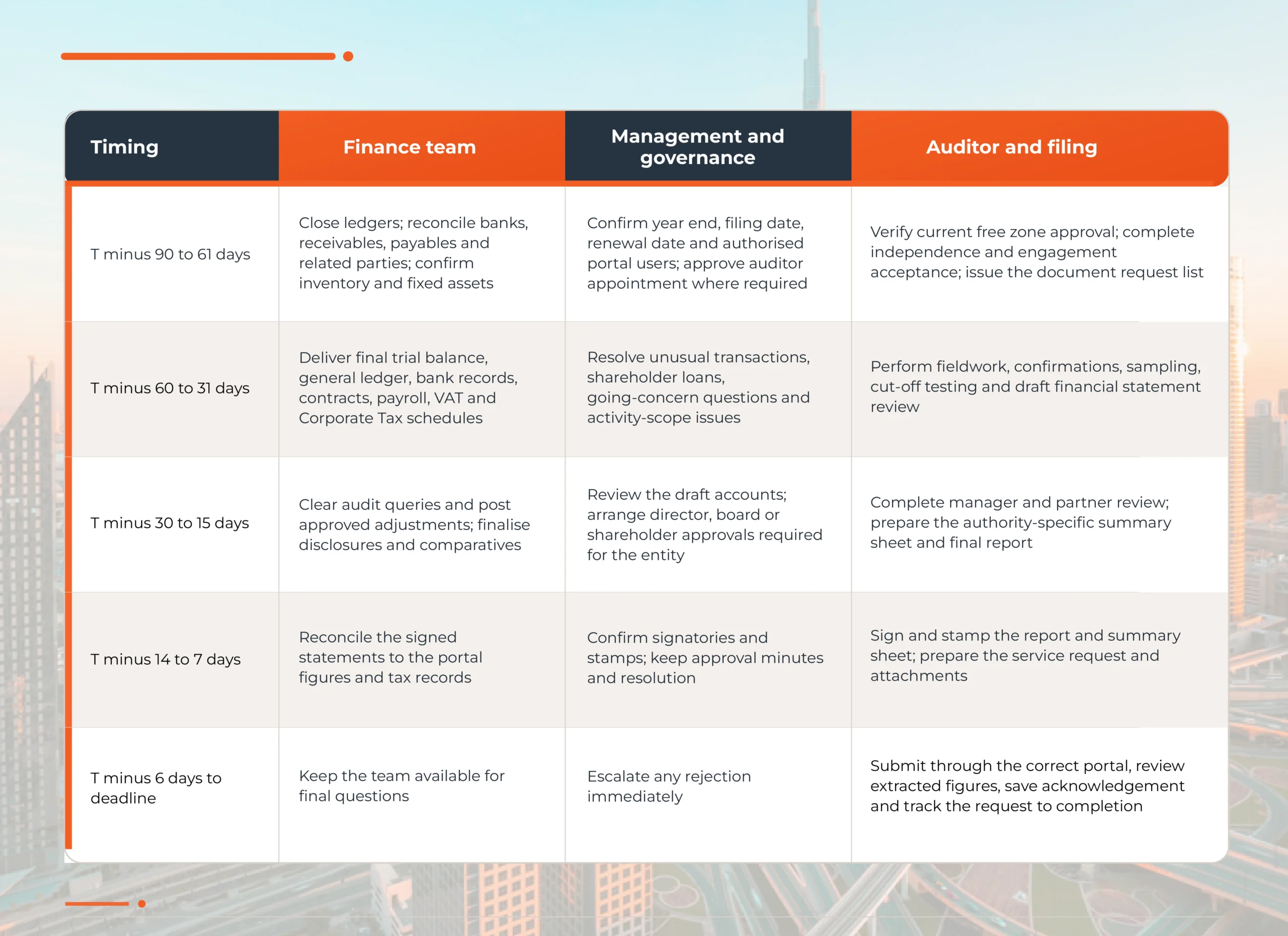
Your 90-Day Audit Readiness Countdown
Use the following timetable by counting backwards from the deadline confirmed for your company. It is deliberately earlier than the authority’s outer deadline so management has time to fix issues without asking the auditor to absorb the risk.
What to Prepare Before the Auditor Starts
An approved auditor can plan efficiently only when the accounting file is complete enough to audit. The exact request will vary by industry and entity, but the following records should be ready before fieldwork begins.
- Corporate documents: current trade licence, certificate of incorporation, constitutional documents, shareholder register, UBO records, director details and auditor appointment resolution.
- Accounting records: final trial balance, general ledger, prior-year audit report, journal support, bank reconciliations, receivables, payables, fixed assets, loans and provisions.
- Transaction evidence: sales and purchase invoices, contracts, delivery or service evidence, leases, payroll and WPS records, inventory count sheets and goods-in-transit schedules.
- Tax records: VAT returns and reconciliations, Corporate Tax registration and computation, related-party schedules, transfer pricing support and free zone qualifying-income analysis where relevant.
- Governance evidence: board and shareholder minutes, signed financial statement approvals, management representation and explanations for significant estimates or unusual transactions.
For a fuller working-paper list, use KGRN’s statutory audit checklist for UAE SMEs. It can be adapted to the entity’s free zone, sector and Corporate Tax position.
How to Verify an Approved Auditor
Do not accept a proposal simply because the firm describes itself as UAE licensed or free zone experienced. Approval is authority-specific and can change. Complete the check before signing the engagement letter and repeat it if the engagement is renewed for a later year.
1. Check the current authority source.
For DMCC, use the Approved Auditors List available through the DMCC Knowledge Bank or Member Portal. For JAFZA, verify the current approved status through the authority or Dubai Trade process rather than relying on an old downloaded list.
2. Match the legal name
The firm name on the proposal, trade licence, authority record and final audit report should be consistent. Confirm the branch and signing partner where relevant.
3. Confirm the engagement period
DMCC approved status is renewed periodically. Verify that the firm is approved when the company engages or renews the appointment, not only when it signs the report.
4. Ask who will sign
Confirm that the audit partner has the required Ministry of Economy authority and that the firm can issue the authority-specific report and summary sheet.
5. Put portal support in scope
Clarify whether the auditor will prepare the summary sheet, review portal figures and help resolve authority queries after submission.
DMCC Submission Requirements That Commonly Cause Rework
DMCC’s current rules are specific. The accounts must comply with IFRS, show a true and fair view, be approved by the directors and be signed on their behalf by at least one director. The audit report must address whether the company operated only within its licensed activities. The Approved Auditor Rules also require the Audit Partner to sign and stamp the audit report and the summary sheet.
The auditor must also consider whether the financial period and share capital agree with the Articles, whether bank balances are confirmed, whether salary expenses are disclosed, whether the notes are sufficiently detailed and whether revenue outside licensed activities is disclosed as other income. These points are why a generic financial statement pack can fail even when the arithmetic is correct.
KGRN’s external audit services in DMCC page explains the current six-month rule, summary sheet process and Member Portal workflow in detail.
JAFZA Submission Requirements to Confirm Early
JAFZA FZE and FZCO entities must provide an updated audit report annually and pass a resolution appointing the auditor. The official service guide requires the summary sheet to be signed and stamped by the auditor and the audit report to be signed by the FZE or FZCO manager and stamped by the company. It also states that the report should be issued by an auditor holding a Dubai audit licence.
The submission is initiated in the Dubai Trade Portal under Registration and Submit Financial Statement. Current guidance describes verification and processing after the service request is created. Because JAFZA’s published materials include legacy regulations, current service instructions and renewal-linked conditions, the company should verify its actual pending requirement in the portal before fixing the countdown date.
For jurisdiction-specific support, see KGRN’s external audit services in JAFZA.
What Happens When the Audit Starts Too Late
The immediate risk is not always a formal fine. More often, the audit remains outstanding while the company is trying to renew its licence, complete another regulatory filing or satisfy a bank. That can turn an accounting delay into an operational one.
Late appointment also reduces the evidence available to the auditor. A year-end stock count cannot always be recreated reliably months later. Bank confirmations depend on third parties. Related-party balances may require confirmations from overseas group companies. A disputed receivable, unrecorded liability or unsupported shareholder loan can delay both the audit opinion and the Corporate Tax computation.
Using the wrong auditor is worse than starting late with the right one. DMCCA expressly reserves the right to reject audited financial statements prepared by a non-approved firm and require resubmission by an Approved Auditor. That can mean paying twice and repeating fieldwork under greater time pressure.
The Corporate Tax Audit Requirement Is a Separate Test
A free zone audit and a Corporate Tax audit obligation can overlap, but they do not arise from the same rule. Ministerial Decision No. 84 of 2025 requires audited financial statements for every Qualifying Free Zone Person, regardless of revenue, and for other taxable persons with revenue exceeding AED 50 million. Tax Groups must prepare audited special-purpose financial statements in the form required by the FTA.
One audit may satisfy more than one requirement when the reporting period, accounting framework, auditor eligibility and scope align. Do not assume this automatically. Confirm the intended Corporate Tax status before the engagement begins so the audit evidence and financial statements support the position being claimed.
KGRN’s guide to audited financial statements for UAE Corporate Tax explains the MD 84 categories and the separate free zone and statutory obligations.
A Practical Decision for CFOs
- If the confirmed deadline is more than 90 days away, use the time to close structural gaps: unreconciled accounts, undocumented related parties, missing contracts, inventory procedures and unclear free zone tax positions.
- If it is between 30 and 90 days away, appoint the approved auditor now and agree on a dated responsibility list.
- If fewer than 30 days remain, escalate internally, give the auditor an honest status report and prioritise the evidence that can block the opinion or portal submission.
The wrong response is to wait for perfect books before speaking to an auditor. Early visibility lets the auditor separate accounting clean-up from audit work, identify evidence that requires third parties and tell management whether the target date is realistic.
How KGRN Chartered Accountants Can Help
KGRN supports DMCC and JAFZA companies from readiness review through audit completion and submission support. The engagement can include deadline confirmation, approved-auditor verification, document planning, IFRS financial statement review, audit fieldwork, authority-specific summary sheets, portal coordination and alignment with Corporate Tax requirements.