

A PDF Is Not an eInvoice. One Missed Data Field Can Hold Up the Payment Chain.
For a UAE contractor, eInvoicing is not another finance-format change. It ranges from the contract and bill of quantities to site certification, progress billing, retention, variations, VAT treatment, credit notes and collection. If those records do not agree, a technically connected system can still produce a rejected or commercially disputed invoice.
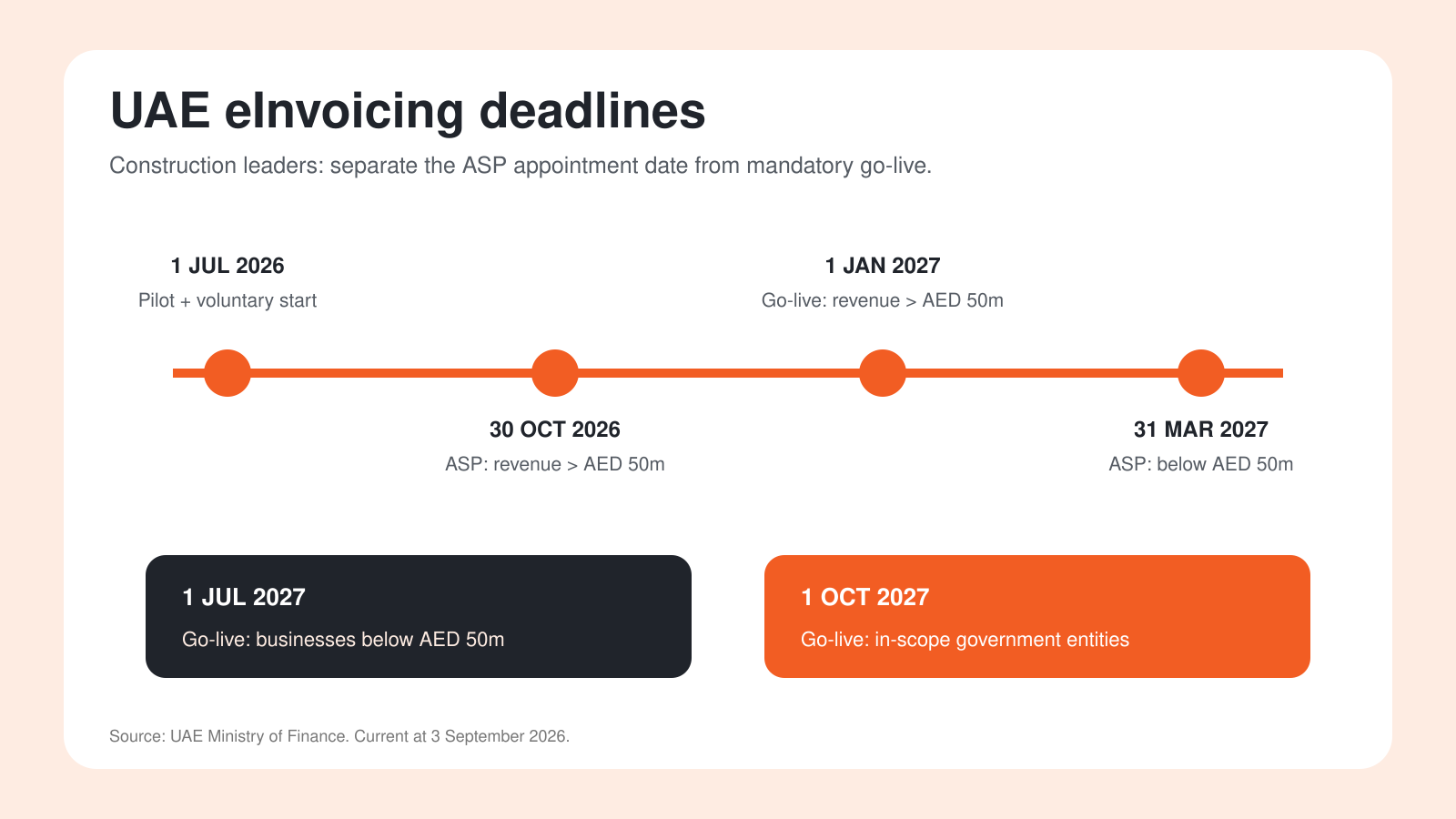
The first mandatory wave is close. Following a 2026 amendment, businesses with annual revenue exceeding AED 50 million must appoint an Accredited Service Provider (ASP) by 30 October 2026 and implement UAE eInvoicing by 1 January 2027. The ASP date moved; the go-live date did not. Businesses below AED 50 million follow on 1 July 2027, after appointing an ASP by 31 March 2027.
That makes eInvoicing a CEO-level cash-flow and control programme—not an IT purchase to leave until the final quarter. This guide explains the rules, the construction-specific pressure points and the actions leaders should sponsor now. KGRN Chartered Accountants supports contractors, subcontractors, developers and project businesses across the UAE with eInvoicing readiness, implementation and ASP services, alongside VAT, accounting and project-tax support.
UAE eInvoicing Deadline: Every Date Construction CEOs Should Know
| Date | Entity or Event | Required Action |
| 1 July 2026 | Selected participants | Pilot programme began; voluntary implementation became available |
| 30 October 2026 | Businesses with annual revenue exceeding AED 50 million | Appoint a UAE Accredited Service Provider |
| 1 January 2027 | Businesses with annual revenue exceeding AED 50 million | Mandatory implementation begins |
| 31 March 2027 | Businesses with annual revenue below AED 50 million | Appoint an ASP |
| 1 July 2027 | Businesses with annual revenue below AED 50 million | Mandatory implementation begins |
| 31 March 2027 | In-scope government entities | Appoint an ASP |
| 1 October 2027 | In-scope government entities | Mandatory implementation begins |
The official threshold concerns annual revenue, not profit or taxable income. Ministerial Decision No. 244 of 2025 describes revenue as gross income earned during the most recent accounting period, based on financial statements prepared under applicable UAE legislation. Groups with several contracting entities should document the phase conclusion for each legal person rather than rely on a group-wide assumption.
The current first-cohort wording in the Ministry’s May 2026 announcement is “exceeding AED 50 million”; the earlier September 2025 announcement used “equal to or exceeding”. Businesses at exactly AED 50 million should obtain phase-specific confirmation instead of treating that drafting difference as a planning advantage.
What Counts as UAE eInvoicing and What Does Not?
An eInvoice is structured invoice data issued and exchanged electronically between supplier and buyer and reported electronically to the FTA. The UAE uses a decentralised continuous transaction control and exchange model based on OpenPeppol. In simple terms:
- The contractor’s billing or ERP system sends invoice data to its ASP.
- The supplier ASP validates it and converts it to the UAE standard XML format where needed.
- The supplier ASP transmits the invoice to the buyer’s ASP and reports the Tax Data Document to the FTA.
- The buyer ASP validates and delivers it to the buyer; status messages return through the network.
A PDF can remain a convenient human-readable copy, but it is not the regulated eInvoice. The Ministry of Finance expressly excludes PDF, Word, image, scan and email formats from the definition because they are not structured for automatic processing. See the official MoF eInvoicing portal and the FTA eInvoicing overview.
The system generally applies to persons conducting business in the UAE for B2B and B2G transactions, subject to specified exclusions. B2C transactions are outside the mandatory system until brought in by a future decision. Mainland or free-zone status does not, by itself, remove a construction business from scope.
Why Construction eInvoicing Is Harder Than Sending a Standard Sales Invoice
Construction billing records commercial events that develop over time. A progress claim may start with work completed on site, move through consultant or engineer certification, face deductions, include an approved variation, withhold retention and then trigger a VAT invoice or adjustment. Those facts may sit in separate project, procurement, document-management and finance systems.
The failure risk therefore lives at the handoffs:
- Progress certificates: claimed, certified and invoiced values must be distinguishable. A certificate is not automatically the same thing as the final structured invoice.
- Retention: gross work, retention withheld and later release need consistent contract and accounting treatment. Do not disguise retention through free-text lines that cannot be mapped.
- Variations: approved and unapproved variations must not be mixed. Structured invoice lines should trace to the governing contract or change order.
- Advance and mobilisation payments: payment timing, invoice timing and later recovery must be mapped to applicable VAT date-of-supply rules.
- Deductions and back charges: determine whether the amount is a commercial deduction, a separate supply, or a correction requiring a credit note; do not force unlike cases into one workflow.
- Subcontractor invoices: receiving is part of compliance. Project teams need a route for validation failures, disputed quantities and invoices addressed to the wrong entity.
- Multi-entity projects: developer, main contractor, joint venture and subcontractors must use the correct legal identities, tax identifiers and buyer endpoints.
For VAT treatment and tax-point decisions, use documented analysis rather than software defaults. KGRN’s VAT consultancy services in Dubai can be integrated with the eInvoicing workstream so structured data reflects the underlying tax position.
The 7-System UAE eInvoicing Readiness Test
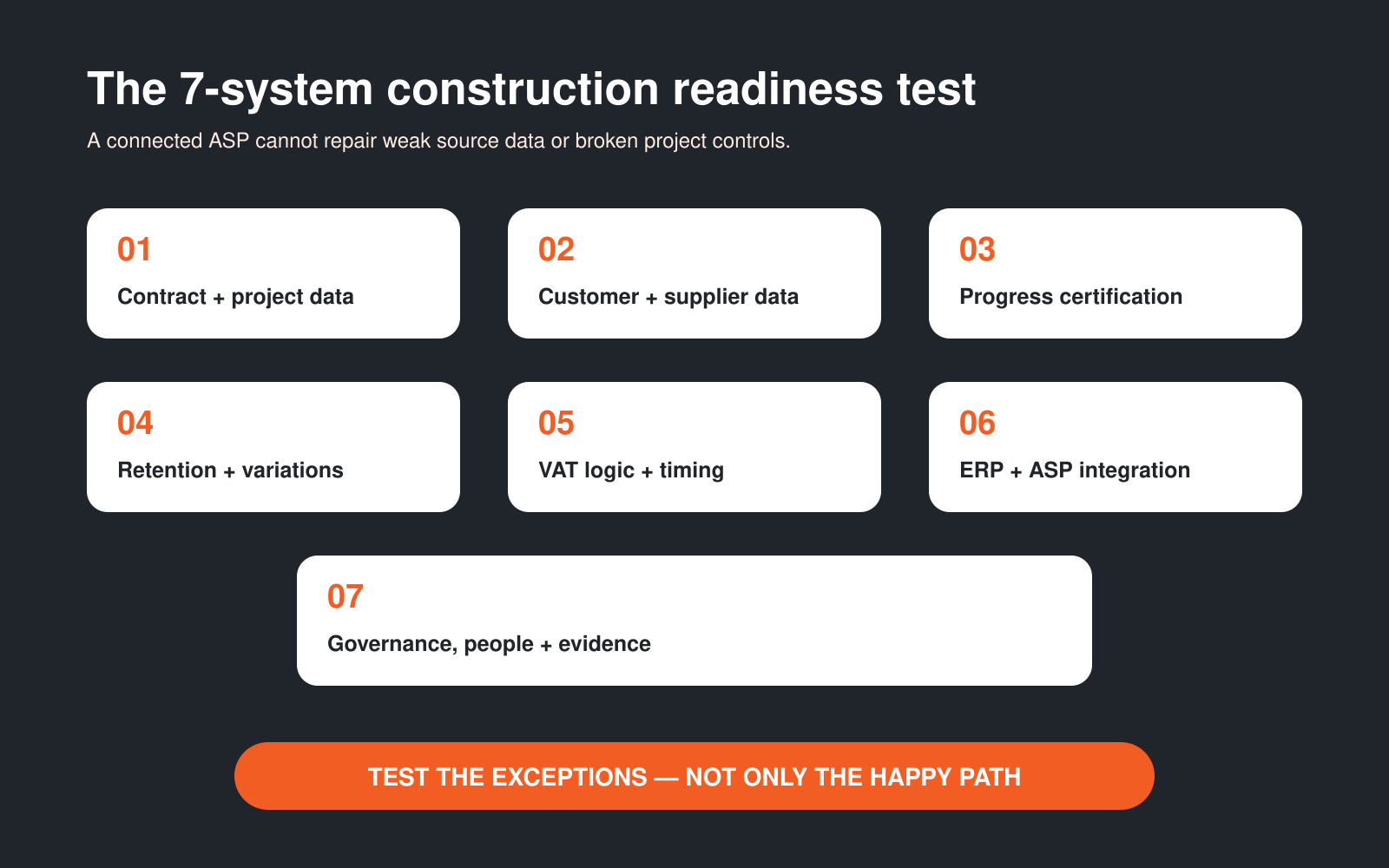
1. Contract and project master data
Create one controlled record for legal entity, customer, project, contract, purchase order, bill-of-quantities reference, currency and payment terms. Decide which identifiers must appear at header and line level. If project teams use informal naming, duplicates will reach the invoice.
2. Customer and supplier master data
Validate legal names, addresses, tax identifiers, Peppol participant identifiers and business classification. The buyer on the contract must match the recipient in the structured invoice. KGRN’s guide to common UAE eInvoicing rejection causes explains why identifier quality matters.
3. Progress billing and certification
Map the path from application for payment to certified amount, invoice approval and issue. Define the source of truth and prevent staff from overwriting certified values in spreadsheets. Include partial certification, rejection and resubmission scenarios.
4. Variations, retention and credit notes
Build separate reason codes and approval controls. UAE rules require electronic credit notes where a transaction is cancelled, consideration is reduced or returned, or an administrative or numerical error occurs. Test the correction process—not only the happy path.
5. VAT logic and invoice timing
Map supply type, tax rate, place and date of supply, reverse-charge indicators where applicable, and credit-note references. VAT-registered issuers follow the VAT-law timing rules. Other in-scope cases are subject to the eInvoicing decision’s timing framework, including the 14-day rule where applicable. Construction contracts require fact-specific review.
6. ERP, project systems and ASP integration
Inventory every invoice source: SAP, Oracle, Dynamics, Tally, bespoke project software and spreadsheets. Agree field mapping to PINT AE, status write-back, authentication, outage handling, archival and reconciliation. Existing software may remain, but “our ERP supports XML” is not proof of UAE compliance.
7. Governance, people and evidence
Name an executive sponsor and owners across tax, finance, commercial, procurement, IT and project controls. Establish approval matrices, access controls, daily failure monitoring, escalation times and evidence retention. Align the accounting foundation through KGRN’s accounting services in Dubai where project ledgers or reconciliations need remediation.
How to Choose an Accredited Service Provider in the UAE
Accreditation is the entry condition, not the entire business case. Verify the provider’s exact legal entity against the official MoF list, then score operational fit:
- integration with every billing and ERP source;
- ability to send and receive PINT AE documents;
- treatment of progress invoices, credit notes and high-volume line items;
- multi-entity, branch and project support;
- validation rules, dashboards and actionable error messages;
- security, continuity, data access and exit arrangements;
- implementation capacity before your deadline; and
- transparent commercial terms for volume, storage and support.
Run a scripted proof of concept using real but sanitised construction scenarios: a standard progress invoice, partial certification, retention release, approved variation, credit note, rejected buyer identifier and service outage. Read KGRN’s ASP selection framework before contracting.
A 90-Day Construction eInvoicing Action Plan
Days 1–15 Govern and scope. Confirm the legal entities, revenue phase, B2B/B2G flows, systems and executive sponsor. Catalogue invoices, credit notes, self-billing and subcontractor receipt processes.
Days 16–35 Diagnose data. Sample recent projects. Measure missing identifiers, inconsistent customer records, manual line descriptions and differences between certified values and posted invoices. Prioritise issues by rejection and cash-flow impact.
Days 36–55 Select and design. Shortlist official providers, define the target architecture, map fields and statuses, and document controls. Lock responsibilities between KGRN, the ASP, ERP vendor and internal teams.
Days 56–75 Build and test. Test outbound and inbound invoices, credit notes, exception routes, VAT logic, reconciliation, access and outages. Include project-commercial users—not finance and IT alone.
Days 76–90 Rehearse go-live. Train role owners, establish dashboards, close critical defects and run a controlled parallel cycle. Obtain sponsor sign-off based on evidence: acceptance rates, unresolved exceptions, reconciliation completeness and support readiness.
Why KGRN for UAE eInvoicing for Construction Companies?
KGRN Chartered Accountants combines UAE tax, accounting and implementation capability. KGRN is listed in the UAE’s Approved eInvoicing service-provider ecosystem and supports mainland and free-zone businesses with readiness assessment, data and VAT-logic review, ERP mapping, Peppol-aligned implementation, testing, training and post-go-live controls.
That combination matters in construction: the objective is not merely to transmit XML. It is to preserve the commercial meaning of each progress valuation while producing complete, accurate, auditable invoice data. KGRN can also coordinate related corporate tax support for construction companies so project accounting supports more than one compliance obligation.
Frequently Asked Questions
- When does UAE eInvoicing become mandatory for construction companies?
For businesses with annual revenue exceeding AED 50 million, mandatory implementation begins 1 January 2027 and an ASP must be appointed by 30 October 2026. Businesses below AED 50 million are appointed by 31 March 2027 and implemented from 1 July 2027, subject to scope and exclusions. - Is a PDF tax invoice emailed to a client a UAE eInvoice?
No. The MoF and FTA state that PDFs, Word documents, images, scans and emails are not eInvoices. A compliant eInvoice is structured, machine-processable data exchanged through the prescribed system and reported to the FTA. A readable PDF may accompany the transaction, but it cannot replace the structured document. - Does UAE eInvoicing apply to free-zone construction companies?
Free-zone status is not a general exclusion. The system broadly covers persons conducting business in the UAE for in-scope B2B and B2G transactions. A free-zone contractor should assess its legal entities, revenue phase, transaction types and any specific exclusions rather than assume corporate-tax or customs treatment decides eInvoicing scope. - How should retention be shown in a construction eInvoice?
There is no safe universal template for every contract. The structured data must reflect the actual transaction, required invoice fields and correct VAT treatment. Contractors should map gross certified work, retention withheld or released, references and taxable amounts with their tax adviser and ASP, then test the scenario before go-live. - Does a contractor need to replace its ERP for UAE eInvoicing?
Usually not. A suitable ASP can often integrate with the existing ERP or billing system. However, the system must contain reliable mandatory data, export it in a mappable format, receive statuses and support corrections. A proof of concept should test actual construction workflows before management approves the target architecture.

Related posts:
 UAE eInvoicing Readiness Checklist: 10 Things to Fix Before 1 January 2027
 Credit Notes and Invoice Adjustments Under UAE eInvoicing
 UAE eInvoicing Phase 1: A Practitioner’s Perspective on Business Readiness
 The Role of Pre-Approved ASP in UAE eInvoicing
 UAE E-Invoicing: Regulatory Clarifications & Practical Compliance Insights