
Internal audit is being asked to address a broader and more complex risk agenda. For UAE organisations, the function increasingly extends beyond financial controls to operational resilience, technology, third-party relationships, regulatory compliance and the quality of information available to management and boards.
The professional framework has also evolved. The Institute of Internal Auditors’ Global Internal Audit Standards became effective in January 2025. During 2026, mandatory Topical Requirements are being introduced for specific areas of assurance. This creates a practical need for organisations to reassess the scope, capability and methodology of their internal audit arrangements.
At a glance:
- Internal audit evaluates governance, risk management and internal controls; it is distinct from an external audit of financial statements.
- There is no single requirement for every UAE private company to establish an internal audit function. The position depends on the entity, sector, regulator, constitutional documents and stakeholder expectations.
- Growth, control failures, regulatory scrutiny and system change are common triggers for review.
- In 2026, the IIA’s Topical Requirements introduced mandatory criteria for applicable assurance engagements involving cybersecurity, third-party risk and organisational behaviour.
The role of internal audit in a UAE business
The IIA’s Global Internal Audit Standards describe internal audit as an independent and objective activity that strengthens an organisation’s ability to create, protect and sustain value. In practice, internal audit assesses whether governance, risk management and control processes are appropriately designed and operating as intended.
The scope may include finance, procurement, inventory, payroll, compliance, technology, fraud risk, business continuity and third-party management. The purpose is to establish why weaknesses exist, assess their effect and support proportionate remediation.
This differs from statutory external audit. Under the UAE Commercial Companies Law, joint stock companies and limited liability companies are required to appoint one or more auditors for an annual audit of their accounts. Internal audit has a different mandate: it provides assurance over the wider control environment and can operate throughout the year.
When should a business engage an internal audit firm?
The need should be determined by risk rather than company size alone. An independent internal audit review may be appropriate when:
- The business has expanded or changed its systems or operating model;
- Recurring reconciliations, stock variances, manual adjustments or policy overrides remain unresolved;
Responsibilities are concentrated, with inadequate segregation of duties;
- Management reporting is delayed, inconsistent or highly manual;
- The organisation is preparing for financing, acquisition or restructuring;
- A regulator, lender, shareholder or audit committee requires stronger assurance;
- Fraud concerns, data incidents or significant control failures have occurred; or
- The existing internal audit team lacks capacity or specialist expertise.
Tax compliance adds a further control consideration. The Federal Tax Authority states that taxable and exempt persons must retain relevant Corporate Tax records for at least seven years after the end of the related tax period. Internal audit does not replace tax advice, but it can assess whether recordkeeping, reconciliations, approval controls and data ownership support reliable compliance. The Ministry of Finance also directs businesses to rely on official MoF and FTA publications when interpreting Corporate Tax obligations.
What to expect from internal audit firms in Dubai
A well-structured engagement begins with the organisation’s objectives and risks, not a standard checklist. While the scope varies, the following stages are generally expected.
Risk assessment and planning
The firm develops an understanding of the business, governance, systems, regulatory context and previous findings. It identifies where control failure could have the most significant effect and uses this to establish a risk-based plan and terms of reference.
Process and control assessment
Auditors conduct walkthroughs, review policies and map transactions and information. They assess key controls, supporting evidence, escalation procedures and segregation of responsibilities.
Testing and analysis
Testing may include transactions, system access, approvals, reconciliations, contracts, master data and exception reports. Data analytics and computer-assisted techniques may extend coverage and identify unusual patterns.
Reporting and remediation
Findings should be prioritised and supported by evidence. Reports should explain the issue, root cause, potential effect and response, with accountable owners and deadlines. Follow-up confirms whether remediation addressed the risk.
The Global Internal Audit Standards and the 2026 requirements
The revised Global Internal Audit Standards were issued on 9 January 2024 and became effective on 9 January 2025. They are organised into five domains covering the purpose of internal auditing, ethics and professionalism, governance of the function, management of the function and performance of internal audit services.
For organisations, the implications extend beyond audit methodology. The Standards reinforce the need for an appropriate mandate, organisational independence, board oversight, competent resources, strategic planning, quality management and effective communication of results.
The significant development in 2026 is the implementation of the IIA’s Topical Requirements. These form a mandatory component of the International Professional Practices Framework and establish minimum criteria for assurance work on specified risk topics.
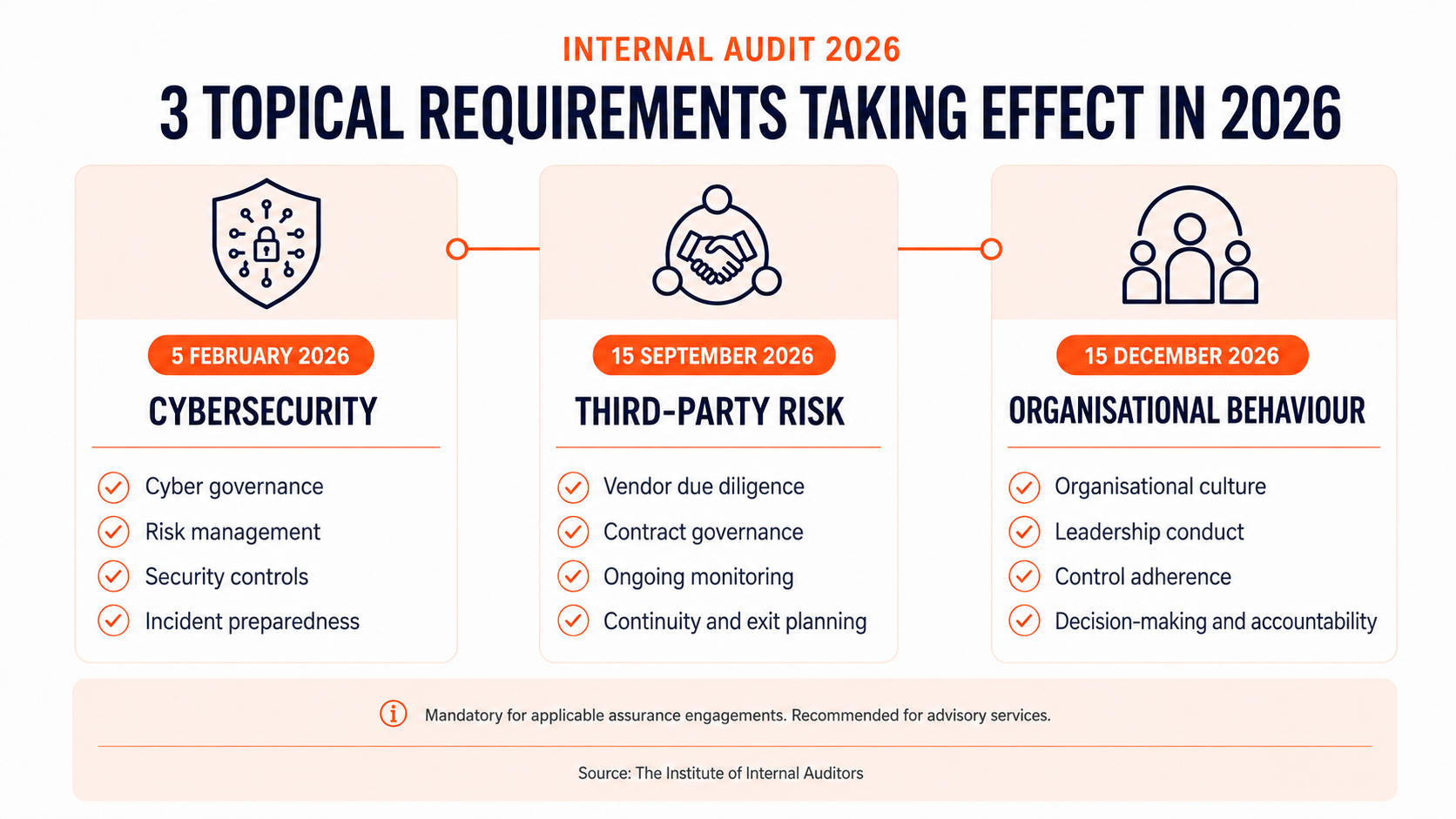
Cybersecurity: Effective 5 February 2026
Where cybersecurity is the subject of an assurance engagement, or becomes applicable through the internal audit risk assessment, the Cybersecurity Topical Requirement must be considered. The requirement provides criteria for assessing governance, risk management and controls in this area. It does not make every internal audit engagement a cybersecurity audit.
Third-party risk: effective 15 September 2026
The Third-Party Topical Requirement addresses governance, risk management and controls across third-party relationships. This is relevant to businesses that depend on technology providers, payment processors, distributors, contractors, logistics partners or outsourced functions. Assurance may need to consider due diligence, contracting, ongoing monitoring, access, incident management, continuity and exit arrangements.
Organisational behaviour: effective 15 December 2026
Organisational behaviour can influence whether controls are followed, challenged or overridden. The requirement provides a consistent basis for assurance over the governance and control environment that shapes conduct and decision-making.
Topical Requirements are mandatory for applicable assurance engagements and recommended for advisory work. Internal audit must assess applicability, retain evidence of that assessment and document the rationale for excluding individual requirements. Organisations should therefore review their audit universe, methodology, working papers and quality-assurance arrangements before the relevant effective dates.
Selecting the appropriate delivery model
The operating model should reflect the organisation’s risk profile, internal capability and assurance needs.
Outsourced internal audit:
Places responsibility for planning, execution, reporting and follow-up with an external provider. It can suit organisations that require an independent function without establishing a permanent team.
Co-sourced internal audit:
Combines the organisation’s existing resources and institutional knowledge with external capacity or specialist capability. This model can address skills gaps in areas such as IT, operational risk, compliance, data analysis or investigations.
Specialist support:
Can be used to establish or transform an internal audit function, undertake an independent quality review, train teams or perform targeted and ad hoc assignments.
Regardless of the model, accountability for governance and the effectiveness of internal controls remains with the board and management. Outsourcing execution does not transfer that responsibility.
How KGRN supports internal audit functions
KGRN’s internal audit services in Dubai include fully outsourced and co-sourced arrangements, as well as specialist support for organisations developing or strengthening an internal audit function.
Depending on the agreed scope, KGRN’s support may include business risk assessments, internal-control documentation and testing, operational audits, IT reviews, process mapping, quality-assurance reviews, concurrent or pre-payment audits, focused transaction reviews, investigative assignments, training and support during a transition to an outsourced model.
The approach is designed around the organisation’s risk profile and operating context. The intended outcome is clear, evidence-based reporting that supports management and board oversight, identifies practical improvements and establishes accountability for remediation.
Questions boards and management should consider
Organisations reviewing their internal audit arrangements for 2026 should consider four questions:
- Does the audit plan reflect the risks that could materially affect the organisation’s objectives?
- Is the function sufficiently independent, skilled and resourced to address those risks?
- Have the IIA’s applicable 2026 Topical Requirements been incorporated into the methodology and assurance plan?
- Are findings translated into owned, time-bound actions and independently followed through to closure?
Where the answer to any of these questions is unclear, a focused risk assessment can establish the required scope before a wider programme is commissioned.
To discuss an outsourced, co-sourced or specialist internal audit requirement, contact KGRN.
Frequently asked questions
-
Is internal audit mandatory for every company in Dubai?
No single rule requires every private company in Dubai to maintain an internal audit function. Requirements depend on the entity’s legal form, sector, regulator, licence conditions, constitutional documents and governance obligations. A legal or regulatory assessment should be obtained where the position is uncertain.
-
What is the difference between outsourced and co-sourced internal audit?
Under outsourcing, an external firm performs the internal audit function within an agreed mandate. Under co-sourcing, internal personnel retain a role while external professionals provide capacity or specialist expertise.
-
How often should a company conduct an internal audit?
There is no universal frequency. Higher-risk processes may require continuous or frequent review, while lower-risk areas may be covered through a rotational multi-year plan. Rapid growth, a new ERP system, an acquisition, a regulatory review or a significant control failure may justify an additional engagement outside the approved audit plan.
-
How is the cost of internal audit services determined?
Fees are usually based on the number and complexity of processes under review, locations, transaction volumes, specialist skills required, data quality and the extent of testing. A defined scope and preliminary risk assessment enable the internal audit firm to estimate the resources and timetable more reliably. Cost alone should not determine provider selection; independence, methodology, sector experience and reporting quality are also relevant.
-
Do the IIA’s 2026 Topical Requirements apply to every internal audit?
No. They apply to assurance engagements when the relevant topic is included in the audit plan, identified during an engagement or requested separately and found applicable through risk assessment. Internal audit must document its assessment of applicability and the rationale for excluding individual requirements. The Topical Requirements are recommended, but not mandatory, for advisory services.
-
Is internal audit relevant for SMEs and family-owned businesses?
Yes. The appropriate scope may be narrower than for a large regulated organisation, but concentration of authority, informal procedures, rapid expansion and limited segregation of duties can create significant risks. An outsourced or periodic review can provide proportionate assurance without requiring the business to maintain a permanent internal audit department.
Related posts:
 How to Choose an Audit Firm in Dubai: Approved Auditors, Free Zone Requirements and Selection Checklist for 2026
 How internal audit improve an organisation’s performance?
 Internal audit firms in UAE
 Importance Of Auditing Financial Statements | Financial Reports | Auditing
 Advantages Of Financial Audit | Financial Audit | Audit Process