
Choosing an audit firm in Dubai is not simply about comparing fees or searching for the “best audit firms in Dubai.” The auditor must be legally eligible to perform the engagement, accepted by the relevant licensing authority and capable of handling the accounting, tax and industry issues affecting the business.
This becomes more important for companies operating in DMCC, JAFZA, DAFZ, Dubai South and other UAE free zones. Each authority may have different audit, auditor-appointment and financial-statement submission requirements.
An audit report prepared by a reputable firm may still be rejected if the auditor is not recognised by the relevant authority. Before appointing an auditor, businesses should therefore verify the firm’s current approval status, relevant experience, proposed scope and ability to meet the applicable deadline.
This guide explains how to evaluate audit firms in Dubai, when an approved auditor is required and what to check before signing an engagement letter.
What Is an Audit Firm?
An audit firm is an independent professional practice authorised to examine a company’s financial statements, accounting records and supporting evidence.
The objective of a statutory external audit is to enable the auditor to express an opinion on whether the financial statements have been prepared, in all material respects, in accordance with the applicable financial reporting framework.
For most UAE businesses, this framework will be International Financial Reporting Standards, or IFRS. Smaller entities may be eligible to use IFRS for SMEs where permitted and appropriate.
An external audit commonly examines:
- Revenue and receivables
- Purchases and expenses
- Bank balances and reconciliations
- Inventory
- Property, plant and equipment
- Loans and other liabilities
- Related-party transactions
- Provisions and contingencies
- Share capital and reserves
- Corporate Tax and VAT balances
- Financial-statement disclosures
An audit is different from bookkeeping. Management remains responsible for maintaining the accounting records and preparing the financial statements. The auditor independently examines those statements and the evidence supporting them.
Do Companies in Dubai Need an Annual Audit?
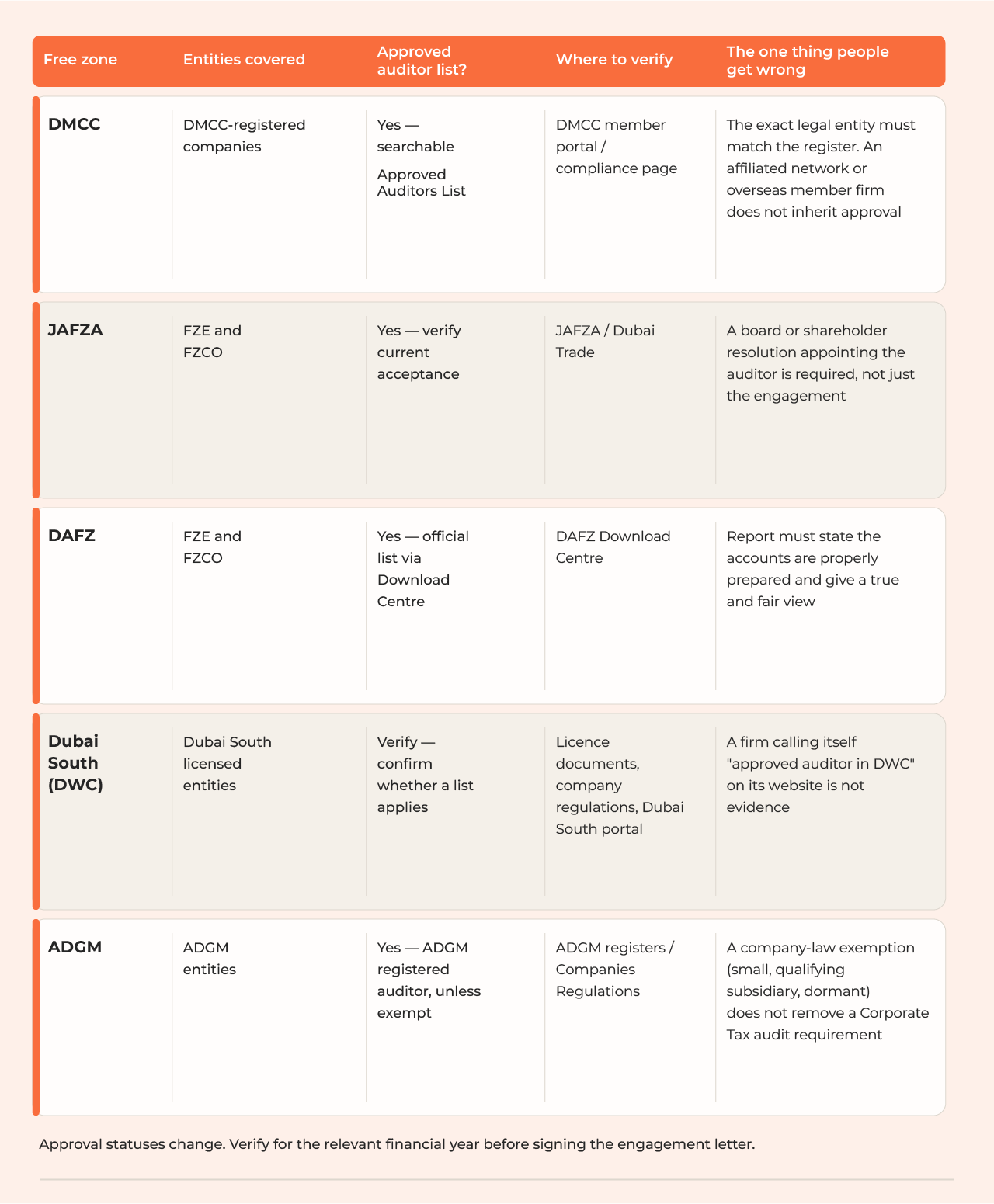
The answer depends on the company’s legal form, licensing jurisdiction, regulatory status and Corporate Tax position.
Under the UAE Commercial Companies Law, every joint-stock company and limited liability company must have one or more auditors to conduct an annual audit of its accounts. Businesses must also maintain accounting records that accurately explain their transactions and financial position. These federal requirements should be considered alongside the rules of the company’s licensing authority. Federal Decree-Law No. 32 of 2021 on Commercial Companies
An audit may also be required because of:
- Free-zone regulations
- Licence renewal requirements
- Corporate Tax requirements
- Qualifying Free Zone Person status
- Bank or lender requirements
- Shareholder agreements
- Group reporting policies
- Investor requirements
- A sale, acquisition or restructuring
- Contractual commitments
Businesses should not assume that an audit is unnecessary simply because they are small, dormant or operating in a free zone. The applicable requirements should be checked against the company’s legal form, licence, constitutional documents and tax status.
What Is an Approved Auditor in Dubai?
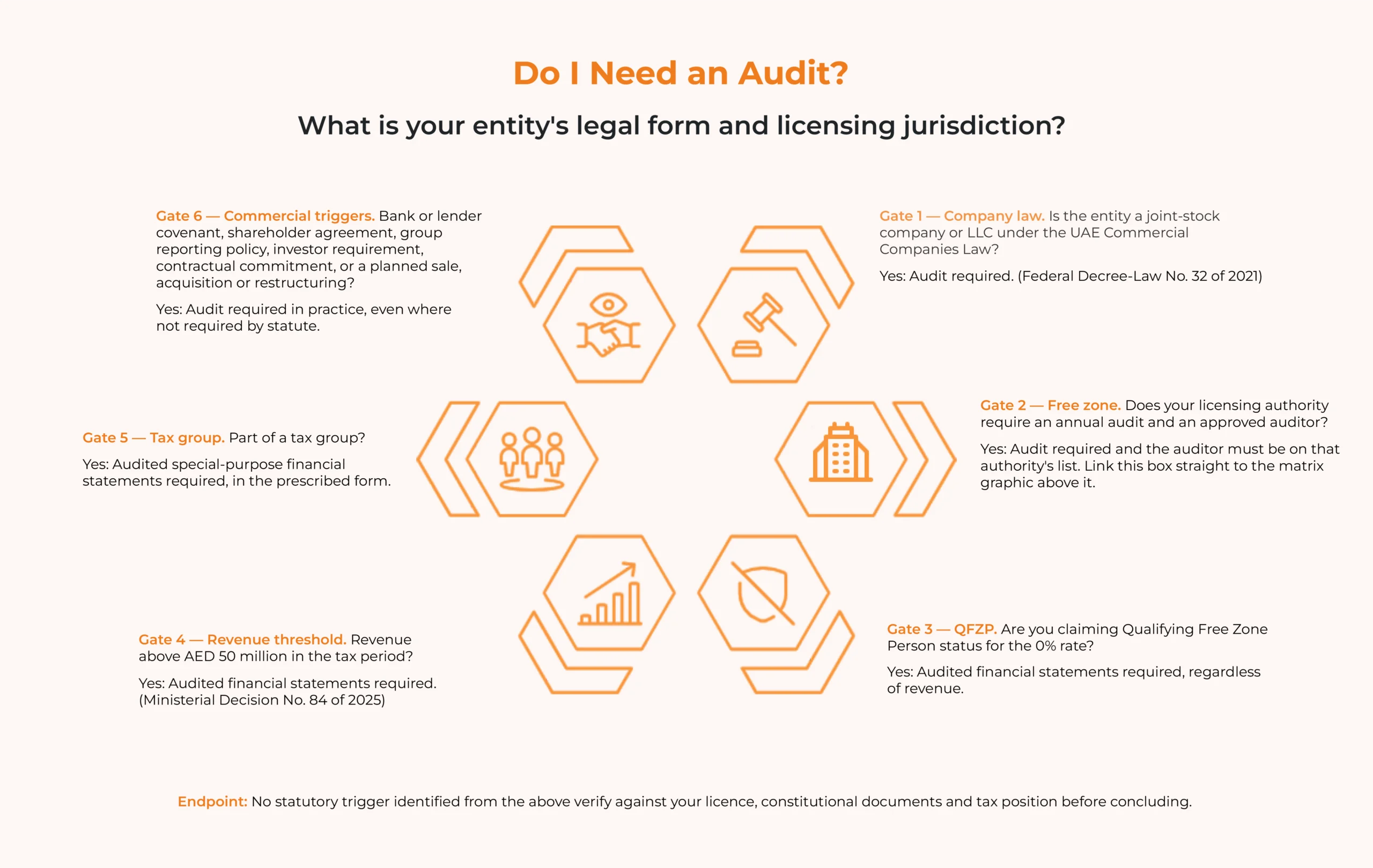
An approved auditor is an audit firm that has been registered, recognised or listed by a particular regulatory or licensing authority to audit entities under that authority’s jurisdiction.
Approval is authority-specific.
A firm appearing on one free zone’s auditor list is not automatically approved by every other free zone. Similarly, being licensed to provide audit services in the UAE does not, by itself, establish that the firm is accepted by DMCC, DAFZ, ADGM or another authority.
This distinction matters because a company may need:
- A UAE-licensed external auditor;
- An auditor approved by its free-zone authority;
- A registered auditor under a separate financial-services regime; or
- A certifying body authorised for a specialist engagement such as ICV certification.
These categories should not be treated as interchangeable.
Approved Auditors in DMCC
DMCC companies should appoint an auditor that meets DMCC’s applicable eligibility and registration requirements.
DMCC maintains company regulations, auditor resources and compliance guidance through its official website. Its current compliance materials include the amended DMCCA Company Regulations 2024 and documentation relating to audited financial statements. DMCC Compliance and Regulations
DMCC also maintains a searchable Approved Auditors List. Companies should verify the audit firm’s current listing directly before making an appointment.
The auditor’s name should match the legal name shown in the official register. A similar trading name, affiliated network or overseas member firm should not be assumed to have the same approval.
DMCC’s service schedule separately provides for appointing or changing an auditor and submitting audited financial reports. DMCC Schedule of Charges
Before appointing a DMCC approved auditor, confirm:
- The firm appears on the current DMCC list
- The exact legal entity shown on the list will issue the report
- The auditor has experience with the company’s activity
- The financial statements will follow the applicable reporting framework
- The auditor can complete the work before the company’s submission deadline
- The engagement includes the reports and documents required by DMCC
The company should confirm its precise filing date through the DMCC member portal or current authority guidance. It should not rely solely on a deadline mentioned in a general online article.
Approved Auditors in JAFZA
JAFZA requires FZE and FZCO entities to provide an updated audit report annually. The company must also pass a resolution appointing the auditor who will prepare the report. JAFZA Audit Report Submission Guide
A JAFZA company should confirm the following before appointment:
- Whether the proposed firm is currently accepted for the relevant entity and engagement
- The required shareholder or board resolution
- The financial year covered by the report
- The submission process through the applicable portal
- Any licence-renewal dependency
- The documents and formats required by JAFZA
Where a business is specifically searching for “approved auditors in JAFZA,” the safest approach is to verify the firm through the current JAFZA or Dubai Trade process before signing the engagement.
A firm’s previous experience with JAFZA companies is useful, but previous work alone is not proof of current approval.
DAFZ Approved Auditors
Dubai Airport Freezone, or DAFZ, expressly states that FZE and FZCO entities registered in the free zone must conduct an annual audit of their financial statements through auditors approved by the authority. DAFZ publishes an official auditor list through its download centre. DAFZ Download Centre
The DAFZ regulations also address the auditor’s report on the company’s annual accounts. Among other matters, the report must state whether the accounts have been properly prepared and whether they give a true and fair view of the company’s financial performance and position. DAFZ Rules and Regulations
When selecting from the DAFZ approved auditors list, assess more than the firm’s inclusion on the register. The firm should also understand:
- The company’s licensed activities
- Import and export transactions
- Related-party and cross-border arrangements
- Inventory and customs documentation
- UAE VAT treatment
- Corporate Tax implications
- Free-zone qualifying-income requirements, where relevant
Approval establishes eligibility. It does not establish that every approved firm has equal experience in the company’s industry.
Approved Auditors in Dubai South or DWC
Businesses frequently use “DWC” when referring to Dubai World Central, now associated with the wider Dubai South ecosystem.
Companies in Dubai South should verify their current audit and submission obligations directly through their licence documents, company regulations and the applicable Dubai South portal. They should also confirm whether the authority requires an auditor from a particular approved or recognised list.
Do not appoint an auditor solely because a website describes the firm as an “approved auditor in DWC.” Ask the firm to provide:
- Its exact registered legal name
- Evidence of current authority acceptance
- The scope of entities covered
- Confirmation that it can issue the required report
- Experience completing Dubai South submissions
Authority lists and registration statuses can change. Verification should be completed for the relevant financial year before the engagement letter is signed.
ADGM Registered Auditors
ADGM has a separate legal and regulatory framework. An audit firm serving a mainland Dubai company or another free zone is not automatically eligible to conduct an ADGM statutory audit.
ADGM guidance states that companies are subject to a statutory audit by an ADGM registered auditor unless the company qualifies for an applicable audit exemption under the ADGM Companies Regulations. Potential exemptions may apply under the small-company, qualifying subsidiary or dormant-company regimes, subject to the relevant conditions. ADGM Annual Accounts Guidance
Even where an exemption may be available under ADGM company law, a separate audit requirement could arise under UAE Corporate Tax or another regulatory obligation.
An ADGM entity should therefore assess:
- Whether it qualifies for a company-law audit exemption
- Whether it intends to claim Qualifying Free Zone Person status
- Whether Corporate Tax rules independently require audited statements
- Whether it is a financial institution or public-interest entity
- Whether its auditor and audit principal hold the relevant ADGM registrations
- Whether consolidated or group accounts are required
ADGM also prescribes specific requirements for annual accounts, including presentation and signing requirements. ADGM Annual Accounts
Audit Requirements Under UAE Corporate Tax
Company-law and free-zone audits are not the only requirements to consider. UAE Corporate Tax can independently require audited financial statements.
Under Ministerial Decision No. 84 of 2025, audited financial statements must be prepared and maintained by:
- A taxable person, other than a tax group, with revenue exceeding AED 50 million during the relevant tax period
- A Qualifying Free Zone Person
- A tax group, which must prepare audited special-purpose financial statements in the prescribed form
The decision applies to tax periods commencing on or after 1 January 2025. Ministerial Decision No. 84 of 2025
The AED 50 million threshold does not remove the audit obligation for a Qualifying Free Zone Person. A free-zone company seeking the 0% Corporate Tax rate on qualifying income must prepare and maintain audited financial statements even when its revenue is below AED 50 million.
External Audit Versus Internal Audit
External and internal audits serve different purposes.
| Area | External Audit | Internal Audit |
| Primary objective | Opinion on financial statements | Evaluation of controls, risks and processes |
| Intended users | Shareholders, regulators, banks and other stakeholders | Board, audit committee and management |
| Independence | Independent of company management | Organisationally independent from the activities reviewed |
| Typical frequency | Annual | Based on a continuous or risk-based plan |
| Main output | Independent auditor’s report | Findings, risk ratings and recommendations |
| Main focus | Material misstatement in financial statements | Controls, governance, fraud risk and operational effectiveness |
An internal audit firm in Dubai may review procurement, revenue, payroll, inventory, cybersecurity, regulatory compliance or other operational areas. It does not replace the statutory external auditor’s opinion.
Audit Firm Versus Accounting Company in Dubai
An accounting company maintains records, prepares reports and may provide bookkeeping, VAT, payroll and management-accounting support.
An audit firm independently examines financial statements and issues an audit opinion where authorised to do so.
The same organisation may offer both accounting and audit services, but independence requirements must be respected. The auditor cannot simply audit its own work where that arrangement would breach applicable ethical or regulatory requirements.
Before appointing an accounting company in Dubai to perform an audit, confirm that:
- The legal entity is licensed for audit work
- The engagement partner is properly authorised
- The firm is accepted by the relevant authority
- No prohibited independence conflict exists
- The audit report will be issued by the correct registered firm
For ongoing finance support, KGRN also provides accounting and bookkeeping services in Dubai.
ICV Certification Agencies and ICV Auditors in Dubai
ICV certification is a specialised engagement and should not be treated as an ordinary statutory audit.
Under the UAE National In-Country Value programme, an ICV certificate must be issued through an authorised ICV certifying body. A business’s regular statutory auditor is not automatically permitted to issue its ICV certificate.
ADNOC states that its ICV certification process is aligned with the UAE’s national framework and requires suppliers to obtain a single ICV certificate through the applicable certification process. ADNOC ICV Programme
Before selecting an ICV certification agency in the UAE, verify:
- That it is currently an authorised ICV certifying body
- Which legal entity will issue the certificate
- Whether the company has audited financial statements in the required form
- The financial period on which the certificate will be based
- The required supplier, payroll and investment information
- The applicable certification validity period
- Whether the certifying body can advise on score improvement without compromising its independence
ICV certification and ICV improvement consulting should also be scoped carefully. The certifying body must remain independent when validating the final submission.
How to Choose the Best Audit Firm in Dubai
There is no single audit firm that is objectively the best for every business.
The best audit firm in Dubai for a company is one that is properly authorised, accepted by the relevant authority and experienced in the company’s industry, reporting framework and regulatory environment.
Use the following criteria to compare audit firms in Dubai.
1. Verify Regulatory Eligibility
Ask the firm which legal entity will sign the audit report.
Then verify that exact name against the relevant authority’s current register or portal. Do not rely only on logos, badges or statements published on the audit firm’s website.
2. Confirm Free-Zone Approval
If the company operates in DMCC, DAFZ, ADGM, JAFZA, Dubai South or another free zone, confirm whether the authority requires an approved or registered auditor.
Approval should be checked for the authority governing the company, not simply for “Dubai” generally.
3. Assess Industry Experience
An audit of a consulting company is different from an audit of a construction contractor, manufacturer, healthcare provider, real estate business or trading company.
Industry experience affects how the auditor evaluates:
- Revenue recognition
- Inventory valuation
- Contract assets and liabilities
- Expected credit losses
- Provisions
- Related-party transactions
- Fixed assets
- Regulatory compliance
Ask the firm for relevant, anonymised examples of similar engagements.
4. Evaluate IFRS Capability
The auditor should be able to identify the standards that materially affect the company.
Depending on the business, these may include:
- IFRS 9 for financial instruments and expected credit losses
- IFRS 15 for revenue from contracts with customers
- IFRS 16 for leases
- IAS 2 for inventories
- IAS 12 for income taxes
- IAS 24 for related-party disclosures
- IAS 36 for impairment
- IAS 37 for provisions and contingencies
A firm that focuses only on matching invoices to ledgers may miss significant accounting and disclosure issues.
5. Check Corporate Tax and VAT Coordination
The audit should not be performed in isolation from tax compliance.
Accounting errors can affect:
- Taxable income
- Deductible expenses
- Related-party pricing
- Free-zone qualifying-income calculations
- Input VAT recovery
- Output VAT reporting
- Tax provisions
- Deferred tax
Ask how the audit team will coordinate with the company’s Corporate Tax and VAT advisers.
6. Understand the Proposed Team
Find out who will actually perform the work.
Request details of:
- Engagement partner
- Audit manager
- Fieldwork team
- Relevant professional qualifications
- Industry experience
- Expected partner involvement
- Escalation process
The firm’s brand is less important than the quality and availability of the assigned team.
7. Review the Audit Plan
A credible proposal should explain:
- Scope of work
- Reporting framework
- Applicable authority
- Information required
- Planned timeline
- Fieldwork approach
- Expected deliverables
- Management responsibilities
- Key exclusions
- Fee assumptions
A one-line quotation without a defined scope makes it difficult to compare firms fairly.
8. Examine Independence
The audit firm should identify financial, business, employment, family or service relationships that could affect its independence.
If the firm also provides accounting, tax or advisory services, ask how it will manage potential conflicts and whether the combined engagement is permitted.
9. Evaluate Communication Quality
Audit issues should be raised early, not one day before the filing deadline.
Ask how the firm communicates:
- Missing information
- Accounting adjustments
- Control weaknesses
- Deadline risks
- Tax issues
- Disagreements with management
- Matters requiring shareholder approval
10. Compare Value, Not Only Fees
The cheapest quotation can become expensive if it leads to missed deadlines, repeated requests, rejected reports or unresolved accounting issues.
Compare:
- Scope
- Team seniority
- Authority experience
- Industry knowledge
- Timeline
- Responsiveness
- Deliverables
- Post-audit support
Choose an Auditor That Fits the Requirement, Not Just the Search Result
Searching for the best audit firms in Dubai can produce a long list of accounting companies, advisory firms and self-declared approved auditors. That list should be the beginning of the selection process, not the final decision.
The right auditor should satisfy four tests:
- Legally eligible to perform the audit;
- Accepted by the relevant licensing or regulatory authority;
- Experienced in the company’s industry and reporting issues; and
- Able to complete a defensible audit within the required timeline.
KGRN Chartered Accountants supports UAE businesses with external audit, internal audit, accounting, Corporate Tax, VAT and related compliance requirements. The engagement can be scoped around the company’s legal structure, licensing authority, financial year and reporting obligations.
Related posts:
 Internal Audit Firms in Dubai: What Businesses Need to Know About the IIA’s 2026 Requirements
 How internal audit improve an organisation’s performance?
 Internal audit firms in UAE
 Importance Of Auditing Financial Statements | Financial Reports | Auditing
 Advantages Of Financial Audit | Financial Audit | Audit Process