
For most UAE SMEs, the statutory audit is not delayed by the audit itself. It is delayed by missing documents, unreconciled balances and decisions that were never recorded.
The stakes are also higher than they were a few years ago. Audited financial statements are no longer only a licensing or shareholder requirement. Under the UAE Corporate Tax regime, they are now the starting point the Federal Tax Authority (FTA) relies on for certain categories of taxpayers.
This guide sets out, in one place, the documents a UAE SME should have ready before audit fieldwork begins, and the legislation that makes each area relevant. Every legal reference in this article is drawn from UAE federal legislation, Ministry of Finance decisions or official FTA communications.
Key Takeaways
- Under Article 27(1) of Federal Decree-Law No. 32 of 2021 on Commercial Companies, every joint stock company and limited liability company must have one or more auditors to audit its accounts annually.
- Article 26 of the same law requires companies to keep accounting records at their headquarters for at least five years from the end of the financial year.
- Ministerial Decision No. 84 of 2025 requires audited financial statements for Corporate Tax purposes from taxable persons (other than Tax Groups) with revenue exceeding AED 50 million, from all Qualifying Free Zone Persons regardless of revenue, and from all Tax Groups.
- Article 56 of the Corporate Tax Law requires records to be kept for seven years following the end of the Tax Period to which they relate.
- Financial statements for Corporate Tax purposes must follow IFRS, or IFRS for SMEs where revenue does not exceed AED 50 million, under Ministerial Decision No. 114 of 2023.
- Free zone companies must also check the company regulations of their own free zone authority, which may set their own audit and filing conditions.
What Is a Statutory Audit?
A statutory audit is an independent examination of a company’s financial statements, carried out by a licensed auditor, that ends in a signed opinion on whether those statements present a true and fair view in accordance with the applicable financial reporting framework.
It differs from an internal audit. An internal audit serves management and is generally voluntary. A statutory audit is required by law, regulation or licence condition, and its report is relied upon by shareholders, regulators, banks and the tax authority.
In the UAE, the auditing and accounting professions are regulated by Federal Decree-Law No. 41 of 2023 on Regulating the Auditing and Accounting Professions, which replaced Federal Law No. 12 of 2014. Onshore, the Ministry of Economy licenses the professionals and firms authorised to provide audit services.
Does Your SME Need a Statutory Audit?
An audit requirement in the UAE can arise from more than one source at the same time. An SME should check each of the following.
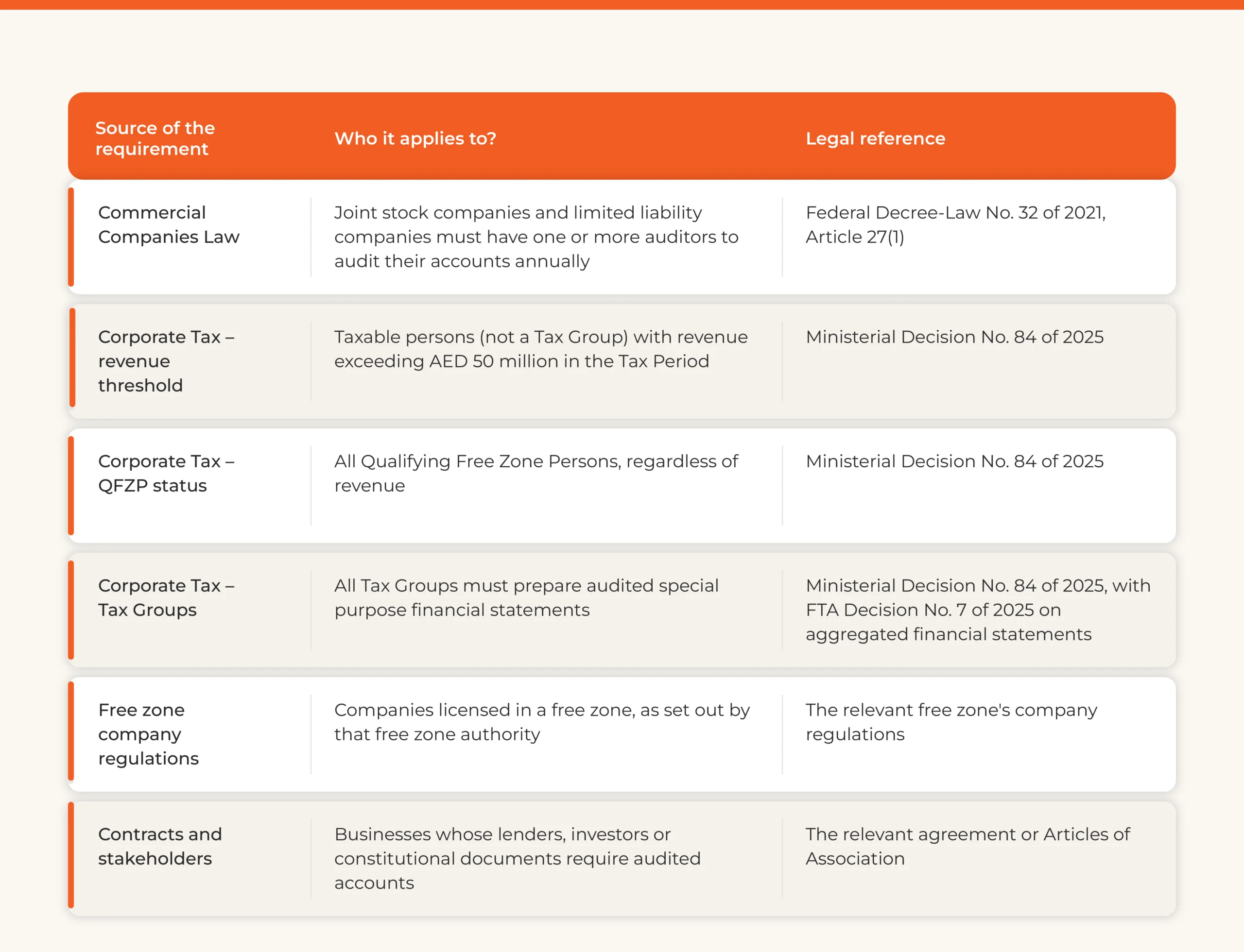
Important timing note: Ministerial Decision No. 84 of 2025 applies to Tax Periods commencing on or after 1 January 2025. It repealed Ministerial Decision No. 82 of 2023, which continues to apply to Tax Periods that commenced before that date.
Non-resident persons: For the AED 50 million test, only revenue derived through a Permanent Establishment or nexus in the UAE is taken into account.
Financial free zones: Companies in the Dubai International Financial Centre (DIFC) and Abu Dhabi Global Market (ADGM) are governed by those centres’ own companies regulations, which contain their own audit rules, including audit exemptions in certain cases. The ADGM exemption does not override the Corporate Tax requirement for a company claiming QFZP status.
For a detailed breakdown of the Corporate Tax audit rules, read our guide: Audited Financial Statements for UAE Corporate Tax: MD 84 Rules Explained.
Before the Checklist: Confirm Your Reporting Framework
Auditors test financial statements against a framework, so the framework must be settled before the year-end close.
Under Ministerial Decision No. 114 of 2023, taxable persons must apply IFRS for Corporate Tax purposes. A taxable person whose revenue does not exceed AED 50 million may apply IFRS for SMEs. The same decision allows the cash basis of accounting only where revenue does not exceed AED 3 million, or in exceptional circumstances on application to the FTA.
For SMEs, this means three practical decisions before the audit:
- Which framework applies to this financial year (IFRS or IFRS for SMEs)?
- Is the framework consistent with the prior year, and if not, has the change been documented?
- If the revenue is close to AED 50 million, has revenue been recognised and cut off accurately at year-end?
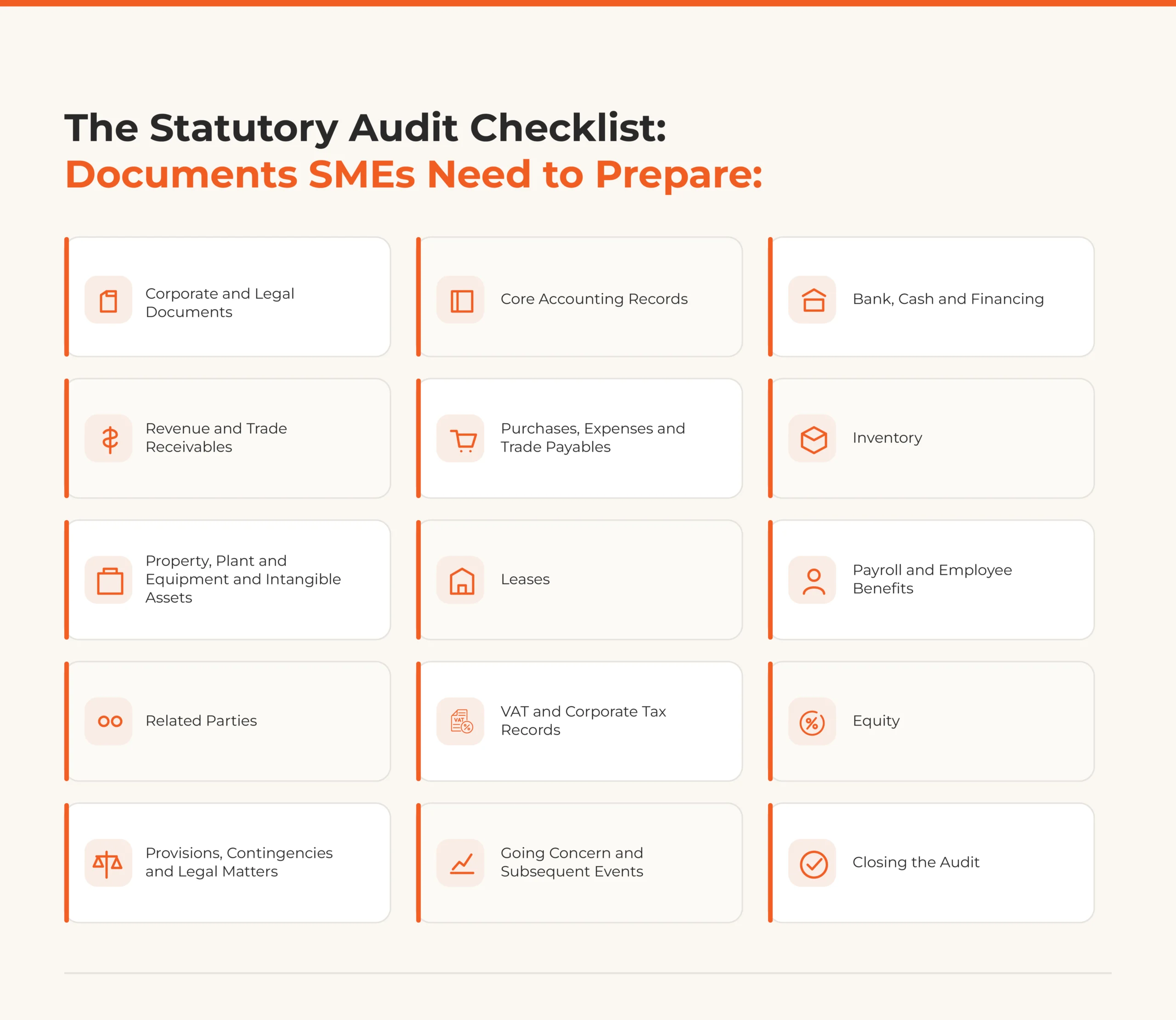
The Statutory Audit Checklist: Documents SMEs Need to Prepare
The checklist below is organised by the audit area. Items marked with an International Standard on Auditing (ISA) reference link to the procedure your auditor is required to perform.
1. Corporate and Legal Documents
These documents establish who the company is, who owns it and who is authorised to act for it.
- Valid trade licence (and any activity-specific approvals or permits)
- Memorandum and Articles of Association, including all amendments
- Certificate of incorporation or registration
- Register of shareholders or partners, and share certificates where issued
- Real Beneficiary (UBO) register and related filings maintained under Cabinet Decision No. 109 of 2023
- Register of directors or managers and their appointment documents
- Shareholder and board resolutions passed during the year, including the appointment of the auditor
- Powers of attorney granted during the year
- Prior-year audited financial statements and auditor’s report
- Prior-year management letter and management’s responses
2. Core Accounting Records
These are the base records from which the financial statements are built. Article 26 of the Commercial Companies Law requires accounting records that give a clear picture of the company’s financial position at any time.
- Final trial balance at year-end, with prior-year comparatives
- General ledger for the full financial year
- Chart of accounts
- Journal listing, including all manual and year-end adjusting entries with supporting evidence
- Draft financial statements: statement of financial position, statement of profit or loss and other comprehensive income, statement of changes in equity, statement of cash flows, and notes
- Mapping of trial balance accounts to financial statement line items
3. Bank, Cash and Financing
Bank balances are among the first areas an auditor confirms directly with third parties.
- Bank statements for every account, covering the full year (including dormant and foreign currency accounts)
- Bank reconciliations at year-end, with evidence of clearance of reconciling items after year-end
- Signed authorisation for the auditor to request bank confirmations (ISA 505)
- Petty cash records and year-end cash count sheet
- Loan and facility agreements, repayment schedules and interest workings
- Details of bank guarantees, letters of credit and any assets pledged as security
- Fixed deposit certificates and interest accruals
4. Revenue and Trade Receivables
Revenue recognition is a significant risk area under ISA 240, so evidence here is tested closely.
- Sales register or revenue listing reconciled to the general ledger
- Sales invoices, customer contracts and purchase orders
- Delivery notes or service completion evidence, especially around year-end (cut-off)
- Credit notes issued during the year and after year-end
- Trade receivables ageing report at year-end
- Customer statements and contact details for receivable confirmations (ISA 505)
- Expected credit loss (ECL) or bad debt provision workings under IFRS 9 or IFRS for SMEs
- Revenue recognition analysis for material contracts under IFRS 15 (where full IFRS applies)
5. Purchases, Expenses and Trade Payables
- Purchase register reconciled to the general ledger
- Supplier invoices, contracts and purchase orders
- Trade payables ageing report at year-end
- Supplier statements and reconciliations for major suppliers
- Accruals schedule with supporting calculations
- Prepayments schedule with supporting documents
- Invoices received after year-end (to test for unrecorded liabilities)
6. Inventory
For trading and manufacturing SMEs, inventory is often the largest balance on the statement of financial position.
- Year-end stock count instructions and signed count sheets
- Confirmation that the auditor was invited to attend the physical count (ISA 501), or arrangements agreed in advance
- Inventory valuation workings (cost formula applied consistently)
- Net realisable value assessment and provision for slow-moving or obsolete stock
- Goods-in-transit and consignment stock details
- Third-party warehouse confirmations, where stock is held externally
7. Property, Plant and Equipment and Intangible Assets
- Fixed asset register reconciled to the general ledger
- Invoices and approvals for additions during the year
- Disposal documents, sale proceeds and gain or loss workings
- Depreciation and amortisation schedules, with useful life policies
- Title deeds, vehicle registration documents and other ownership evidence
- Impairment assessment, where indicators exist
- Capital commitments at year-end
8. Leases
- All tenancy and lease contracts in force during the year (including Ejari registration for Dubai properties)
- Right-of-use asset and lease liability workings under IFRS 16 (where full IFRS applies), or lease accounting workings under IFRS for SMEs
- Discount rate basis and lease modification records
9. Payroll and Employee Benefits
- Payroll register for the full year, reconciled to the general ledger
- Salary transfer records under the Wage Protection System (WPS)
- Employment contracts for key staff and headcount listing at year-end
- End-of-service gratuity provision workings, based on Federal Decree-Law No. 33 of 2021 on the Regulation of Labour Relations or the applicable free zone employment regulations
- Leave and air ticket accrual workings, where applicable
- Pension contribution records for UAE national employees, where applicable
10. Related Parties
Related party transactions are a focus area for both auditors (ISA 550) and the FTA under the arm’s length rules of the Corporate Tax Law.
- Complete list of related parties and connected persons
- Agreements for all related party transactions
- Year-end related party balances, with confirmations
- Shareholder or director loan agreements and their terms
- Transfer pricing documentation and benchmarking, where the business is required to maintain it
- Workings supporting the related party disclosures in the Corporate Tax return, where applicable
11. VAT and Corporate Tax Records
The audit and the tax position now rely on the same numbers, so these records should reconcile to the accounts.
- VAT registration certificate
- VAT returns filed for all periods in the financial year
- Reconciliation of VAT returns to revenue and expenses in the general ledger
- VAT payable or recoverable reconciliation at year-end
- Corporate Tax registration certificate
- Corporate Tax computation and prior-year Corporate Tax return
- Current and deferred tax workings, where applicable
- For QFZPs: analysis separating qualifying and non-qualifying income, and supporting evidence of adequate substance in the free zone
- For Tax Groups: documents supporting the aggregated financial statements required under FTA Decision No. 7 of 2025
- Correspondence, assessments or clarifications received from the FTA
12. Equity
- Evidence of capital contributions and changes in share capital
- Resolutions approving dividends or profit distributions
- Statutory reserve workings, where required by the company’s constitutional documents or applicable law
- Current accounts of partners or shareholders
13. Provisions, Contingencies and Legal Matters
- Schedule of legal cases, claims and disputes
- Contact details for the company’s lawyers, so the auditor can seek legal confirmations
- Provision workings under IAS 37 (or the equivalent section of IFRS for SMEs)
- Details of guarantees given, penalties and regulatory notices
14. Going Concern and Subsequent Events
- Management’s going concern assessment covering at least twelve months from the reporting date (ISA 570)
- Budgets and cash flow forecasts supporting that assessment
- Board or management minutes held after year-end
- Details of significant events after year-end, such as new financing, major contracts or losses (ISA 560)
15. Closing the Audit
- Responses to the auditor’s queries, with supporting evidence
- Approved adjustments posted to the final trial balance
- Signed management representation letter (ISA 580)
- Financial statements approved by those charged with governance
Record Retention: How Long to Keep These Documents
| Requirement | Minimum retention period | Legal reference |
| Accounting records under company law | At least 5 years from the end of the financial year, kept at the company’s headquarters | Federal Decree-Law No. 32 of 2021, Article 26 |
| Corporate Tax records (Taxable Persons and Exempt Persons) | 7 years following the end of the Tax Period to which they relate | Federal Decree-Law No. 47 of 2022, Article 56 |
The FTA has also reminded businesses that the records to be kept include the record of transactions in the Tax Period, assets (including purchases and disposals), liabilities, and shares held at the end of the Tax Period, and that failure to keep required records attracts administrative penalties.
Practical baseline: Because the Corporate Tax period is the longer of the two, most SMEs should plan their document retention around seven years.
Regulatory Changes SMEs Should Not Miss
Ministerial Decision No. 84 of 2025 replaced Ministerial Decision No. 82 of 2023.
The decision applies to Tax Periods commencing on or after 1 January 2025. Its most significant change is that all Tax Groups must now prepare audited special purpose financial statements, regardless of the Tax Group’s revenue.
Economic Substance Regulations no longer apply to recent years.
Cabinet Decision No. 98 of 2024 limited the Economic Substance Regulations to financial years from 1 January 2019 to the year ending 31 December 2022. ESR notifications and reports are no longer required for financial years ending after 31 December 2022. Documents for the 2019–2022 period should still be retained.
The audit profession law has been updated.
Federal Decree-Law No. 41 of 2023 now regulates the auditing and accounting professions, replacing Federal Law No. 12 of 2014. SMEs should confirm that their auditor holds a valid licence under the current framework and, for free zone companies, that the auditor is accepted by the relevant free zone authority.
Common Documentation Gaps That Delay SME Audits
Unreconciled bank accounts, particularly foreign currency and inactive accounts.
No supporting evidence for year-end journals, such as accruals and provisions.
Missing fixed asset register, or a register that does not agree to the ledger.
Undocumented related party balances, including shareholder current accounts with no written terms.
VAT returns that do not reconcile to revenue in the financial statements.
No stock count records, or counts carried out without notifying the auditor.
Gratuity provisions not updated for salary changes and new joiners.
Auditor appointment not formally recorded in a shareholder or board resolution.
Each of these can be resolved during the year. None of them can be resolved quickly during fieldwork.
How KGRN Supports SMEs Through the Statutory Audit
KGRN works with SMEs across the UAE mainland and free zones to deliver independent, ISA-based statutory audits that stand up to scrutiny from shareholders, banks, free zone authorities and the FTA.
Our approach starts before fieldwork. We share a tailored document request aligned to your legal form, free zone and Corporate Tax status, so your team knows exactly what is needed and when. The result is fewer queries, fewer adjustments and a timely audit report.