


Healthcare organisations in the UAE should not treat eInvoicing as a finance-system upgrade to be handled shortly before the deadline.
For hospitals, clinics, laboratories, pharmacies, medical suppliers and healthcare groups, implementation can affect several connected processes: patient billing, insurer and third-party administrator (TPA) claims, corporate contracts, procurement, credit notes, VAT classification, accounts receivable, accounts payable and data governance.
The UAE eInvoicing framework is already live for voluntary adoption. Mandatory implementation begins on 1 January 2027 for businesses with annual revenue of AED 50 million or more. For healthcare organisations in that first phase, the practical question is no longer whether to prepare. It is whether their systems, data and controls can produce and receive compliant structured invoices without disrupting billing or collections.
This guide explains what healthcare leaders should assess now. For an overview of how KGRN approaches these projects, see our UAE eInvoicing services for healthcare providers.
What UAE eInvoicing actually means
An eInvoice is not a PDF invoice sent by email. Ministerial Decision No. 243 of 2025 defines an Electronic Invoice as an invoice issued, transmitted and received in a structured electronic format that enables automatic and electronic processing. The same definition applies to Electronic Credit Notes. A scanned document, a Word file or a PDF attached to an email therefore does not meet the definition, even if it contains every required particular.
Under the UAE’s Decentralised Continuous Transaction Control and Exchange model, commonly described as the five-corner model, an invoice moves through the following stages:
The five-corner model:
- The supplier sends invoice data from its system to its accredited service provider. The invoice originates in the supplier’s own billing, ERP or accounting system. For a healthcare provider, this may be the revenue-cycle platform, the ERP or a combination of both.
- The service provider validates and converts the data into the required UAE standard where necessary. The supplier’s accredited service provider (ASP) checks the invoice data against the UAE specification before it is exchanged.
- The invoice is transmitted to the buyer through the buyer’s accredited service provider. The buyer does not receive the invoice directly from the supplier’s system. It receives it through its own appointed ASP.
- Tax data is reported to the Federal Tax Authority. Ministerial Decision No. 243 of 2025 requires both the issuer and the recipient to report Electronic Invoices and Electronic Credit Notes to the FTA within the timeline prescribed by the Minister.
- Status messages confirm whether exchange and reporting were successful. These messages allow each party to know whether an invoice has been accepted, and they are the starting point for any exception handling.
The UAE framework uses PINT AE, the UAE invoice data specification based on the Peppol International Invoice model. A healthcare organisation does not connect directly to the FTA for invoice exchange. Ministerial Decision No. 243 of 2025 requires both the issuer and the recipient to fulfil their exchange and reporting obligations through the appointment of an accredited service provider.
The organisation must therefore appoint an ASP and integrate that provider with its relevant billing, ERP or accounting environment. The Ministry of Finance publishes the list of accredited service providers on its eInvoicing portal. Our guide to the role of a pre-approved ASP in UAE eInvoicing explains how the provider fits into the five-corner model.
Is healthcare within the scope?
Yes. Ministerial Decision No. 243 of 2025 applies to any person conducting business in the UAE in respect of every business transaction, unless the person or transaction is specifically excluded. The excluded transactions listed in Article 4 relate to government entities acting in a sovereign capacity and not in competition with the private sector, specified airline passenger and cargo services, and financial services that are exempt or zero-rated under Article 42 of the VAT Executive Regulation. Healthcare is not listed as an excluded sector under the current eInvoicing legislation.
However, one distinction is essential:
Business-to-consumer transactions are currently outside the mandatory eInvoicing system until a future ministerial decision brings them into scope. Ministerial Decision No. 244 of 2025 defines a business-to-consumer transaction as one between a person carrying on business and a recipient who is a natural person not carrying on business. It also provides that a person engaged exclusively in such transactions is not currently subject to the system.
This means a clinic’s invoice directly to an individual patient acting as a consumer is not currently subject to mandatory eInvoicing. Healthcare organisations must still identify the transactions that are B2B or B2G and therefore potentially in scope. The following flows typically need to be reviewed.
Invoices to insurers, TPAs and corporate customers.
These are business counterparties, so the invoices raised to them may fall within scope. Whether a particular invoice is in scope depends on the legal identity of the buyer and the contractual billing arrangement, which is why the contract should be reviewed rather than assumed.
Services supplied under employer or corporate healthcare contracts.
Where an employer or corporate client contracts with a provider for services delivered to its employees, the commercial relationship may be between the provider and the corporate client rather than with each individual patient.
Intercompany and shared-service charges within healthcare groups.
Charges between group entities, such as management fees, shared-service recharges or centrally procured supplies, are transactions between businesses and must be considered in the scoping exercise.
Laboratory, radiology or other outsourced services supplied to another healthcare business.
When one healthcare business provides services to another, rather than directly to a patient, the recipient is a business and the transaction may be B2B.
Sales by pharmaceutical, medical device and healthcare suppliers to business customers.
Suppliers selling to hospitals, clinics, pharmacies and distributors are making business-to-business supplies and should assess their own obligations as issuers. Pharmaceutical manufacturers and distributors can find sector-specific guidance in our article on eInvoicing for the pharmaceutical industry in the UAE.
Invoices issued to government entities.
Supplies to government bodies are business-to-government transactions and form part of the scoping exercise.
Supplier invoices received by hospitals, clinics and healthcare groups.
eInvoicing is not only about issuing invoices. Ministerial Decision No. 243 of 2025 requires recipients to process Electronic Invoices and Electronic Credit Notes through the Electronic Invoicing System, so the purchasing side of a healthcare organisation is equally affected.
Do not classify the transaction only by who pays. The contract, recipient of the supply, invoice recipient and underlying flow must be reviewed together.
UAE eInvoicing deadlines healthcare organisations should track
| Entity category | Deadline to appoint an accredited service provider | Mandatory implementation date |
| Revenue of AED 50 million or more | 30 October 2026 | 1 January 2027 |
| Revenue below AED 50 million | 31 March 2027 | 1 July 2027 |
| Government entities | 31 March 2027 | 1 October 2027 |
Voluntary implementation began on 1 July 2026.
The ASP appointment deadline for the first phase was originally 31 July 2026 under Ministerial Decision No. 244 of 2025. Ministerial Resolution No. 66 of 2026 moved it to 30 October 2026, but left the 1 January 2027 implementation date unchanged. The extension adds time for provider selection. It does not delay go-live, as the Ministry of Finance confirmed when announcing the amendment.
The revenue threshold is based on gross income earned during the most recent accounting period, using the entity’s financial statements or other documentation acceptable to the FTA. Groups should not assume that a consolidated revenue figure automatically settles the position of every legal entity. Scope and timing should be assessed entity by entity against the legislation and current guidance.
Why healthcare readiness is more complex than standard invoicing

1. One care journey can create several financial flows
A single episode of care may involve a patient, healthcare provider, insurer, TPA, employer, pharmacy and outsourced laboratory. The eInvoice flow must reflect the actual supplier and buyer relationship. It should not simply copy the operational claim flow.
An insurance e-claim and a tax eInvoice are not automatically the same document. Existing claim platforms may continue to manage clinical approvals, coding and adjudication, while the eInvoicing system manages structured commercial invoice exchange and tax reporting. The two processes must reconcile.
2. VAT treatment is not uniform
Qualifying healthcare services supplied by a licensed provider and related to the wellbeing of a human being may be zero-rated, subject to the conditions in the UAE VAT legislation. That does not mean every healthcare-related supply is zero-rated.
The FTA has clarified, in its public clarification VATP016, that a B2B healthcare service is not zero-rated merely because the ultimate patient receives healthcare. Where the recipient of the supply is not the patient receiving the treatment, the supply may be subject to VAT at the standard rate. Cosmetic services, administrative charges, non-qualifying products and other supplies may also have different treatments.
This makes tax mapping a core eInvoicing control. Each relevant service, item, fee, discount and adjustment should carry a documented VAT treatment supported by the contract and supply flow.
3. Credit notes are frequent and operationally sensitive
Healthcare billing often changes after insurer adjudication, coding review, package reconciliation or eligibility checks. Under Article 6 of Ministerial Decision No. 243 of 2025, an electronic credit note is required where a transaction is cancelled, where the agreed consideration is reduced, where consideration is returned in full or in part, or where an administrative or numerical error occurs.
Healthcare providers should map how claim rejections, partial approvals, resubmissions and contractual adjustments affect the original invoice. A rejected insurance claim does not, by itself, determine the correct tax-document response. The accounting and tax consequence must be established. For a detailed walkthrough of reason codes and invoice references, read our guide on how to issue credit notes and debit notes under UAE eInvoicing.
4. Data is distributed across several systems
The information needed for a compliant invoice may sit across the hospital information system, electronic medical record, revenue-cycle or claims platform, pharmacy or laboratory system, ERP and customer master.
If these systems use different customer names, tax registration numbers, legal entities, transaction identifiers or VAT codes, structured invoice validation and reconciliation can fail even when the PDF currently looks correct.
5. Privacy must be designed into the data flow
Tax invoices require sufficient information to describe the supply, but a healthcare organisation should not transmit unnecessary clinical or personal data through an eInvoice.
The implementation team should determine what information belongs in the eInvoice, what remains in the clinical record or e-claim, and how reference numbers can connect the records without exposing unnecessary patient information. This matters because Ministerial Decision No. 243 of 2025 gives the FTA the power to access and use data processed and stored under the Electronic Invoicing System. Tax compliance, data protection, cybersecurity and contractual confidentiality should be reviewed together.
A seven-step healthcare eInvoicing readiness plan
Step 1: Establish scope by legal entity and transaction flow
Create an inventory of every legal entity in the group, including hospitals, clinics, pharmacies, laboratories, procurement entities and management companies. For each entity, record:
- Revenue and phase. Record revenue for the most recent accounting period, which decides the entity’s phase under Ministerial Decision No. 244 of 2025.
- VAT registration. eInvoicing applies whether or not the entity is registered. For registrants, however, invoices must also meet the VAT Law timeline.
- Revenue streams. Split revenue into B2B, B2G and B2C, so it is clear which revenue is inside the mandate today.
- Volumes, peak periods and systems. Record invoice volumes and peak periods, and the systems that issue and receive invoices.
- Major counterparties. List the main insurers, TPAs, corporates and government bodies.
The output should be a scope matrix, not an assumption that the whole group follows one date.
Step 2: Map end-to-end invoice journeys
Map each flow from service delivery or dispatch through invoicing, claims, payment, credit notes and ledger posting. Start with the highest-risk flows:
- Insurer and TPA billing. This is where claims and invoice adjustments interact most often.
- Corporate contracts and outsourced diagnostics. In both, the recipient of the supply determines scope and VAT treatment.
- Pharmacy and medical-supply sales, intercompany charges and government billing.
- Supplier invoices. These matter because recipients must process eInvoices through the system.
For each flow, note who creates, approves, changes and posts the invoice, and how failures are resolved today.
Step 3: Separate e-claim requirements from eInvoice requirements
Define which data the claims process needs, which data the tax eInvoice needs, and the reference fields that link the two. The organisation should be able to answer these questions:
- When did the transaction occur? Ministerial Decision No. 243 of 2025 defines this as the earlier of the transaction date or the payment date. The eInvoice must be issued within 14 days of that date, subject to the VAT Law timeline for registrants.
- Who is the legal recipient of the supply? The answer drives both B2B/B2C classification and zero-rating.
- What event triggers the invoice?
- Does claim approval change the consideration, or only payment certainty?
- When is a credit note required? Article 6 lists four cases: cancellation, reduced consideration, returned consideration, and an administrative or numerical error.
- How will claim, invoice and payment values be reconciled?
Step 4: Validate VAT and master-data mapping
Check customer and supplier masters for legal name, address, tax identifiers and entity type. Changes to data registered with the FTA must be notified to the ASP in writing within five business days of the FTA confirming them.
Then map each service, product and adjustment to its VAT treatment. Pay particular attention to these areas:
- Healthcare services. Zero-rating applies only where Article 41 of the VAT Executive Regulation is met.
- B2B healthcare arrangements. Under VATP016, zero-rating applies only where the recipient of the supply is also the patient.
- Medicines and medical equipment. These are zero-rated only if listed in the relevant Cabinet decision.
- Cosmetic and elective services. These fall outside the zero-rating provisions.
- Other items to map:
- bundled packages;
- discounts, rebates and co-payments;
- intercompany supplies;
- reverse-charge transactions.
Do not leave VAT selection to free text or manual judgement. The Ministry’s mandatory fields guidance requires codes that many systems do not yet capture, such as transaction type and credit note reason codes.
Step 5: Assess systems and integration readiness
Confirm that your systems can generate the mandatory data, connect to an ASP, receive invoices and status messages, and keep a full audit trail. The assessment should cover:
- which system owns each mandatory field;
- the interface between healthcare billing systems and the ERP;
- invoice numbering and duplicate prevention;
- linking each credit note to its original invoice;
- handling of rejections and resubmissions;
- foreign-currency invoices and AED tax reporting;
- processing of received invoices;
- access controls and change management;
- storage of all eInvoice data within the UAE, as required by Article 11 of Ministerial Decision No. 243 of 2025.
Step 6: Select an accredited service provider on operational fit
Price should not be the only criterion. Test each provider on:
- transaction volumes;
- ERP and healthcare-system integration;
- security;
- reporting;
- service levels;
- exception handling.
The provider must appear on the Ministry of Finance’s published list. KGRN’s eInvoicing ASP services in Dubai page outlines what implementation support covers.
Run a proof of concept with protected real-world scenarios:
- a standard invoice;
- a zero-rated invoice;
- mixed supplies;
- a credit note;
- a rejected message and its corrected resubmission.
Step 7: Test controls and operational resilience
Testing should show that finance, tax, IT and revenue-cycle teams can resolve failures without disrupting care or collections. At a minimum, test:
- invalid buyer data;
- incorrect VAT classification;
- an ASP or interface outage;
- duplicate invoices;
- a credit note issued against the wrong invoice;
- mismatches between claim and invoice values;
- rejected supplier invoices;
- reconciliation between the ERP, ASP records and tax reporting.
Article 12 of Ministerial Decision No. 243 of 2025 requires issuers and recipients to notify the FTA of a System Failure within two business days. A documented detection, escalation and notification procedure must therefore be in place before go-live.
How KGRN can support healthcare eInvoicing readiness
KGRN can support hospitals, clinics, laboratories, pharmacies, medical suppliers and healthcare groups across each stage of eInvoicing readiness.
We begin with entity-level scope and deadline assessment, confirming which phase applies to each legal entity in your group, and B2B, B2G and B2C transaction classification, so that in-scope flows are clearly separated from those currently outside the mandate.
Our healthcare VAT and invoice-flow review examines how your services, products and adjustments are treated for VAT and how invoices move through your organisation. Alongside this, a PINT AE data-gap assessment identifies where your current systems do not yet capture the data the UAE specification requires.
We also carry out a billing, ERP and control-readiness review to assess whether your systems and controls can support compliant issuance and receipt, and provide accredited service provider evaluation support so that your selection is based on operational fit as well as price.
As implementation approaches, we help design testing scenarios and reconciliation controls that reflect real healthcare billing situations, and provide implementation governance and post-go-live assurance to confirm that the process continues to operate as intended.
You can learn more about our end-to-end UAE eInvoicing solution and our healthcare eInvoicing readiness services.
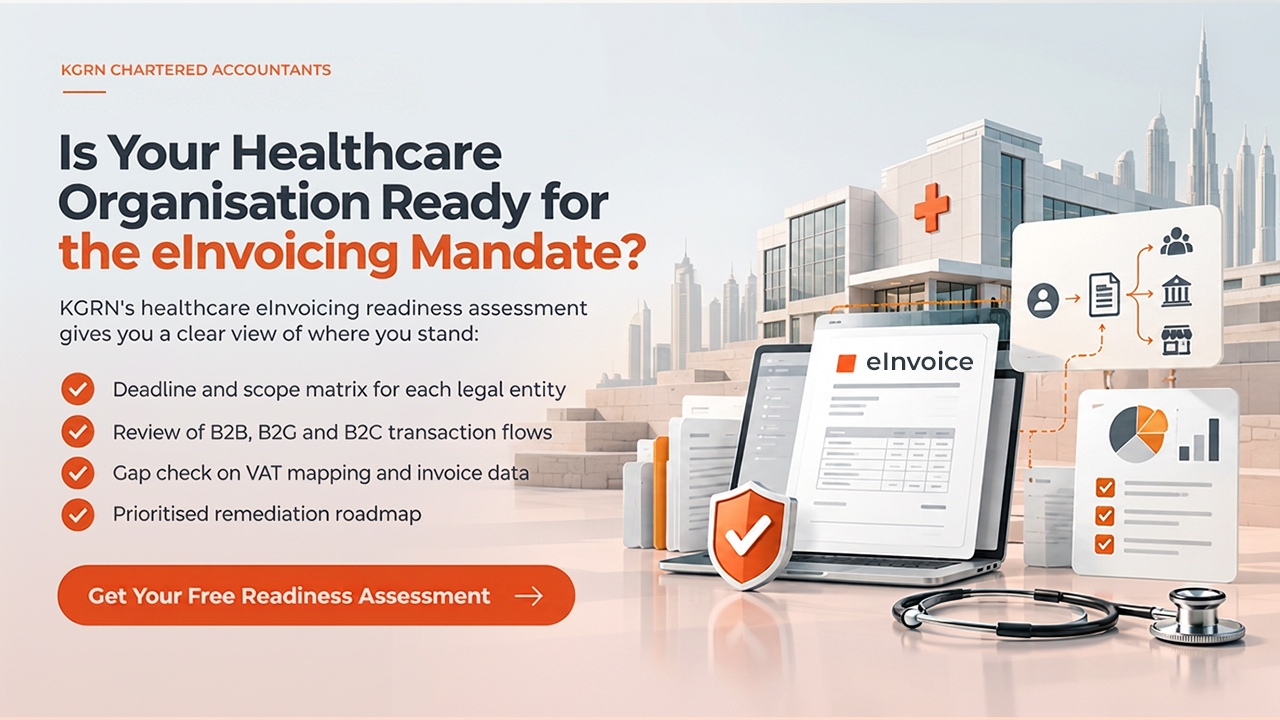
If your organisation has not yet completed a healthcare-specific eInvoicing readiness assessment, now is the time to identify gaps before they become implementation blockers.
Related posts:
 UAE eInvoicing Readiness Checklist: What to Check Before You Go-Live
 Credit Notes and Invoice Adjustments Under UAE eInvoicing
 UAE eInvoicing Guide 2026 – Everything Businesses, CFOs & ERP Teams Need to Know.
 The Role of Pre-Approved ASP in UAE eInvoicing
 UAE E-Invoicing: Regulatory Clarifications & Practical Compliance Insights