


IFRS 18 changes how companies structure and explain financial performance. One of its most important requirements is the classification of income and expenses into operating, investing and financing categories in the statement of profit or loss.
For UAE finance teams, implementation requires more than adding three headings to the income statement. Each material item must be traced to its underlying asset, liability or transaction. Companies must also reassess broad lines such as “other income” and “finance costs”, determine whether investing or providing finance is a main business activity, and document significant judgements.
Incorrect classification may not change profit for the year, but it can distort operating profit and profit before financing and income taxes. These defined subtotals will become important indicators of performance under IFRS 18.
This guide explains how the IFRS 18 income statement categories work, where common items belong and what UAE companies should do before adoption.
For the standard’s scope, effective date, transition requirements and principal differences from IAS 1, read KGRN’s IFRS 18 in UAE guide.
IFRS 18 effective date and scope
IFRS 18, Presentation and Disclosure in Financial Statements, replaces IAS 1. It applies to entities preparing financial statements under IFRS Accounting Standards for annual reporting periods beginning on or after 1 January 2027. Earlier application is permitted.
The standard must be applied retrospectively. A company with a 31 December year-end will therefore generally need to present its 2026 comparative statement of profit or loss using the IFRS 18 structure when issuing its 2027 financial statements.
IFRS 18 mainly changes presentation and disclosure. It does not generally change how transactions are recognised or measured under other IFRS Accounting Standards. Reclassifying an amount between operating, investing and financing does not, by itself, change profit for the year.
The categories also should not be confused with operating, investing and financing activities in the statement of cash flows. Although the labels are similar, IFRS 18 and IAS 7 apply different classification objectives and requirements.
The five IFRS 18 income statement categories
Income and expenses included in profit or loss must be classified into five categories:
- Operating
- Investing
- Financing
- Income taxes
- Discontinued operations
The income taxes category contains tax income and expenses included in profit or loss under IAS 12, together with related foreign exchange differences. The discontinued operations category contains income and expenses from discontinued operations under IFRS 5.
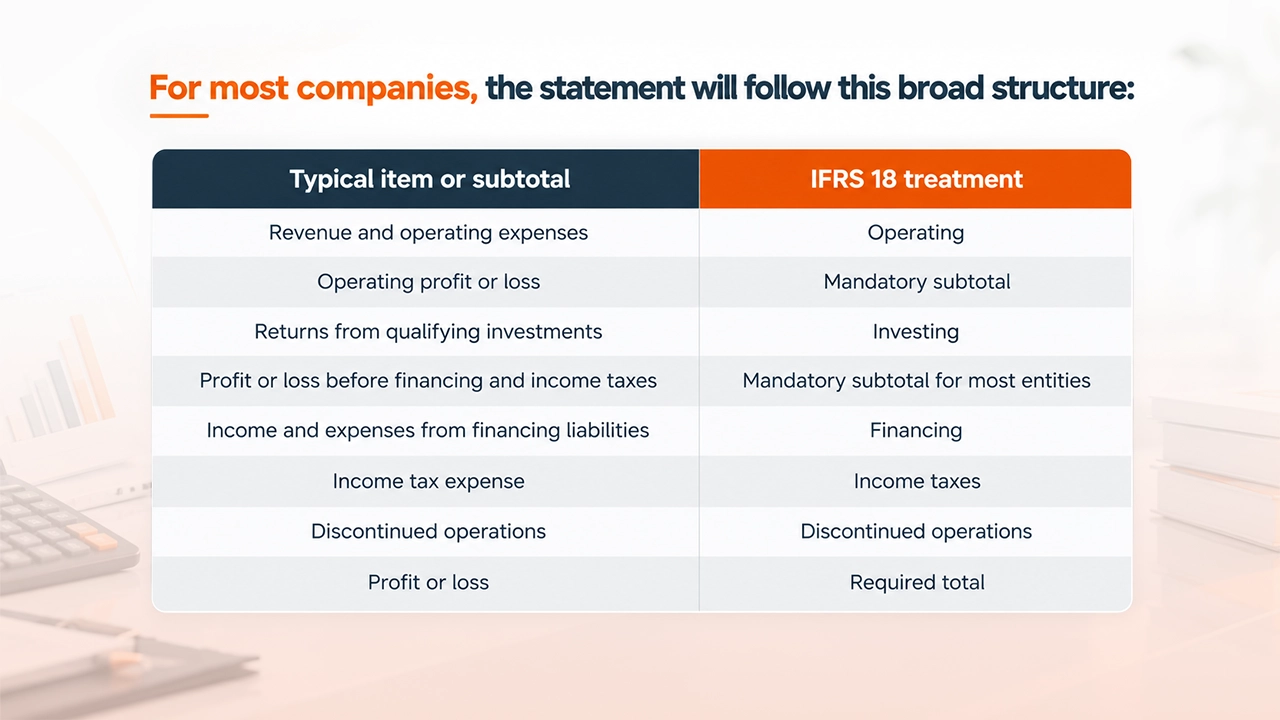
The two central defined subtotals are:
- Operating profit or loss: all income and expenses classified as operating.
- Profit or loss before financing and income taxes: operating profit or loss combined with all income and expenses classified as investing.
Under IAS 1, companies could present operating profit without applying a standardised definition. IFRS 18 establishes a consistent basis for calculating it, improving comparison between companies and reporting periods.
First determine the company’s main business activities
Before classifying individual items, a company must determine whether it has either of these specified main business activities:
- Investing in particular types of assets as a main business activity
- Providing financing to customers as a main business activity
This matters because an item that is investing or financing for an ordinary trading company may be operating for a bank, finance company, insurer or investment-focused entity.
For example, interest on a debt investment may be investing for a manufacturer. Interest earned on customer loans will normally be operating for a bank or automotive finance company whose main business includes providing customer finance.
Whether an activity is a main business activity is a matter of fact, not a management designation. Evidence may include:
- How the company describes its business externally
- How management measures and reports performance
- The importance and continuity of the activity
- Segment information reported under IFRS 8
- How resources are allocated
The assessment is made for each reporting entity. A subsidiary and its consolidated group can therefore reach different conclusions.
Operating category under IFRS 18
Operating is the residual category. It contains all income and expenses not classified as investing, financing, income taxes or discontinued operations. For most companies, it will capture income and expenses arising from their main operations.
For a trading, service or manufacturing company, operating items will commonly include:
- Revenue from customers
- Cost of sales and inventory write-downs
- Employee, selling and administrative expenses
- Depreciation and impairment of operational assets
- Expected credit losses on trade receivables and contract assets
- Gains or losses on the disposal of operating assets
- Restructuring and litigation expenses connected with operations
- Interest on trade receivables or contract assets
- Certain income and expenses arising from business combinations
Operating does not mean recurring
An item cannot be excluded from operating merely because it is unusual, volatile, non-recurring, large or outside management’s control.
For example, if a manufacturer’s factory is destroyed by fire, the loss may be exceptional in size and frequency. However, the factory was used with other resources to generate operating returns. The loss therefore remains operating, subject to the applicable IFRS requirements.
Material items may require separate presentation or disclosure, but IFRS 18 does not create an “extraordinary” category.
| Item | Likely category for a typical non-financial company | Reason |
| Customer revenue | Operating | Arises from business operations |
| Depreciation of a factory | Operating | Factory works with other resources to generate returns |
| Expected credit loss on trade receivables | Operating | Receivables arise from operating activity |
| Restructuring cost | Operating | Being unusual does not change its category |
| Gain on disposal of production equipment | Operating | Relates to an operating asset |
Investing category under IFRS 18
The investing category is narrower than the everyday meaning of “investment”. It captures returns from specified assets, particularly those generating returns individually and largely independently of the company’s other resources.
Income and expenses enter the investing category through three principal gateways:
- Investments in associates, joint ventures and unconsolidated subsidiaries
- Cash and cash equivalents
- Other assets generating returns individually and largely independently
The treatment is subject to the special rules for specified main business activities.
The independent-return test
The central question is whether an asset generates a return individually and largely independently of other resources. The return does not need to be positive. An asset producing a loss can still meet the test.
Assets that may qualify include:
- Portfolio equity investments
- Debt investments such as bonds and notes
- Investment property held to earn rentals or capital appreciation
- Certain other financial assets
- Cash and cash equivalents
Assets that generally fail the test include inventory, trade receivables, factories, operating machinery, head-office assets and intangible assets used with other resources to supply goods or services. Related income and expenses will generally be operating.
When the underlying asset qualifies, investing income and expenses may include:
- Interest and dividends
- Rental income
- Fair value gains and losses
- Depreciation of qualifying investment property
- Impairment losses and reversals
- Disposal or derecognition gains and losses
- Incremental costs directly attributable to acquisition or disposal
Income and expenses from associates, joint ventures and unconsolidated subsidiaries generally fall within investing. The share of profit or loss and impairment of equity-accounted associates and joint ventures remain investing even when investing in assets is a main business activity.
| Item | Likely category for a typical non-financial company |
| Share of profit from an equity-accounted associate | Investing |
| Dividend from a portfolio investment | Investing |
| Interest on an investment bond | Investing |
| Rental income from passive investment property | Investing |
| Fair value gain on passive investment property | Investing |
| Depreciation of an owner-occupied office | Operating |
Financing category under IFRS 18
The financing category explains the effect of liabilities used to finance the company. However, not every expense labelled “interest” or “finance cost” automatically belongs there.
The company must first determine whether the liability arises from a transaction involving only the raising of finance.
Pure financing liabilities
A liability generally falls within this group when the company receives finance in the form of cash, the extinguishment of a financial liability or its own equity instruments, and will later return cash or its own equity instruments.
Typical examples include bank borrowings, bonds, notes and certain shareholder loans. Income and expenses from the initial and subsequent measurement and derecognition of these liabilities generally enter financing, subject to the detailed requirements of IFRS 18 and other applicable Standards.
Other liabilities
Some liabilities arise because the company received goods, services, labour, the use of an asset or another non-financing benefit. These include:
- Trade payables
- Lease liabilities
- Contract liabilities with a significant financing component
- Defined-benefit pension liabilities
- Decommissioning and restoration provisions
For these liabilities, financing generally includes separately identified interest income or expense and qualifying effects of changes in interest rates. Other movements relating to the same liability normally remain operating unless another requirement applies.
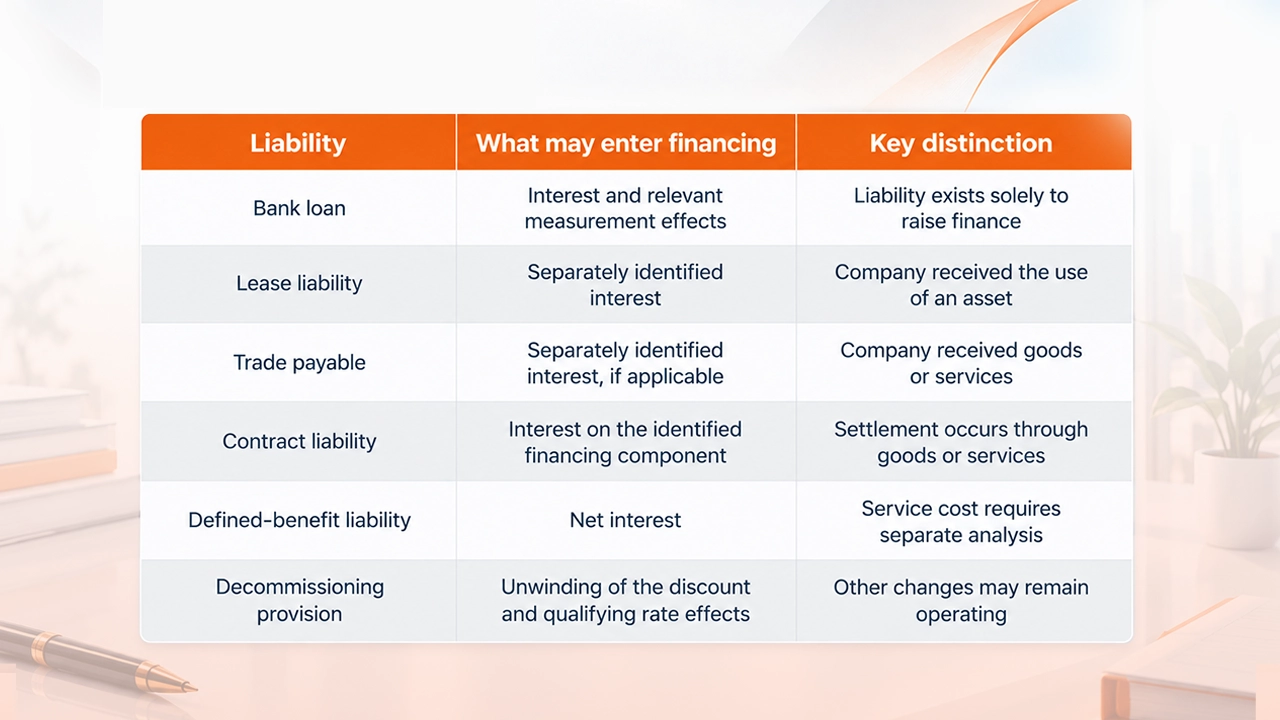
This is why companies should not move a broad “finance costs” account wholesale into financing. Its components may require different classifications.
Foreign exchange and derivatives
Foreign exchange differences generally follow the category of the income and expenses arising from the underlying item:
- FX on a trade receivable is generally operating.
- FX on an investment bond generally follows investing.
- FX on a borrowing generally follows financing.
- FX related to income tax balances is classified as income taxes.
IFRS 18 contains a practical requirement where allocating an FX difference would involve undue cost or effort. Companies should assess that provision rather than treating all exchange differences as financing.
Derivative gains and losses generally follow the category of the income and expenses affected by the risk being managed. A derivative managing an operating commodity exposure will generally be operating, while one managing the interest-rate risk of a financing liability will generally be financing. Specific requirements apply to designated hedges, derivatives managing multiple risks and cases involving undue cost or effort.
IFRS 18 classification decision framework
Apply the following sequence to each material class of income and expense:
- Identify tax and discontinued operations. Determine whether IAS 12 or IFRS 5 directs the item to one of those categories.
- Assess main business activities. Document whether the reporting entity invests in relevant assets or provides customer financing as a main business activity.
- Identify the source. Trace the amount to its underlying asset, liability or transaction rather than relying on the ledger label.
- Test the investing gateways. Consider associates, joint ventures, unconsolidated subsidiaries, cash and independently generating assets.
- Test the liability. Determine whether it arose solely from raising finance. If not, identify any separately recognised interest or interest-rate effect.
- Analyse FX and derivatives. Link them to the underlying exposure.
- Classify remaining items as operating. Do not exclude an item merely because it is unusual or non-recurring.
Common classification errors
- Treating operating profit as recurring or normalised profit
- Classifying every interest item as financing
- Treating every investment return as investing without assessing the business model
- Applying IAS 7 cash-flow categories to the income statement
- Mapping “other income”, “finance costs” or “FX” without analysing components
- Assuming the group and every subsidiary have identical main business activities
- Assuming presentation changes automatically alter taxable income
IFRS 18 reclassification does not, by itself, alter UAE Corporate Tax treatment. Corporate Tax remains determined under UAE tax legislation using accounting income and the required tax adjustments. Clear reconciliation between the ledger, financial statements and tax return remains important.
What UAE companies should do now
A calendar-year company will generally need IFRS 18-compatible 2026 comparatives. Finance teams should therefore:
- Inventory all material income and expense lines.
- Break down other income, other expenses, finance costs and FX accounts.
- Document specified main business activities with supporting evidence.
- Map material amounts to the relevant assets, liabilities or transactions.
- Separate mixed accounts in the chart of accounts or reporting layers.
- Review leases, payables, provisions, pensions and customer-financing arrangements.
- Link FX and derivative results to their underlying exposures.
- Prepare a parallel IFRS 18 income statement using 2026 data.
- Discuss material judgements with the external auditor before year-end.
KGRN’s IFRS advisory services in the UAE can support impact assessment, classification mapping, accounting-position papers and comparative preparation. Companies preparing for assurance can also review KGRN’s external audit services in the UAE.
Related posts:
 UAE Corporate Tax Group Formation: Eligibility, Process & Deadlines
 UAE Valuation Rules in 2026: Business Valuation, Property and Transfer Pricing
 FTA Decision No. 6 of 2026 Explained: The New AUP Report Requirement for Free Zone Distributors
 Taxable Person as per Corporate Tax Law in UAE
 Significant CD, MD, and FTA Decisions related to Corporate Tax in UAE