
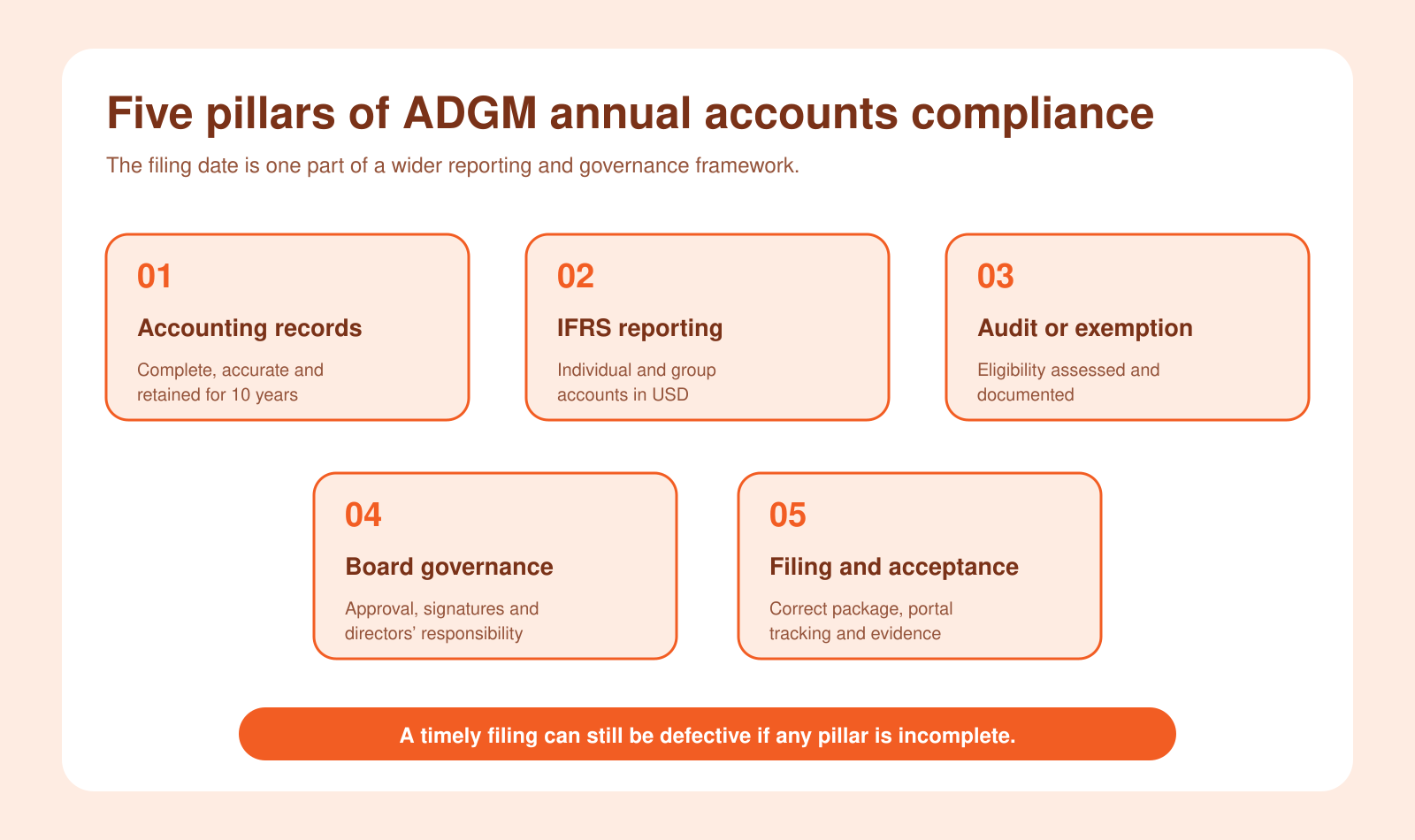
Annual accounts are not simply documents submitted after the financial year closes. For companies established in Abu Dhabi Global Market, they form part of a wider statutory framework covering financial reporting, audit, governance, record-keeping and regulatory compliance.
The directors are responsible for ensuring that the accounts are properly prepared, approved and filed. The financial statements must comply with the applicable reporting framework, present the required information in US dollars and, unless an exemption applies, be audited by an ADGM Recognised Auditor. The filing also needs to align with the entity’s legal form, group structure, regulated status and UAE Corporate Tax position.
This is why focusing only on the deadline is insufficient. A company may file on time and still face questions if the accounts are incomplete, incorrectly signed, prepared under the wrong framework or supported by an audit that does not meet ADGM requirements.
This guide explains the complete annual accounts framework for ADGM companies and LLPs in 2026, including the regulations, reporting obligations, audit requirements, exemptions, filing process and management actions. KGRN Chartered Accountants supports ADGM entities with IFRS reporting, statutory audit and filing readiness through its external audit services in ADGM.
The regulatory framework for ADGM annual accounts
The principal requirements arise from the ADGM Companies Regulations 2020 and the rules and guidance issued by the ADGM Registration Authority. LLPs are subject to the corresponding Limited Liability Partnership framework. Financial services firms may also have additional obligations under Financial Services Regulatory Authority rules.
The framework places responsibility on directors and relevant officers to:
- maintain adequate accounting records;
- prepare annual accounts for each financial year;
- ensure that the accounts provide a fair representation of the entity’s financial position and performance;
- prepare group accounts where required;
- arrange a statutory audit unless an exemption is available;
- approve and sign the accounts correctly; and
- deliver the required documents to the Registration Authority within the applicable filing period.
These are related but separate obligations. Outsourcing the accounting function or appointing an auditor does not transfer the directors’ statutory responsibility.
Who must prepare and file ADGM annual accounts?
Generally, every ADGM company and Limited Liability Partnership must file annual accounts with the Registration Authority.
The position differs for certain structures:
| Entity type | General annual accounts position |
| Private company | Must prepare and generally file annual accounts |
| Public company | Must prepare and file, with a shorter filing period |
| Limited Liability Partnership | Must prepare and generally file annual accounts |
| Restricted Scope Company | Generally not required to file unless directed by the Registrar |
| Branch | Must maintain accounting records but is not generally required to file them annually with the Registrar |
| Foundation | Must maintain accounting records but is not generally required to file them annually with the Registrar |
| Dormant company | Must generally file accounts, although an audit exemption may be available |
| Private unlimited company | May be exempt from filing where the regulatory conditions are met |
The legal form should be verified before a company concludes that no filing is required. Labels such as “SPV”, “holding company”, “dormant” or “non-operational” do not automatically determine the outcome.
An ADGM SPV incorporated as a company will generally remain within the accounts framework. If it controls another entity, it may also need to assess group reporting and consolidation requirements.
What accounting records must an ADGM company maintain?
Every company must maintain records that are sufficient to show and explain its transactions, disclose its financial position with reasonable accuracy and enable the directors to prepare compliant annual accounts.
The records should include:
- money received and paid;
- invoices, contracts, bank records and electronic transfers;
- assets and liabilities;
- supporting documentation for material transactions;
- stock records where the company deals in goods; and
- records needed to support group accounts where the entity is a parent.
Accounting records must generally be preserved for 10 years from the date they are made. If records are held outside ADGM, the company must ensure that the required accounts and returns are made available within ADGM in accordance with the regulatory requirements and remain open to inspection by its officers.
Weak bookkeeping cannot be corrected solely through the year-end audit. Companies should maintain a controlled monthly close, reconcile bank and intercompany balances and preserve supporting evidence throughout the year. KGRN’s accounting services in Abu Dhabi can support entities that require ongoing ledger and reporting assistance before the audit begins.
How must ADGM financial statements be prepared?
ADGM individual and group accounts must be prepared in accordance with the applicable International Accounting Standards framework. ADGM guidance links this framework to current and future standards and interpretations issued or adopted by the International Accounting Standards Board, which issues IFRS Accounting Standards.
Annual accounts generally include:
- the company’s ADGM registration number;
- the registered office address;
- the company’s legal status and form;
- a statement of profit or loss;
- a statement of financial position;
- notes to the financial statements;
- group accounts where consolidation is required;
- a directors’ report, unless a valid exemption applies; and
- an auditor’s report, unless the company is exempt from audit.
The directors must not approve the accounts unless they are satisfied that the financial statements fairly represent the assets, liabilities, financial position and profit or loss of the company. For a group, this assessment extends to the undertakings included in the consolidation.
Currency and presentation requirements
Amounts in annual accounts filed with ADGM must be shown in US dollars. A company may also present a translation into another relevant currency, but the additional presentation does not replace the USD requirement.
The balance sheet must be signed by a director on behalf of the board and state the director’s name. For audited accounts, the directors’ report must be signed by a director or company secretary and identify the signatory.
The Registration Authority may return accounts that do not satisfy the formal requirements. The entity should retain both the submission acknowledgment and evidence of acceptance.
ADGM audit requirements in 2026
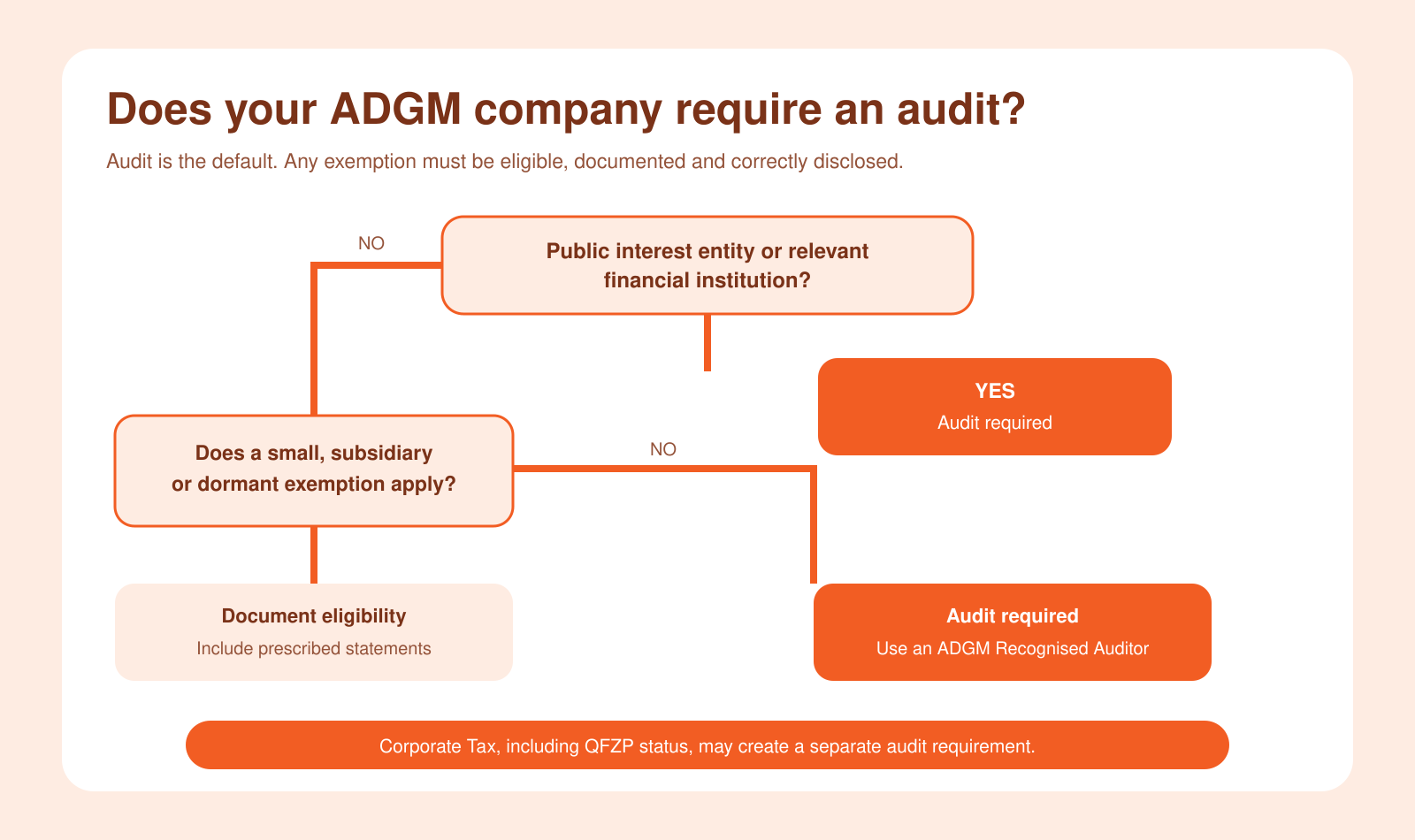
The default position under the Companies Regulations 2020 is that annual accounts must be audited unless a statutory exemption applies. Where an audit is required, it must be performed by an auditor recognised or registered by ADGM.
The audit is not limited to checking whether totals agree. It considers whether the financial statements have been properly prepared under the applicable reporting framework and whether they provide a fair representation of the company’s financial position and performance.
Common areas requiring management judgement include:
- revenue recognition;
- valuation and impairment;
- related-party transactions and balances;
- going-concern assessment;
- provisions and contingencies;
- lease accounting;
- investments and financial instruments;
- consolidation and group boundaries; and
- events occurring after the reporting date.
Appointing the auditor after the accounts are drafted can create avoidable problems, particularly where inventory observation, external confirmations, valuation evidence or group reporting must be planned in advance. KGRN’s ADGM Recognised Auditor services cover audit planning, IFRS review, fieldwork, reporting and filing-document readiness.
When can an ADGM company claim an audit exemption?
ADGM provides audit exemptions for certain small companies, qualifying subsidiaries and dormant companies. Each exemption has conditions and documentation requirements.
Small-company exemption
A standalone company generally meets the size conditions for the small-company regime if both of the following apply:
- annual turnover is not more than USD 13.5 million; and
- the average number of employees is not more than 35.
Meeting these thresholds does not automatically establish entitlement. Public interest entities, financial institutions other than eligible FinTech Participants and companies within certain ineligible groups cannot use the small-company regime. A parent company or group member must consider the applicable group thresholds and eligibility rules.
Where the exemption is used, the balance sheet must contain the prescribed statements confirming the entitlement, the members’ position and the directors’ responsibilities.
Subsidiary-company exemption
An eligible subsidiary may claim exemption where the statutory conditions are met. These include circumstances in which an ADGM parent provides the relevant guarantee and the subsidiary is included in consolidated accounts submitted to the Registration Authority.
Dormant-company exemption
A dormant company may qualify for exemption from audit where it has had no significant accounting transactions and satisfies the other requirements under the Companies Regulations. Dormancy does not generally remove the duty to file annual accounts. The accounts must also include the required exemption statements.
How UAE Corporate Tax affects the audit conclusion
The ADGM audit analysis should not be completed in isolation. UAE Corporate Tax legislation may require audited financial statements even where an exemption is available under ADGM regulations.
This is particularly relevant for an ADGM entity that is, or intends to be, a Qualifying Free Zone Person. The UAE Corporate Tax framework requires a QFZP to prepare and maintain audited financial statements regardless of revenue. Tax Groups and taxable persons exceeding the applicable revenue threshold may also have separate audit requirements.
Consequently, an ADGM company may reach two different conclusions:
- it is eligible for an ADGM statutory audit exemption; but
- it still requires audited financial statements to satisfy its Corporate Tax position.
Management should document both assessments. Read KGRN’s guide to audited financial statements for UAE Corporate Tax for the federal requirements.
What documents are filed with the Registration Authority?
The filing package depends on the entity’s size, legal form, activities and exemption status. It will commonly include:
- signed annual financial statements;
- the independent auditor’s report where an audit is required;
- the directors’ report where applicable; and
- a board resolution approving the accounts.
A qualifying small company may file a reduced set of information. However, reduced disclosure and audit exemption are separate questions. The financial statements and balance sheet must contain the relevant statutory wording where an exemption or simplified regime is used.
Before filing, management should verify:
- the exact legal name and ADGM registration number;
- the reporting period and ARD;
- USD presentation;
- comparative information;
- director and auditor signatures;
- the applicable exemption statements;
- consistency between individual and group accounts; and
- board approval and the supporting resolution.
ADGM annual accounts filing deadline 2026
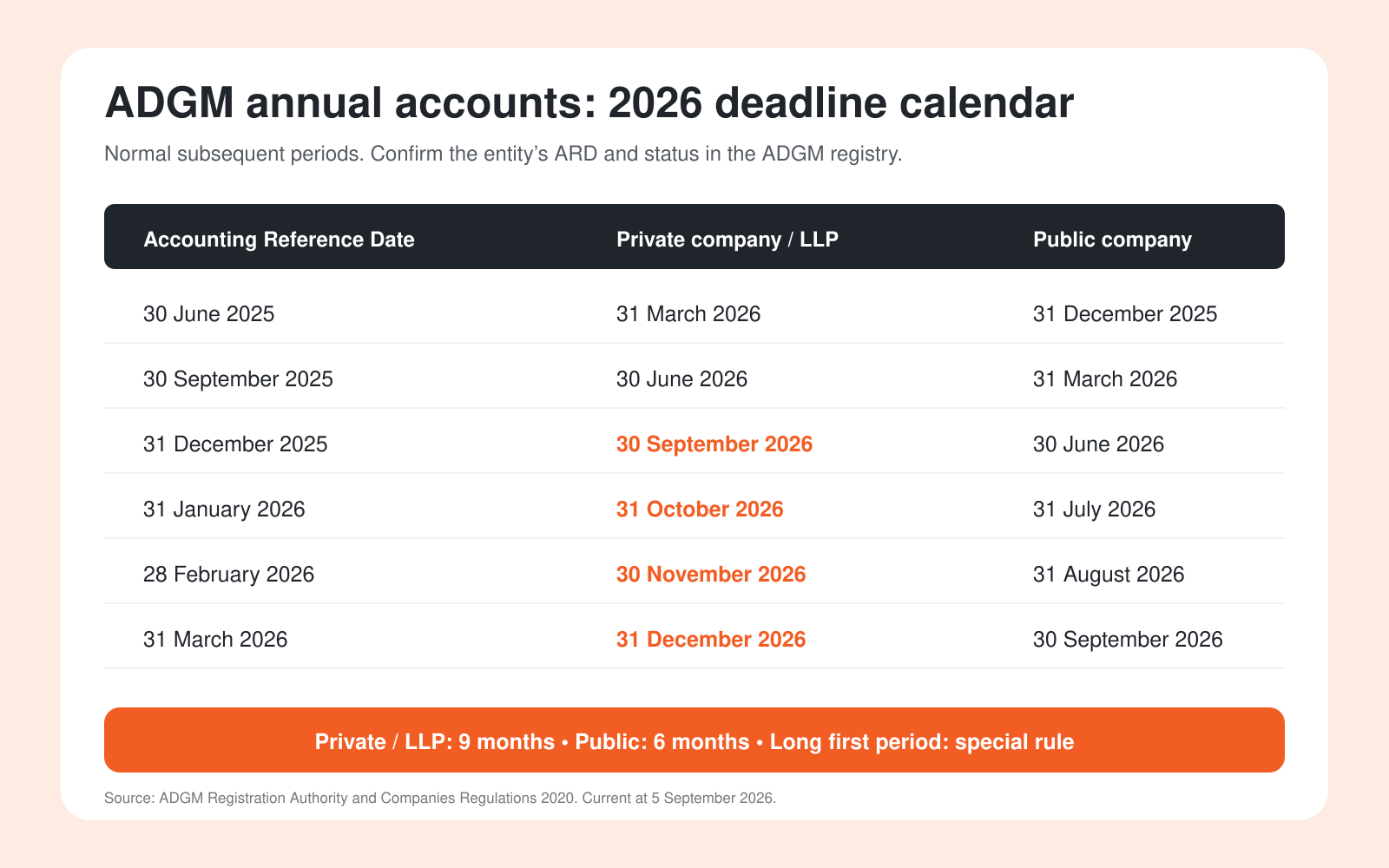
The deadline is calculated from the Accounting Reference Date, not from the commercial licence renewal date or the anniversary of incorporation, except where the special first-period rules apply.
For second and subsequent accounting periods:
- private companies generally file within nine months after the ARD;
- public companies generally file within six months; and
- LLPs generally follow the nine-month timetable described by ADGM.
Long first accounting periods
Where the first accounting reference period exceeds 12 months, the filing period ends on the later of:
- nine months for a private company, or six months for a public company, from the first anniversary of incorporation; and
- three months after the end of the accounting reference period.
The entity should therefore calculate a long first-period deadline separately rather than applying the standard ARD formula.
Annual accounts are separate from other ADGM and tax filings
| Obligation | Purpose | Deadline basis |
| Annual accounts | Financial performance, position and statutory reports | Accounting Reference Date |
| Confirmation statement or annual return | Updates and confirms registry information | Separate annual registry cycle |
| Commercial licence renewal | Renews permission to conduct the licensed activity | Licence expiry date |
| Corporate Tax return | Reports federal taxable income and tax liability | Tax period end |
Completing one filing does not satisfy the others. Management should maintain a consolidated compliance calendar with a separate owner, deadline and acceptance record for each obligation.
Can the ADGM annual accounts filing deadline be extended?
The Registrar may approve an extension where a special reason exists, generally involving an unforeseen event outside the company’s control. The application must be made before the existing deadline and supported by a complete explanation and evidence.
An extension may be granted for up to three months, but cannot extend the filing period beyond 12 months after the end of the relevant accounting period. If approval has not been received before the ordinary deadline, ADGM guidance requires the company to file by the ordinary deadline. An application does not suspend the existing obligation.
Consequences of late or defective filing
The ADGM Registration Authority has stated that non-compliance may result in regulatory action, including financial penalties of up to USD 15,000 against the company, LLP, director or partner, and possible cancellation of the commercial licence.
Continued default may affect the entity’s good standing and access to registry services. Where the Registrar believes the company is no longer carrying on business or operating, it may also be struck off the register and dissolved.
Defective accounts can also create operational consequences even where the initial submission was made before the deadline. This reinforces the need for adequate time to complete review, approval, signatures, portal submission and any requested revisions.
Common ADGM annual accounts filing issues
The most frequent weaknesses arise before the portal stage:
- the audit was initiated too late;
- the company relied on an exemption without documenting eligibility;
- the QFZP audit requirement was not considered;
- accounts were presented only in AED rather than USD;
- group and standalone accounts were not properly distinguished;
- related-party balances were not reconciled;
- the balance sheet or directors’ report was not correctly signed;
- the board resolution was missing;
- the wrong reporting period was used; or
- the submission acknowledgment was retained without confirming acceptance.
These issues are best addressed through an annual reporting timetable agreed before the financial year closes.
Practical readiness plan for management
Before the financial year-end
Confirm the ARD, entity status, group structure, applicable reporting framework and audit requirement. Appoint an ADGM Recognised Auditor early enough to plan inventory observations, confirmations and specialist work.
During the financial close
Complete reconciliations, related-party confirmations, impairment assessments, revenue recognition analysis, going-concern evaluation and consolidation. Prepare the accounts under IFRS with the required USD presentation.
Before board approval
Resolve audit matters, review disclosures and verify the filing package. Directors should understand the material judgements and confirm that the financial statements provide a fair representation of the entity’s position and performance.
Before portal submission
Check all signatures, names, dates, reports, exemption wording and the board resolution. File through the ADGM Online Registry Solution, retain the acknowledgment and monitor the filing until acceptance.
How KGRN supports ADGM annual accounts compliance
KGRN Chartered Accountants is an ADGM Recognised Auditor with an Abu Dhabi presence. Its ADGM services include:
- annual accounts and audit-requirement assessment;
- IFRS financial statement preparation support;
- statutory audit by an ADGM Recognised Auditor;
- small-company, subsidiary and dormant exemption assessment;
- group reporting and related-party review;
- QFZP and Corporate Tax audit alignment;
- review of board and filing documents; and
- support with Registration Authority queries.
For related requirements, see KGRN’s external audit services in the UAE and corporate tax services in Abu Dhabi.