On 30 September 2024, The Federal tax Authority in UAE included key provisions in the VAT regulations for the introduction and implementation of electronic invoicing (e-invoicing).
To establish a groundwork for e-invoicing, the UAE government amends certain provisions on the VAT Law and Tax Procedures Law by issuing Federal Decree-Law No. 16 of 2024 and Federal Decree-Law No. 17 of 2024, respectively.
E-invoicing Framework in UAE
On 30 October 2024, The UAE Ministry of Finance later launched an official portal for the e-Invoicing programme with basic information, including the overview of the e-invoicing regime and FAQ Section. The phase-1 of e-invoicing will be set into effect on July 2026 for B2B and B2G transactions.
The e-invoicing framework is yet to be launched soon, business need to be prepared by learning about the e-invoicing regulations and adapt to the transformation. In this article, let us provide the brief overview of this new e-invoicing system in UAE, key requirements, timelines, and practical measures to be taken by businesses and government organisations in UAE to acclimate to this transition.
The Objectives of The e-invoicing System
E-invoicing is one of the significant initiatives towards digitalization of the tax system under the “E-Billing System”. By July 2026, e-Invoicing UAE will be mandatory for B2B and B2G transactions.
The objective of this e-invoicing system:
- Streamline invoicing processes
- Reduce usage of paper
- Ensure compliance with tax regulations
Timeline for e-invoicing in UAE:
The estimated date of implementation of e-invoicing was July 2025 but due to technical challenges, it has been postponed to July 2026.
During the Dubai E-invoicing Exchange Summit in 2024, the Ministry of Finance (MoF) in UAE declared additional information on the implementation of the timeline and model.
The proposed timeline for the e-invoicing implementation is as follows:
Q4 2024: Development of accreditation procedures for UAE service providers and data dictionary.
Q2 2025: Issuance of e-invoicing related legislation
July 2026: Phase 1 go-live of e-invoicing reporting
What is e-invoicing?
E-invoicing is the process of issuing, receiving and processing invoices electronically between a supplier and a buyer. Unlike traditional invoices, invoices are exchanged in a machine-readable format in e-invoicing process, ensuring efficiency and accuracy in any transaction.
How e-Invoicing Will Work in UAE:
The e-Invoicing framework is implemented on a 5-corner Decentralized Continuous Transaction Control and Exchange (DCTCE) model based on PEPPOL (Pan-European Public Procurement On-Line) which is also called as 5-corner PEPPOL model. This PEPPOL network enhances cross-border interoperability by enabling seamless communication and document sharing between enterprises by ensuring systemized invoice processing across businesses.
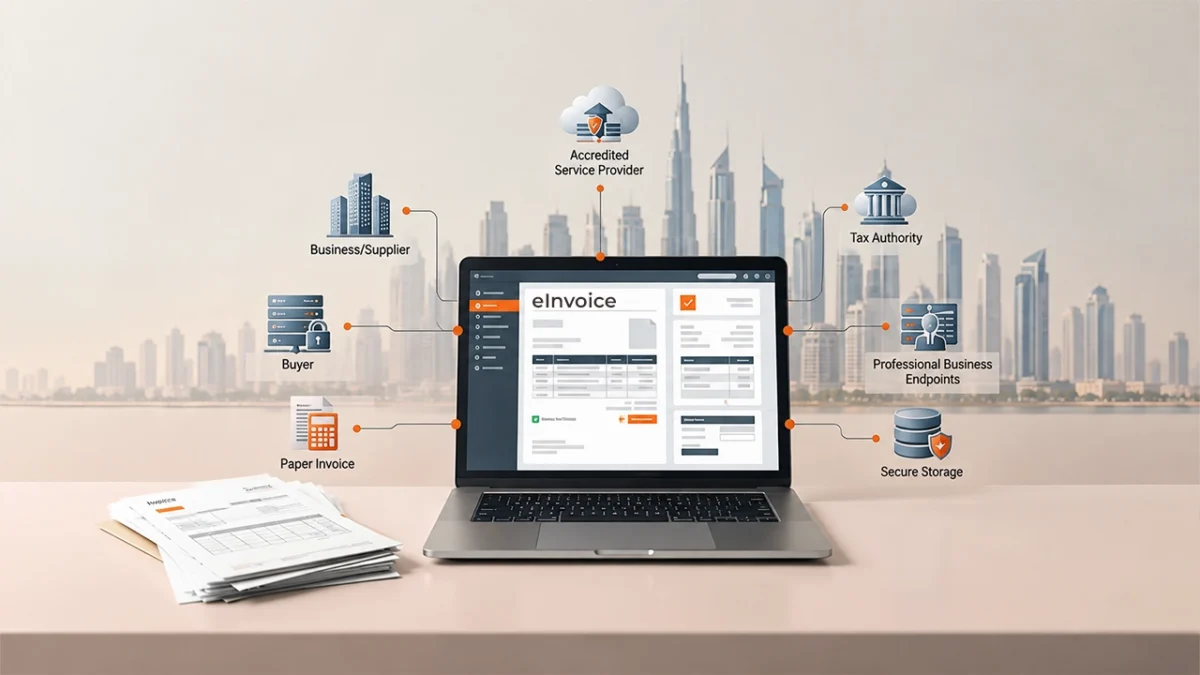
Taxpayers will be required to integrate with Accredited Service Provider (ASP) who are accredited by the Ministry of Finance (MoF). Only the ASPs will have a direct access to e-invoicing technology infrastructure.
Note: All the members of the VAT group will be required to have an independent endpoint connection with the ASP, while still operating under the group’s TRN (Tax Registration Number)
The e-invoicing process in UAE
Step 1: The supplier generates the invoice data to the accredited service provider (ASP).
Step 2: The ASP converts and validates the invoice to ensure it meets the UAE e-invoicing standards.
Step 3: The supplier’s ASP will send the e-invoice to the buyer’s ASP and ensure compliance with PEPPOL Standards.
Step 4: The ASP send the validated e-invoice data to the FTA in real-time.
Step 5: The FTA sends an acknowledgement of successful receipt while the buyer receives the invoice from its ASP.
E-Invoicing Obligations for Taxpayers
To facilitate e-invoicing transactions, it is crucial for taxpayers to engage with an
Accredited Service Provider (ASP) for validation and exchange of invoices. As the e-invoices are exchanged through the ASP’s systems, the list of ASPs will be published soon by the UAE government.
Data Requirements and Validation
The data dictionary will outline all the requirements for that data in an e-invoice and taxpayers must ensure e-invoices adhere to the conditions. The ASP will evaluate the date prior to transmitting the invoice to the FTA and the buyer. In case of any errors, the ASP will send back the invoice to the supplier.
For now, business-to-business (B2B) and business-to-government transactions will be in scope under the e-invoicing systems, irrespective of their VAT registration status of the supplier and buyer.
Launching Phases: The launch of e-Invoicing framework in the UAE will be in a phased approach. Based on the predetermined criteria, businesses are expected to integrate the framework to their system at specific stages. A sufficient notification will be published for the taxpayers by the FTA before the requirements are defined.
UAE Businesses are Required to Prepare to Adopt e-invoicing
Although it has been official that the e-invoicing will be mandatory for businesses in UAE by July 2026, further clarification related to the true scope of the framework, specifications, clear requirements and procedures are yet to be issued.
While waiting for further notice, VAT registered businesses need to prepare to harmonize their systems with compliance requirements of e-invoicing regime. This involves assessing their internal systems such as invoicing technology and data management systems, train their staff, identify system issues and upgrade the ERPs or other systems to prepare the ground for e-invoicing system.
Need help in evaluating your accounting systems, ensuring compliance with regulations and train your team on adapting to the new regulations in the UAE. Our KGRN team can help you navigate the UAE regulations seamlessly and meet all the compliance requirements with ease. Reach Out To Our Experts Today!
UAE E-Invoicing Mandate: A Complete Guide for Businesses in Dubai and the UAE
The United Arab Emirates (UAE) is rapidly transforming its financial and tax ecosystem, and e-invoicing is at the center of this major shift. Businesses operating in Dubai and across the UAE are now preparing for a mandatory digital invoicing system, introduced by the Federal Tax Authority (FTA) and the Ministry of Finance (MoF).
If you are a business owner, finance manager, or compliance officer, understanding the UAE e-invoicing mandate is crucial. The new regulations are not just about replacing paper invoices with digital versions. They represent a complete overhaul of how invoices are generated, transmitted, authenticated, and stored.
This article will help you clearly understand what the e-invoicing system means, why it is being implemented, and how your business can prepare for full compliance while taking advantage of its long-term benefits.
What is E-Invoicing in the UAE?
E-invoicing, also known as electronic invoicing, refers to the process of creating and managing invoices in a structured, digital format that complies with the standards set by the UAE’s Federal Tax Authority. Unlike traditional invoices, e-invoices are automatically generated, validated, and transmitted through secure digital systems.
This move eliminates paper invoices and manual data entry, ensuring that all business transactions are standardized, verifiable, and transparent. It allows the FTA to receive, review, and process financial data in real time, improving tax compliance and reducing errors across the board.
The UAE Ministry of Finance and the Federal Tax Authority are leading this initiative to bring the nation’s business landscape in line with international standards for digital finance and tax administration.
Why the UAE Introduced E-Invoicing
The main goal behind implementing the UAE e-invoicing system is to enhance Value Added Tax (VAT) compliance, increase efficiency, and reduce the administrative burden on businesses.
With e-invoicing, every invoice generated by a company in Dubai or other emirates will follow the same format and structure. This level of standardization allows machines to communicate directly without the need for manual processing. It also ensures that all data can be instantly interpreted and verified by the government’s systems.
In simple terms, the UAE government is creating a digital bridge between businesses and tax authorities, making transactions more transparent and efficient.
The Four Key Stages of UAE E-Invoicing
To make compliance easier to understand, the UAE’s e-invoicing process can be divided into four major stages. If your business follows these steps, you will meet all the core requirements of the e-invoicing mandate.
1. Invoice Creation
The first step involves generating the invoice digitally using accounting or Enterprise Resource Planning (ERP) software. The invoice must be created in a specific structured format defined by the FTA, such as XML or UBL (Universal Business Language).
This ensures the invoice contains all the mandatory fields required for VAT compliance, including supplier details, customer details, transaction values, and tax amounts. The invoice data should be generated automatically within your system, not converted or modified later.
2. Authentication
Authentication is the process of verifying that the invoice is genuine, accurate, and secure. Every e-invoice must carry a digital signature or cryptographic seal that guarantees its integrity. This prevents tampering and ensures non-repudiation, meaning the sender cannot deny having issued the invoice.
The FTA’s technical framework ensures that all invoices are digitally verifiable, ensuring trust between businesses and government authorities.
3. Submission
Once authenticated, the invoice must be transmitted electronically to the buyer and simultaneously submitted to the Federal Tax Authority’s system. This is a key change from the previous process, where invoices were only shared with customers.
Under the new system, every transaction will also be shared with the FTA in real time. This enables faster review and validation, making it easier for businesses to maintain compliance with VAT regulations.
4. Storage
The final stage of e-invoicing is secure digital storage. Businesses in the UAE must retain electronic copies of all invoices for the legally required period, which is typically five years.
Invoices must be stored in a secure, accessible, and organized digital format that allows easy retrieval during audits or tax reviews. Simply saving files on a shared drive is not enough. A compliant storage system must guarantee data integrity, accessibility, and long-term security.
Benefits of E-Invoicing for Businesses in the UAE
While e-invoicing is mandatory, it brings significant benefits that go beyond compliance. When implemented correctly, this system can improve business efficiency, financial accuracy, and overall productivity.
1. Improved Efficiency and Time Savings
Automation removes the need for manual entry and verification. This results in faster invoice creation, smoother reconciliation, and reduced administrative workloads for finance teams.
2. Fewer Errors and Better Accuracy
Because e-invoices are standardized and verified electronically, the likelihood of errors or mismatches in VAT filings drops significantly. This reduces disputes with customers and the tax authority.
3. Faster VAT Refunds
One of the most important financial advantages of the new e-invoicing system is faster VAT refund processing. Since all invoice data is authenticated and transmitted instantly to the FTA, refund claims can be processed up to 50 percent faster.
This means better cash flow and quicker access to working capital, especially for exporters and VAT-registered businesses.
4. Enhanced Transparency and Audit Readiness
E-invoicing creates a clear digital trail for every transaction, which improves transparency and ensures your company is always ready for audits. It also helps build stronger relationships with suppliers and clients by ensuring consistent, reliable billing practices.
Challenges Businesses May Face During Implementation
Transitioning to e-invoicing is not without challenges. Many businesses, especially small and medium enterprises (SMEs), may face obstacles such as:
- System Compatibility: Legacy ERP systems may not support the required e-invoice formats and will need upgrades or integrations.
- Technical Expertise: Some businesses lack in-house IT or compliance teams to handle the implementation process.
- Training Requirements: Employees need to be trained to use the new e-invoicing tools and understand the submission workflows.
- Initial Costs: Upgrading systems or subscribing to third-party e-invoicing platforms may involve upfront expenses.
However, these challenges can be overcome with careful planning and by partnering with experienced compliance service providers.
How Businesses Can Prepare for UAE E-Invoicing
Preparation for the UAE’s e-invoicing mandate should start immediately. Businesses should take a structured approach to ensure full compliance before the regulations become fully enforced.
- Evaluate Current Systems
Conduct a thorough assessment of your accounting or ERP software. Determine whether it can generate, authenticate, and transmit invoices in the required structured data format. - Plan and Budget Early
Allocate resources for upgrades or integrations. For large organizations, this may involve planning for ERP module updates and staff training. SMEs should explore cloud-based accounting solutions with built-in e-invoicing support. - Select Certified Providers
Work with certified solution providers that are recognized by the FTA. These vendors can simplify integration and ensure that your invoices meet all regulatory standards. - Train Employees
Proper training ensures that your staff can create, authenticate, and transmit invoices correctly. It also minimizes operational disruptions during the transition. - Stay Informed About FTA Updates
Keep track of the FTA’s latest circulars, technical documentation, and implementation timelines to stay compliant with the latest requirements.
E-Invoicing as a Part of the UAE’s Digital Transformation Vision
The e-invoicing initiative is not just about improving tax collection. It is a key part of the UAE’s long-term vision to create a fully digital and data-driven economy.
By adopting standardized electronic invoicing, the government aims to build a smart infrastructure that connects businesses, consumers, and regulators in real time. This transformation supports predictive analytics, fraud prevention, and economic forecasting, setting a strong foundation for sustainable growth.
In the future, e-invoicing could enable innovations such as:
- Faster access to business loans through verified transaction histories
- Real-time data analytics for business performance tracking
- Advanced fraud detection based on verified financial data
This shows that the e-invoicing system is not only about tax compliance but also about creating a more connected and efficient business ecosystem in the UAE.
Conclusion: Prepare Early and Embrace the Digital Shift
The UAE e-invoicing mandate is a mandatory requirement for all VAT-registered businesses, but it also presents a remarkable opportunity to modernize financial operations.
By preparing early, upgrading systems, and ensuring staff readiness, companies can benefit from faster VAT refunds, reduced paperwork, improved efficiency, and stronger compliance with FTA regulations.
E-invoicing represents the future of business in Dubai and the UAE. Those who act now will be better positioned to thrive in this new digital economy.
Partner With KGRN Chartered Accountants for E-Invoicing Compliance
KGRN Chartered Accountants has over 16 years of experience supporting businesses in Dubai and across the UAE with VAT registration, tax compliance, and digital transformation.
Our team of experts can help you:
- Integrate e-invoicing with your ERP or accounting system
- Ensure full FTA compliance
- Provide staff training and process guidance
- Manage system upgrades and digital documentation
Contact KGRN Chartered Accountants today for expert assistance with UAE e-invoicing implementation and compliance. Let our professionals help you stay ahead of the curve in the UAE’s rapidly evolving digital business environment.