Overview Summary
The UAE Ministry of Finance has rolled out mandatory e-invoicing using a Peppol-based Decentralized Continuous Transaction Controls and Exchange (DCTCE) 5-corner model. Businesses must use an Accredited Service Provider (ASP) to issue, validate, exchange, and report structured electronic invoices in PINT-AE XML format. Large entities (annual revenue AED 50 million+) must appoint an ASP by 30 October 2026, with mandatory compliance from 1 January 2027. This framework strengthens VAT compliance, enables near real-time oversight, and drives broader digital tax transformation across the UAE.
The UAE Ministry of Finance Issues Decision on Accreditation of E-Invoicing Service Providers
I am a senior tax technology consultant at KGRN Chartered Accountants and have assisted many UAE businesses to navigate complex regulatory changes. The switch to mandatory e-invoicing is one of the biggest digital tax changes in the region since VAT was introduced in 2018. It’s not just a technical upgrade, it’s a strategic alignment with finance, IT, compliance and operations.
CFOs, Finance Directors, Tax Managers and Business Owners need to understand the nuances of the UAE e-invoicing framework, including accredited service provider accreditation, Peppol interoperability and ERP readiness, in order to stay compliant and realize efficiency gains.
This guide is based on official documentation from the Ministry of Finance (MoF), Ministerial Decisions (e.g. 243 and 244 of 2025, with amendments in 2026), practical implementation experience and international best practices. It gives decision-makers actionable
The UAE is making significant progress toward a fully electronic and compliant E-Invoicing system. In order to enhance security, streamline transactions and improve tax reporting, the UAE government has developed an e-Invoicing framework, which will be rolled out in July 2026 and required to be adopted widely in the UAE business landscape.
On 19 March 2025, The UAE Ministry of Finance (MoF) issued Ministerial Decision No. 64 of 2024, that outlines the introduction of the accreditation process and criteria for companies to become Accredited Services Providers (ASP) for the e-invoicing system. This initiative is designed to regulate service providers and ensure adherence to the compliance standards related to the e-invoicing system.
What Is UAE E-Invoicing?
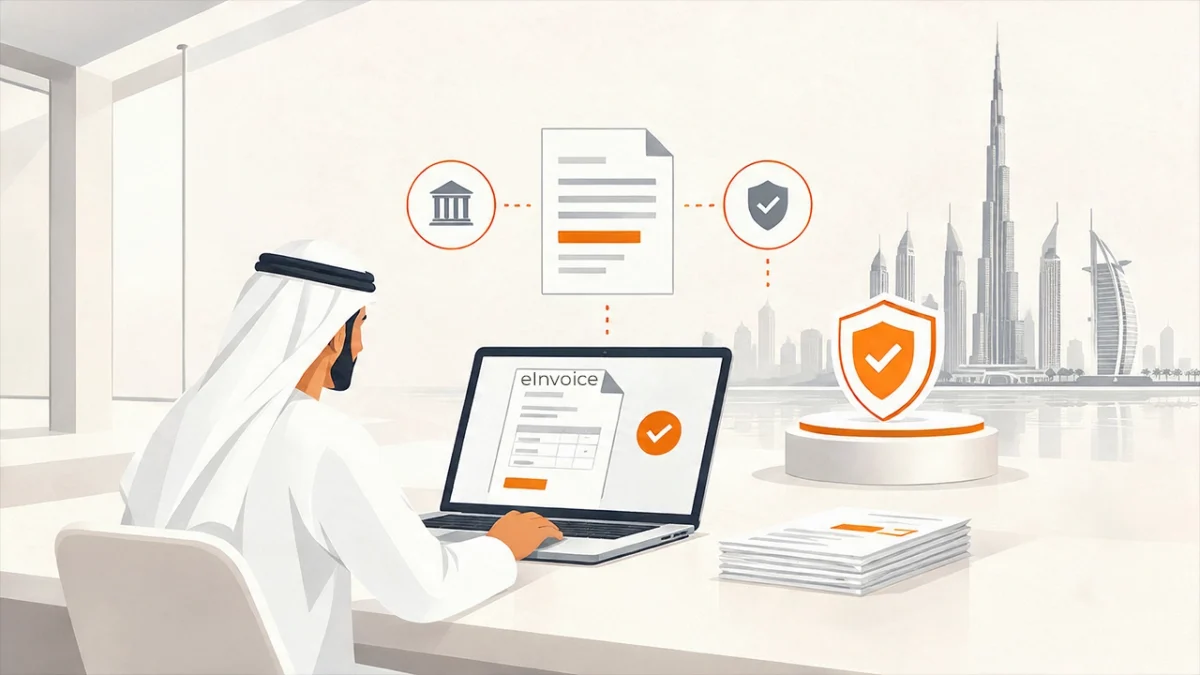
UAE e-invoicing is the mandatory issuance, exchange, and reporting of tax invoices in a structured, machine-readable digital format (primarily XML based on PINT-AE standards). It replaces or supplements traditional PDF/paper invoices for B2B and B2G transactions.
Unlike simple electronic billing, it incorporates Continuous Transaction Controls (CTC) for near real-time validation and data sharing with the Federal Tax Authority (FTA). This supports VAT automation, audit readiness, and fraud reduction while enabling cross-border interoperability via Peppol.
Key Regulatory Highlights:
- Governed by Ministerial Decision No. 243/2025 (Electronic Invoicing System) and No. 244/2025 (Implementation), with amendments.
- Applies to businesses carrying out taxable activities in the UAE.
- Invoices must contain mandatory fields from the MoF’s data dictionary
- The UAE authorities launched an accreditation portal for companies to become an accredited service provider (ASP) for the e-Invoicing system, where the eligibility and process outlined in the Ministerial Decision No.64 of 2025.
- The ASPs will serve as the only access point for businesses, enabling access to Peppol network, widely used E-Invoicing framework and they are responsible for validating, transmitting eInvoices between buyer and suppliers and reporting relevant data to the FTA.
- Though businesses are not going to be directly involved in the accreditation process, they must be prepared to ensure compliance with eInvoicing regulations and to integrate with an Accredited Service Provider (ASP).
Accredited Service Provider: Importance, Eligibility, And Process of Accreditation
The ASPs play a critical role in the UAE’s E-Invoicing System as the mandatory intermediaries for businesses. For eInvoicing service providers who want to get accredited, should understand the accreditation process, eligibility criteria and compliance requirements.
Traditional Invoicing vs. UAE E-Invoicing
| Aspect | Traditional (PDF/Paper) | UAE E-Invoicing (2026+) |
|---|---|---|
| Format | Human-readable | Structured XML (PINT-AE) |
| Transmission | Email/Post | Peppol network via ASP |
| Validation | Post-issue | Pre-exchange by ASP + FTA |
| Reporting | Periodic VAT returns | Near real-time CTC |
| Archiving | Manual | Automated, auditable digital |
| Cross-border | Limited | Peppol-enabled |
What Is an Accredited E-Invoicing Service Provider?

An Accredited Service Provider (ASP) is a MoF/FTA-approved entity acting as the technical intermediary for e-invoice creation, validation, exchange, and reporting. Businesses cannot bypass ASPs for compliant transactions.
ASPs handle Peppol certification, digital signatures, format validation, FTA data submission, and status acknowledgments. Pre-approved lists are published on the MoF portal, with full accreditation ongoing.
Eligibility Criteria To become Accredited Service Provider
To qualify as an accredited eInvoicing service provider, companies must meet the following criteria:
Peppol Certification: To become ASPs, the eInvoicing service provider must have a Peppol certification and OpenPeppol conformance tests.
Industry Experience: Should possess at least two years of experience in managing an electronic Invoicing system.
Legal Compliance: Must meet the company registration requirements as per Article 6 of the Ministerial Decision.
Tax Compliance: Must meet tax registration requirements as per Article 8 of the decision.
Operational & Security Standards: Service providers must adhere to the standards based on Article 9 in which guidelines for operational efficiency, data protection and security are provided.
Information Security Standards: Must adhere to the Peppol Product Information Security Requirements as per Article 9 of the decision.
Insurance Coverage: Must fulfil the liability and operational insurance obligations under the Article 11.
Self-Declaration: Must submit a self-declaration obligation as per Article 10 of the decision.
Documents Required For Accreditation of Service Providers
The service providers must submit the following documents to apply for accreditation:
Corporate & Legal Documents
- Trade License
- Proof Of Paid-up Capital
UAE Corporate Tax Registration Certificate
- Insurance Documents (submitted post pre-approval testing)
- Representative Power Of Attorney
Technical & Security Compliance
- OpenPeppol PKI Certificate
- Signed Service Provider Agreement With OpenPeppol or another Peppol Authority
- ISO/IEC 27001 Security Compliance Certificate
- Details Of Technical Environmental Design
- Regular Security Monitoring Reports
- Multi-factor Authentication Implementation
- Business Continuity (ISO 22301) Certificate
- Encryption At Rest And In Transit
Operational And Maintenance Framework
- Proof Of eInvoicing Experience
- Process For Handline Updates and Upgrades
- Ongoing Support & Maintenance Framework
Accreditation Process For eInvoicing Service Providers
The accreditation process for e-Invoicing service providers in UAE involves a six-step procedure:
- Submission of Application: The service providers should submit a formal application along with all the required documents.
- Pre-Approval Testing: The authority will conduct an initial evaluation to determine the providers capability to process and exchange e-Invoices in compliance with UAE regulations.
- Production Trial Run: The provider must demonstrate successful execution of e-Invoicing scenarios.
- Pre-Approval Certification: Certification is provided upon fulfilling all technical, operational and security compliance requirements.
- Tax Data Reporting Testing: The provider’s ability verified on how accurately and efficiently they report tax data to the FTA.
- Accreditation Certification: Upon fulfilling all the requirements, accreditation will be awarded, authorizing the service provider.
Factors Businesses Should Consider Before Choosing An ASP
While ASPs handle the validation and transmission of eInvoice data, businesses should be responsible for ensuring that their data is accurate and complete. Before engaging with an accredited eInvoicing service provider, businesses should:
- Evaluate Current Invoicing System: It is crucial for businesses to assess their current billing system that generates invoices.
- Review Transactions: Businesses should review and segregate their transactions that fall under the scope of e-Invoicing.
- Map Transactions to eInvoicing Requirements: Businesses should ensure that they match each transaction that are in scope to eInvoicing use case to identify the applicable data set for each transaction.
- Compare Existing Data Set: Compare current data set (per billing system) for each transaction against the relevant eInvoicing requirements.
- Address Gaps in The Invoicing System: The source system that feeds the data to the billing system should be identified and take necessary steps to remediate any gaps that are present. Then verify that the updated invoicing data meet the e-Invoicing standards.
Since businesses should remain accountable for the accuracy of eInvoicing data, it is important to ensure their systems and processes align with requirements under the eInvoicing regulations before engaging with an Accredited Service Provider (ASP).
Conclusion:
The UAE Ministry of Finance’s new accreditation program for e-Invoicing service providers is a significant step towards providing secure, and standardized solutions for businesses. This initiative establishes stringent compliance requirements, reinforcing trust and alignment with global standards for a seamless e-Invoicing transactions and tax reporting.
It is mandatory for all businesses in UAE to adopt the eInvoicing system and ensure compliance with the regulations, if you need expert guidance navigating the regulations and implementation of the eInvoicing system, consult our professionals today! Let us ensure a smooth transition to e-Invoicing.
Related Posts
UAE E-Invoicing: Regulatory Clarifications & Practical Compliance Insights