


Raising investment is a pivotal moment for any startup. Yet without a clear understanding of your company’s worth, negotiations can quickly go off track. Investors scrutinise every detail before committing capital, and an accurate startup valuation gives founders the confidence to protect their equity while still offering an attractive opportunity.
At KGRN Chartered Accountants, we have helped dozens of Indian founders and early-stage ventures secure funding on fair terms. A realistic valuation is not just a number—it is the foundation for better equity deals, stronger investor relationships, and smarter strategic decisions. Whether you are preparing for a seed round or scaling toward Series A, knowing how to calculate startup valuation before raising investment can mean the difference between giving away too much ownership or leaving money on the table.
What Is Startup Valuation?
Startup valuation is the estimated monetary worth of your company at a specific point in time—usually before an investment round. It determines how much equity you must offer investors in exchange for their capital.
Unlike traditional businesses, which rely on years of audited financials and steady cash flows, startups are valued primarily on future potential. Revenue may be zero or minimal, yet the business can still command a high valuation if the market opportunity, team, and growth trajectory are compelling.
There are two key figures every founder should know:
- Pre-money valuation: the value of the company before the new investment.
- Post-money valuation: pre-money value plus the fresh capital raised.
Understanding this distinction is essential when discussing terms with venture capitalists or angel investors. A professional business valuation for startups bridges the gap between your vision and the investor’s required return.
Why Startup Valuation Is Important Before Raising Investment
Getting the number right delivers five immediate advantages:
- Attracting the right investors – A credible valuation signals that you have done your homework and respect their time.
- Determining equity dilution – You can calculate exactly how much ownership you will part with and still retain control.
- Negotiating stronger funding terms – Armed with data, founders avoid accepting undervalued offers or overpaying in equity.
- Financial planning – Valuation informs cap-table modelling, option-pool planning, and future fundraising strategy.
- Strategic decision-making – It forces you to stress-test your business model and growth assumptions early.
In short, a well-prepared startup valuation before investment turns an emotional pitch into a professional business discussion.
Key Factors That Influence Startup Valuation
No single formula captures every variable, but experienced investors consistently weigh these six factors:
- Market opportunity – Size of the addressable market and your ability to capture meaningful share.
- Business model – Scalability, recurring revenue potential, and unit economics.
- Revenue potential and traction – Even modest early revenue or user growth can lift valuation significantly.
- Competitive advantage – Intellectual property, network effects, or first-mover positioning.
- Founding team strength – Track record, domain expertise, and execution capability.
- Growth projections – Realistic yet ambitious forecasts backed by data.
Founders who present these elements clearly and with supporting evidence invariably achieve higher and more defensible valuations.
Common Startup Valuation Methods
Several established approaches help quantify what a startup is worth. The best method depends on your stage, revenue status, and industry.
1. Scorecard Valuation Method
Popularised by Bill Payne, this method starts with the average pre-money valuation for similar startups in your region and sector. You then adjust that benchmark up or down based on a scorecard that rates your team, market size, product, competitive environment, marketing channels, and other key risks. It is especially useful for pre-revenue companies because it relies on qualitative and quantitative comparisons rather than financial history.
2. Venture Capital Method
This forward-looking approach works backward from an expected exit. Investors estimate the company’s terminal value at exit (usually 5–7 years out), divide by their required return multiple (often 10× or higher), and arrive at today’s post-money valuation. Subtract the investment amount to find pre-money value. The venture capital method is widely used in India for tech and SaaS startups chasing rapid scale.
3. Discounted Cash Flow (DCF)
DCF calculates the present value of projected future cash flows, discounted at a rate that reflects the high risk of early-stage ventures. While more common for later-stage companies with predictable revenue, it can still provide a useful cross-check for startups that already have paying customers and clear unit economics.
4. Comparable Company Analysis
Also called “comps,” this method examines recent funding rounds or exits of similar companies. Valuation multiples—such as price-to-revenue or enterprise-value-to-EBITDA—are applied to your own projected figures. In the Indian ecosystem, founders often reference deals from sectors like fintech, edtech, or healthtech to anchor their numbers.
5. Berkus Method
Designed specifically for pre-revenue startups, Dave Berkus’s approach assigns a monetary value (typically up to ₹2–3 crore equivalent in India) to five key risk-reduction milestones: sound idea, prototype, strong management team, strategic relationships, and product rollout or initial sales traction. It is quick, transparent, and widely accepted by angel networks.
Step by Step Process to Calculate Startup Valuation
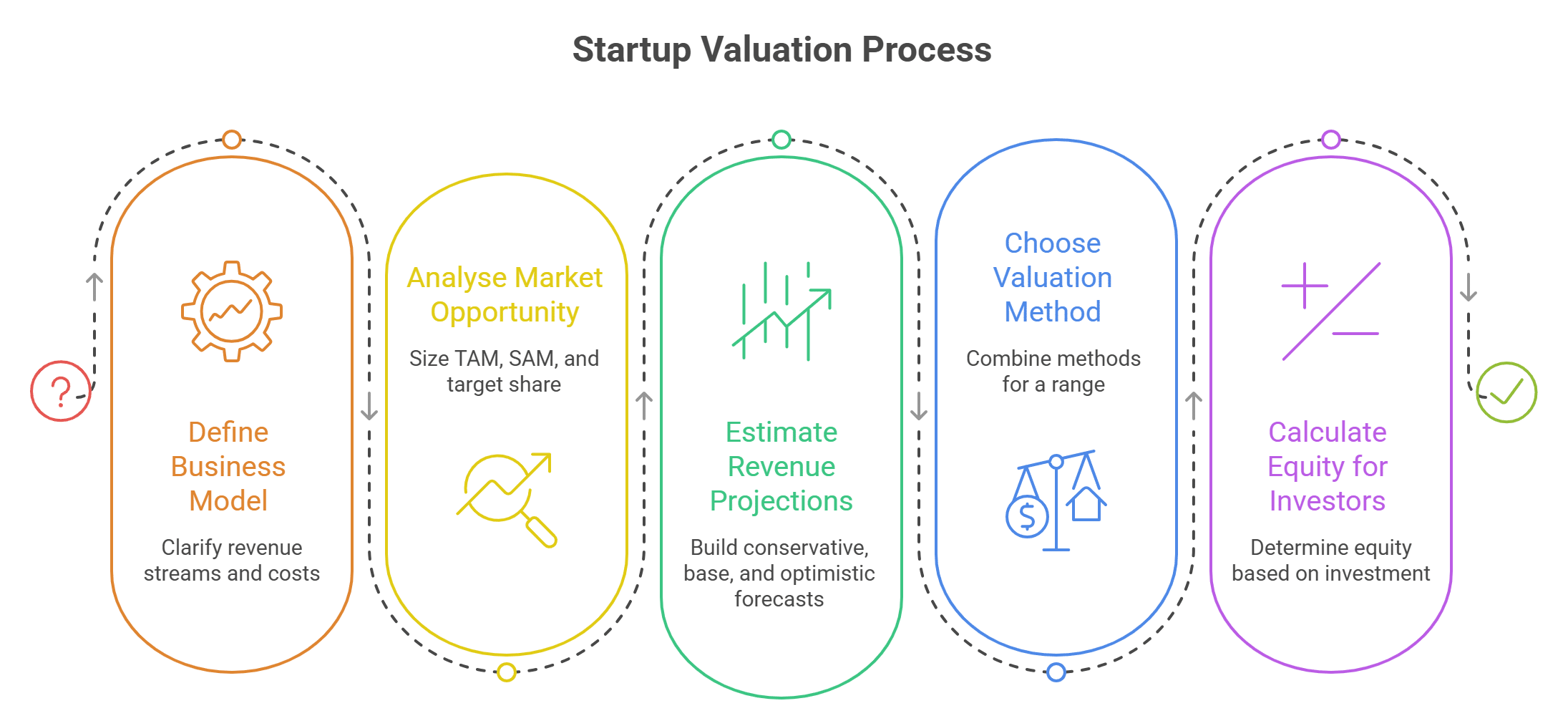
Follow this practical sequence to arrive at a credible number:
Step 1: Define your business model
Clarify revenue streams, customer acquisition cost, lifetime value, and unit economics.
Step 2: Analyse the market opportunity
Size the total addressable market (TAM), serviceable available market (SAM), and your target share using credible third-party data.
Step 3: Estimate revenue projections
Build conservative, base, and optimistic three-to-five-year forecasts. Support every assumption with evidence.
Step 4: Choose an appropriate valuation method
Combine two or more methods (e.g., Scorecard + VC Method) to create a valuation range rather than a single point estimate.
Step 5: Calculate equity for investors
Decide how much capital you need. Divide the investment amount by post-money valuation to determine the percentage of equity offered.
Step 6: Prepare financial projections and sensitivity analysis
Model different scenarios so you can defend your numbers when investors push back.
KGRN Professional Startup Valuation Approach
At KGRN Chartered Accountants, we follow a structured, founder-friendly process that blends financial rigour with sector insight:
Step 1: Business Model and Market Assessment
We deep-dive into your idea, industry dynamics, and realistic growth opportunities using both primary research and our extensive database of Indian startup deals.
Step 2: Financial Data Evaluation
We review revenue projections, cost structures, burn rate, and profit milestones. Where data is limited, we benchmark against similar funded companies.
Step 3: Selection of Appropriate Valuation Method
Depending on whether you are pre-revenue, early-traction, or scaling, we apply the most relevant mix of Scorecard, VC, DCF, or Berkus methods.
Step 4: Financial Modelling and Investment Analysis
Our team builds detailed models covering revenue forecasts, funding requirements, cap-table impact, and investor ROI scenarios.
Step 5: Valuation Report and Strategic Insights
You receive a professional report with a clear valuation range, supporting assumptions, and negotiation talking points—ready for pitch decks and term-sheet discussions.
Mistakes to Avoid When Calculating Startup Valuation
Even experienced founders trip over these common pitfalls:
- Overestimating market size without credible segmentation
- Using hockey-stick revenue projections that lack supporting metrics
- Ignoring competitive intensity and pricing pressure
- Applying generic multiples without adjusting for Indian market realities
- Relying on a single method instead of creating a triangulated range
A quick reality check with a professional advisor can save months of difficult renegotiations later.
How Professional Valuation Helps Founders Raise Investment
A polished valuation report from KGRN does more than justify a number. It becomes a powerful tool in investor presentations, venture capital discussions, and funding negotiations. Investors appreciate the transparency and confidence that comes from numbers prepared by chartered accountants who understand both finance and the startup ecosystem. Many founders tell us that having our report in hand shortened their closing timeline and improved the final terms they secured.
Conclusion
Accurate startup valuation before raising investment is not a nice-to-have—it is a strategic necessity. It protects your ownership, builds investor trust, and sets the stage for sustainable growth. While online calculators and rule-of-thumb multiples can give a rough idea, the complexity of today’s funding environment demands professional rigour.
The experienced team at KGRN Chartered Accountants stands ready to guide you through every step. Whether you are preparing your first angel round or scaling toward a larger Series A, we deliver clear, defensible valuations that help founders raise capital on their terms. Contact us today to schedule a confidential valuation consultation and turn your vision into a number investors respect.