
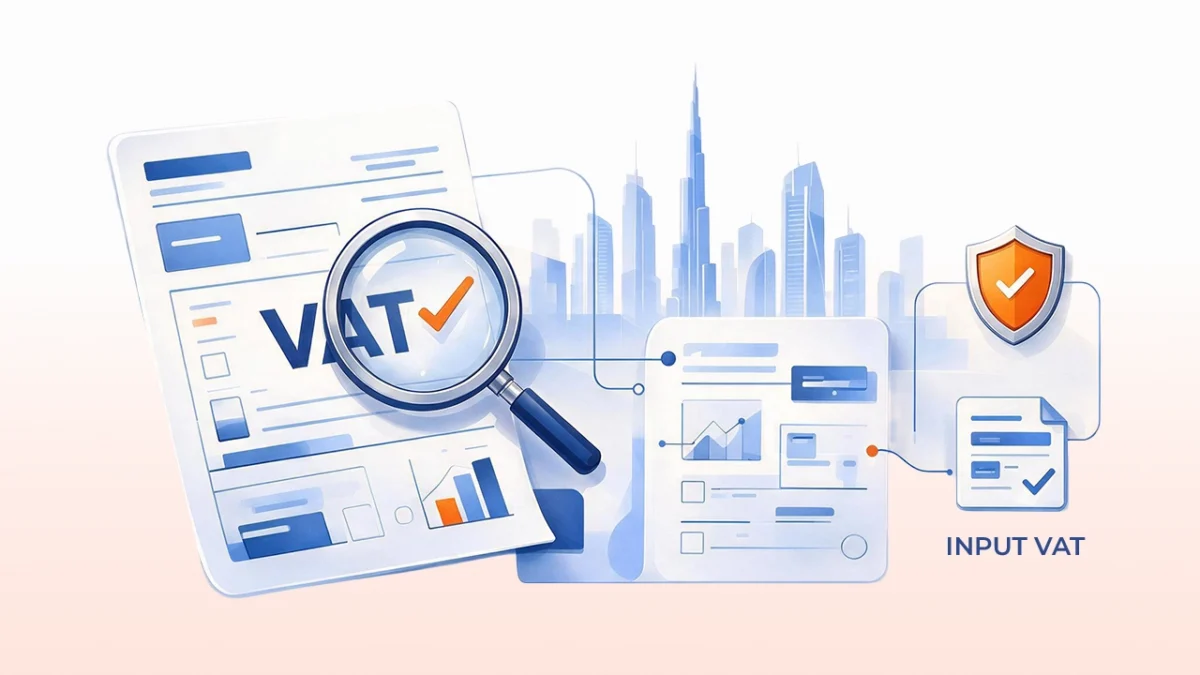
From 1 October 2026, businesses in the UAE will face additional verification requirements before deducting Input VAT on taxable supplies.
Federal Tax Authority Decision No. 13 of 2026 sets out the measures, procedures and conditions Taxable Persons must follow to verify both their suppliers and the supplies they receive before deducting Input Tax.
The change significantly increases the importance of supplier due diligence, transaction verification and documentation within the VAT compliance process.
For businesses, this means that holding a valid tax invoice alone may no longer be sufficient. Supplier identity, commercial activity, payment arrangements, transaction circumstances and supporting records can all form part of the verification process.
What is FTA Decision No. 13 of 2026?
FTA Decision No. 13 of 2026 is titled “Measures, Procedures and Conditions required by Taxable Persons for the Verification of the Validity and Integrity of the Supplies before Deduction of Input Tax.”
It was issued on 22 July 2026 and took effect from 1 October 2026.
The Decision applies to Taxable Persons when verifying the validity and integrity of supplies received before deducting Input Tax.
It follows amendments to the UAE VAT framework that strengthened the Federal Tax Authority’s ability to deny Input Tax deductions where a transaction forms part of a Tax Evasion arrangement and introduced an obligation for Taxable Persons to verify the legitimacy and integrity of supplies before claiming Input Tax.
What changes from 1 October 2026?
The practical change is that VAT recovery will involve a broader verification process.
Businesses may need to demonstrate that they have appropriately checked:
- The identity and legal status of the supplier
- The supplier’s place of business
- Risk indicators associated with the supplier
- The commercial rationale for the transaction
- Payment arrangements
- Pricing and margins
- The nature and origin of goods or services
- Supporting evidence for each taxable supply
- The internal controls used to carry out these checks
The Decision therefore places greater emphasis on supplier due diligence and transaction-level VAT controls, rather than relying only on documentation such as tax invoices.
1. Supplier identity must be verified
The first stage is verification of the supplier. The requirements differ depending on whether the supplier is a natural person or a legal person.
If the supplier is a natural person
The Taxable Person must obtain valid identification, such as an Emirates ID or passport.
The Taxable Person must also meet the supplier, either physically or virtually, before the supply is made.
If the supplier is a legal person
The Taxable Person must verify the supplier’s incorporation through official databases or obtain a copy of its certificate of incorporation.
The incorporation information should correspond with information such as the entity’s:
- Name
- Address
- Employees
- Other related information
The identity of the director, agent or employee authorised to represent the supplier must also be verified using valid identification.
2. Businesses must verify the supplier’s place of business
The Decision also requires verification of the supplier’s address and business location.
Businesses must verify that the supplier has an actual place of business. This may be done using appropriate electronic means or through a physical visit.
The location should also be compatible with the nature of the activities carried out by the supplier.
3. Specific supplier risk indicators must be considered
The Decision identifies certain circumstances that businesses must consider when assessing supplier risk.
These include whether the supplier:
- Changed its address more than twice during the previous 12 months
- Changed key employees more than twice during the previous 12 months
- Undertook transactions that appear disproportionate or unexpected in volume, value or nature compared with the size and operating history of the business
Where one of these indicators exists, the Taxable Person must retain a clear and justified explanation and be able to provide it to the FTA upon request.
The explanation must also be consistent with the information and evidence available to the business.
4. Additional checks apply above AED 375,000
Enhanced checks apply where the value of supplies received from the same supplier:
- Exceeds AED 375,000 during the previous 12 months, or
- Is expected to exceed AED 375,000 during the next 12 months
In these circumstances, the Taxable Person must undertake additional supplier verification.
Bank account verification
The supplier must provide written confirmation from a bank authorised in the UAE confirming that the supplier has a bank account.
The FTA Decision specifies that the confirmation should not contain relevant reservations or conditions.
Importantly, the bank confirmation does not necessarily have to be addressed to the recipient of the supply.
Public information and reputation checks
Businesses must also review and assess publicly available reviews and media coverage relating to the supplier from reliable sources. The information should be considered against the nature and size of the supplier’s business, including whether there are indicators of suspected Tax Evasion.
This means supplier onboarding for larger relationships may increasingly need to include documented external due diligence.
5. Every taxable supply must also be assessed
Supplier verification alone is not enough.
FTA Decision No. 13 of 2026 requires Taxable Persons to verify each Taxable Supply received or accepted.
This includes reviewing the commercial circumstances surrounding the transaction.
Genuine commercial reason
Businesses must undertake a general assessment of the transaction and establish that the supplier’s involvement is based on genuine commercial reasons.
Commercially reasonable payment arrangements
The payment method and payment conditions should be justifiable for commercial reasons.
Additional attention may be required where:
- A third party is involved in making or receiving payment
- Payment is made to a bank account outside the supplier’s country of incorporation
In such cases, there must be a reasonable commercial explanation that is consistent with the available information and evidence.
6. Electronic payment is the general requirement
One of the most significant operational provisions concerns payment.
The Decision states that consideration for the supply shall be paid by electronic means.
Where payment is made in cash, it must:
- Have a documented commercial reason
- Be within the thresholds permitted under the applicable Tax legislation
- Be easily verifiable
Businesses that routinely make supplier payments in cash should therefore review their processes before 1 October 2026.
7. Pricing and commercial circumstances must make sense
Businesses are also required to assess the circumstances surrounding the supply.
Among other things, they must verify that prices or profit margins are not commercially unjustifiable or significantly different from market conditions without a clear reason.
The Taxable Person must also consider whether:
- The goods or services are within the supplier’s normal business activities or licensed activities
- The authenticity and origin of goods can be verified
- The supplier owns the goods or has the right to dispose of them
- Any intermediary involved in the transaction has a clear and commercially justifiable role
These checks make the VAT verification process substantially broader than a traditional invoice-based Accounts Payable review.
8. How often must a supplier be verified?
Supplier verification is required:
- When dealing with a supplier for the first time, or
- For an existing supplier where that supplier has not been verified during the previous 12 months
Therefore, businesses with recurring suppliers will need a mechanism for tracking when supplier verification was last completed.
A supplier onboarding process alone may not be sufficient if the supplier continues to be used for several years.
9. Businesses must document the verification process
The Decision expressly requires businesses to document the verification steps they perform.
Supporting documents and records must be retained so the FTA can verify that the required procedures were correctly implemented.
Businesses must also maintain a documented verification policy identifying the people responsible for:
- Implementing the verification procedures
- Reviewing the verification
- Supervising the process
- Exercising the relevant powers and responsibilities
The roles and responsibilities must be clearly defined.
This means the new requirements should be treated as an internal control framework rather than an informal supplier review.
10. Is there an exception for transactions below AED 10,000?
Yes, but it is limited.
A Taxable Person may disregard the verification measures for a taxable supply where the consideration, excluding VAT, is less than AED 10,000.
However, this exception cannot be used where the total value of supplies received from the same supplier:
- Exceeds AED 100,000 during the previous 12 months, or
- Is expected to exceed AED 100,000 during the next 12 months
What should UAE businesses do before 1 October 2026?
Businesses should use the period before implementation to review their procurement, Accounts Payable and VAT recovery processes.
Key actions include:
Review supplier onboarding
Supplier onboarding forms and procedures should capture the information required under the new Decision, including identity, incorporation, authorised representative and place-of-business information.
Categorise suppliers by annual spend
Systems should identify suppliers approaching:
- AED 100,000 over 12 months, because this affects the low-value exception
- AED 375,000 over 12 months, because additional verification requirements apply
Create a supplier re-verification process
A mechanism should be introduced to identify recurring suppliers that have not been verified during the previous 12 months.
Review Accounts Payable controls
Invoice approval should incorporate transaction-level verification where required rather than relying exclusively on tax invoice checks.
Review payment practices
Cash payments and unusual payment structures should be reviewed. Businesses should ensure electronic payment is used unless the conditions for cash payment can be satisfied and documented.
Establish a documented verification policy
Responsibility should be clearly allocated across relevant functions such as:
- Finance
- Tax
- Procurement
- Accounts Payable
- Compliance
The policy should also explain how evidence is collected, reviewed, retained and escalated.
Maintain an audit trail
Businesses should be able to demonstrate not only that a supplier or transaction was reviewed, but when the review occurred, who completed it, what was checked and what evidence supported the conclusion.
Frequently Asked Questions
- What is the new UAE VAT supplier verification requirement?
Taxable Persons must follow specified procedures to verify the validity and integrity of suppliers and taxable supplies before deducting Input Tax. The requirements include supplier identity checks, business-location verification, risk assessment, transaction checks, payment verification and record keeping. - Does every supplier need to be verified every year?
A supplier must be verified when the business deals with them for the first time. For recurring suppliers, verification is required where the supplier has not been verified during the previous 12 months. - What happens when purchases from a supplier exceed AED 375,000?
Where supplies received from a supplier exceed AED 375,000 during the previous 12 months, or are expected to exceed that amount during the next 12 months, additional measures apply. These include UAE bank account confirmation and reviewing publicly available reviews and media coverage from reliable sources. - Are cash supplier payments allowed under the new UAE VAT rules?
The Decision provides that consideration should be paid electronically. Cash payment is permitted only where it is supported by a documented commercial reason, falls within applicable Tax legislation thresholds and is easily verifiable. - Is there an exemption for small transactions?
The verification measures may be disregarded for taxable supplies with consideration below AED 10,000 excluding VAT. However, this exception does not apply where supplies from the same supplier exceed or are expected to exceed AED 100,000 during the relevant 12-month period. - Does a valid VAT invoice alone satisfy the new requirements?
The Decision establishes verification measures that extend beyond possessing a tax invoice. Depending on the circumstances, businesses must verify the supplier, the taxable supply, payment arrangements and commercial circumstances and retain evidence of the checks performed. - Does the business need a written supplier verification policy?
Yes. The Decision requires a documented policy identifying the persons responsible for implementing, reviewing and supervising verification procedures, together with their powers and responsibilities.
Related posts:
 UAE Tax Penalty Update Explained: What Cabinet Decision No. 129 of 2025 Changes for Businesses
  Guide to Business Valuation Services in Dubai UAE for Investors & SMEs
  Business Advisory Services in Dubai – Overview and Benefits
  Explore the Benefits of Financial Advisory Services in the UAE
  New IFRS standards 2020