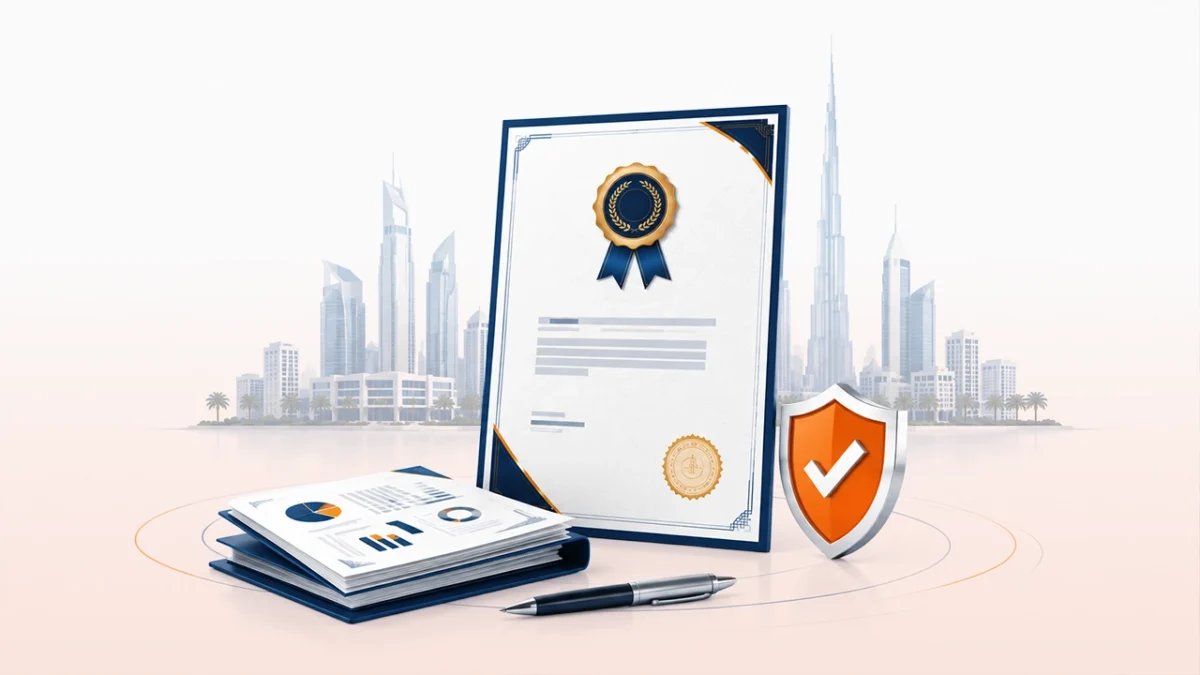
The National In-Country Value (ICV) Program is a UAE government initiative designed to increase the amount of procurement spending retained within the UAE economy and encourage businesses to contribute through local procurement, investment, Emiratisation and other economic activities.
For companies supplying government entities and organisations participating in the National ICV Program, obtaining an ICV Certificate can significantly affect their competitiveness in procurement and tender evaluations.
But who needs an ICV Certificate? What documents are required? How does the certification process work? And how long is an ICV Certificate valid?
This guide explains the UAE ICV certification requirements for 2026, based on the latest guidance published by the UAE Ministry of Industry and Advanced Technology (MoIAT).
What is an ICV Certificate in the UAE?
An ICV Certificate is an official certificate issued through the National ICV Platform that states a company’s In-Country Value score.
The ICV score measures the extent to which a supplier contributes economically within the UAE through factors such as local expenditure, investment, employment of UAE nationals and other qualifying activities.
Under the National ICV Program, authorised Certifying Bodies verify suppliers’ applications and issue ICV Certificates in accordance with MoIAT requirements.
The program aims to redirect more public and private procurement spending into the national economy, strengthen local supply chains and create economic opportunities within the UAE.
Is ICV Certification mandatory in the UAE?
ICV certification is not universally mandatory for every company operating in the UAE.
MoIAT states that certification is optional for suppliers seeking to participate in federal government tenders. However, if a supplier does not submit an ICV Certificate, its ICV score is treated as zero for the relevant evaluation.
This means certification can become commercially important for companies bidding for contracts with federal government entities and other organisations participating in the National ICV Program.
Businesses should therefore distinguish between:
- A general legal requirement to operate in the UAE
- An ICV requirement or commercial advantage associated with a specific tender or customer
Suppliers should review the procurement requirements of the relevant participating entity before bidding.
Who can obtain an ICV Certificate?
Companies seeking to demonstrate their In-Country Value can apply for certification through the National ICV Program.
Under the current MoIAT guidelines, the ICV Certificate is generally obtained for each legal entity that intends to be certified.
Each company licence is considered an independent legal entity, even where ownership is the same.
However, there is an important exception for certain branches.
Where a company has different branches:
- In the same Emirate
- With identical activities
- With identical ownership as shown on the licences
one combined ICV Certificate can be issued for those branches in that Emirate.
What are the main requirements for ICV Certification in 2026?
The key requirements include:
1. NAFIS registration
Private companies are required to register as Partners on the NAFIS platform before obtaining an ICV Certificate.
MoIAT identifies NAFIS registration as a prerequisite to certification.
2. Audited financial statements
In most cases, the company must have audited financial statements.
The financial statements must:
- Be prepared in accordance with International Financial Reporting Standards (IFRS)
- Be audited by a licensed auditor in the UAE
- Follow the International Standards on Auditing (ISA)
- Meet the age requirements prescribed by MoIAT
According to the current supplier guidelines, audited financial statements used for ICV certification must not be older than two years from the certification year.
3. Completion of the ICV application
The supplier must complete the prescribed ICV application and provide information used to calculate its ICV score.
Figures entered into the ICV Template must correspond with the company’s audited financial statements and relevant supporting records.
4. Verification by an authorised Certifying Body
The supplier must appoint an ICV Certifying Body authorised by MoIAT.
The Certifying Body reviews the information submitted, verifies the application and approves the ICV Certificate through the official platform.
What documents are required for ICV Certification?
The exact supporting documentation required can depend on the company’s size, activities, financial structure and the information reported in its ICV application.
At a minimum, MoIAT’s service guidance identifies:
- A valid business licence
- Audited financial statements
- Additional supporting documents depending on the company’s circumstances
The ICV verification itself can require supporting records underlying the figures reported in the application.
Businesses should therefore prepare financial and operational records that support the components included in their ICV calculation.
Depending on the business and the figures being claimed, relevant records may need to substantiate areas such as local costs, payroll, investment and other ICV-related information.
Importantly, MoIAT’s current guidelines state that the figures reported in the ICV Template should correspond with the audited financial statements and the supporting documents used to generate those financial figures.
How does the ICV Certification process work?
MoIAT outlines a structured certification process.
Step 1: Register with NAFIS
Private companies should first complete the required NAFIS registration.
Step 2: Prepare IFRS-compliant audited financial statements
The company should have eligible audited financial statements available, unless it qualifies for the newly established company exception.
Step 3: Apply through the National ICV Platform
The supplier completes the online application process through the official ICV platform.
Step 4: Select an authorised ICV Certifying Body
The supplier appoints a Certifying Body authorised by MoIAT.
The selected Certifying Body uploads the engagement letter and reviews the company’s ICV submission.
Step 5: Complete and substantiate the ICV information
The company enters the required information and provides supporting records.
The draft is reviewed, endorsed, signed and approved by the Certifying Body.
Step 6: Receive the ICV Certificate
Once the verification process is completed, the ICV Certificate is issued through the official platform.
The supplier can then submit the certificate to participating entities where relevant.
Does ICV Certification apply to Free Zone companies?
Free Zone companies are addressed specifically within MoIAT’s ICV guidelines.
For ICV calculation purposes, the treatment differs depending on the nature of the company.
The current guidance distinguishes between:
- Mainland UAE companies
- Free Zone companies
- Offshore companies
- Representative offices
- Mainland branch offices
For Free Zone companies, the treatment also varies between goods manufacturers and service providers.
Because this can affect the ICV calculation, Free Zone businesses should apply the rules relevant to their exact entity type and activities rather than assuming that the mainland methodology applies without adjustment.
Frequently Asked Questions
-
What does ICV stand for in the UAE?
ICV stands for In-Country Value. The National ICV Program measures a supplier’s economic contribution within the UAE and is administered by the Ministry of Industry and Advanced Technology.
-
Who issues the ICV Certificate?
ICV Certificates are verified and issued through Certifying Bodies authorised by MoIAT using the official National ICV Platform.
-
Is an audit mandatory for ICV Certification?
Generally, ICV certification is based on IFRS-compliant audited financial statements.
However, a newly established company that is less than 10 months old may use management accounts covering up to nine months where it does not yet have audited financial statements.
-
How long is an ICV Certificate valid in the UAE?
The ICV Certificate is valid for 14 months from the issuance date of the audited financial statements used for certification.
-
Is ICV Certification compulsory for government tenders?
MoIAT states that ICV certification is optional for suppliers participating in federal government tenders. However, a supplier that does not provide an ICV Certificate receives an ICV score of zero for the applicable evaluation.
-
Do I need a separate ICV Certificate for every company licence?
Generally, yes. Each licence is treated as a separate legal entity.
Qualifying branches in the same Emirate with identical ownership and activities may be covered by one combined certificate.
-
Can a Free Zone company obtain an ICV Certificate?
Free Zone companies are included within MoIAT’s ICV calculation guidance. The applicable treatment differs depending on whether the company is a manufacturer or service provider.
-
Can I renew an ICV Certificate using the same audited financial statements?
Yes. A supplier may obtain recertification using the same audited financial statements while the certificate remains valid. However, the original 14-month validity period does not restart.