UAE Corporate Tax Registration in Mainland vs Free Zone – What Businesses Actually Pay?
The introduction of corporate tax in the UAE in 2023 has brought a major change to how businesses manage their finances and operations. The core objective is to align with global standards and support the global economy.
This corporate tax and registration regime applies to all businesses in the UAE, except those engaged in the extraction of natural resources. Additionally, foreign individuals and businesses operating in the UAE may also be liable to corporate tax.
Up to this point, everything seems clear about UAE corporate tax, but the real questions arise when comparing mainland and free zone taxation. Does corporate tax registration apply in the same way for both mainland and free zone businesses?
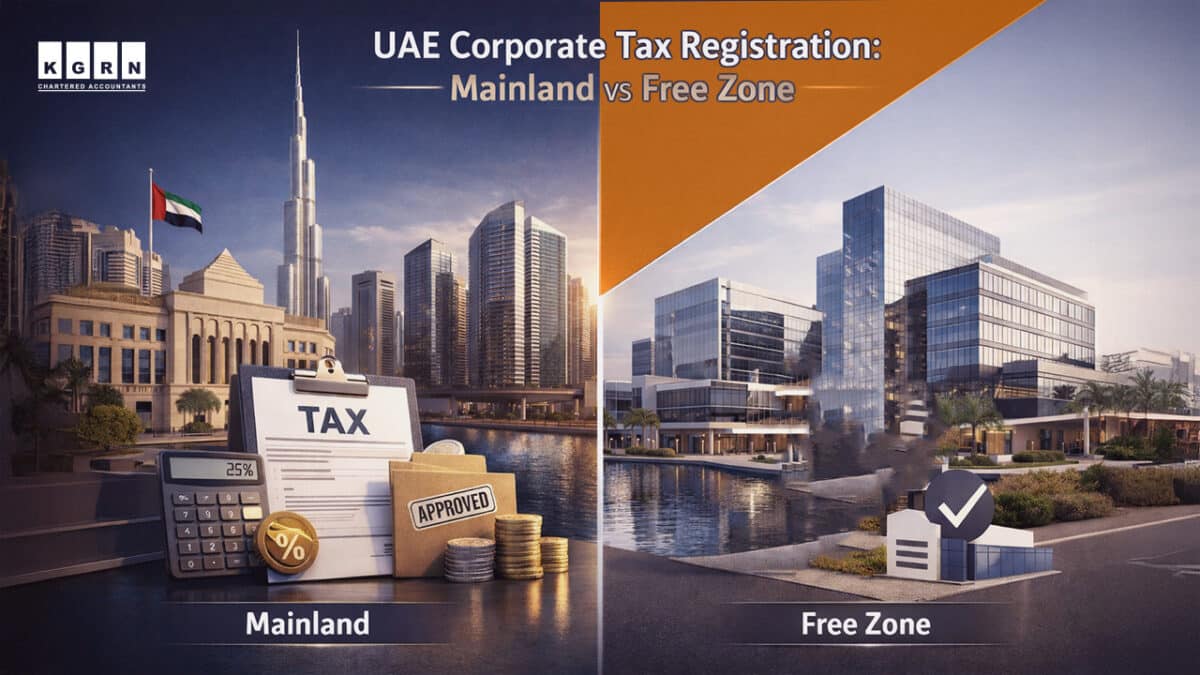
While these both fall under the same tax category in the UAE, the mainland companies are taxed at 9%, whereas the free zone businesses can acquire a 0% rate on qualifying income as long as they meet the conditions.
This article from KGRN will break down what businesses in mainland and free zones actually pay under the corporate tax registration regime based on the real-time scenarios from our experience and not theory.
Why is the Mainland vs Free Zone in Corporate Tax Registration Misunderstood?
The standard corporate tax rate in the UAE is 9% on profits above AED 375000.
So, any income below AED 375000 is taxed at 0% which means small and growing businesses can operate in the UAE with minimal tax.
On the other hand, the 9% corporate tax regime will still preserve Free Zone tax incentives. This created the misconception that free zones still enjoy a 0% environment which is partially true.
In reality, the applicable corporate tax treatment depends on several factors, including:
- The nature of the income
- Where businesses’ customers are located
- Whether the businesses deal with other Free Zones, Mainland, or outside UAE
- Whether the business qualifies as a Free Zone Person (FZP) eligible for the 0% tax rate
- Compliance with all FZP conditions
Mainland Corporate Tax Registration in UAE:
Businesses that are setting up in the mainland or operate on the mainland of the United Arab Emirates are subject to the ordinary corporate tax framework, which has simple requirements and a well-defined tax structure. The Federal Tax Authority portal registration, trade license documents submission, and financial information provision are all part of the extensive process for corporate tax registration in the United Arab Emirates for mainland firms.
What Mainland Businesses Actually Pay?
Although mainland businesses have a high tax-free threshold, profits over this level are subject to taxation. The following is how the tax computation structure works:
Taxable income up to AED 375,000 is taxed at 0%, while taxable income exceeding AED 375,000 is taxed at 9%.
This means a mainland business generating AED 1 million in taxable income pays zero tax on the first AED 375,000 and 9% on the remaining AED 625,000, resulting in a total tax liability of AED 56,250.
Compliance Requirements for Corporate Tax in Mainland:
- Registration: Registration: Corporate tax registration is mandatory for all taxable persons, including those benefiting from the 0% threshold. So, all the businesses must register with the Federal Tax Authority (FTA) to obtain a Tax Registration Number (TRN) via the EmaraTax platform.
- Aligning with IFRS: All financial statements must be streamlined and prepared according to International Financial Reporting Standards (IFRS) or other accounting standards accepted in the UAE.
- Transfer Pricing: Mainland companies with local and international related-party transactions must ensure compliance with the internationally recognised arm’s length principle.
Free Zone Corporate Tax Registration in UAE
Free zone organizations in the UAE can benefit from 0% corporate tax on qualifying income provided they meet specific conditions. and maintain ongoing compliance with substantive activity requirements. However, the businesses involved in the free zone have additional complexity and compliance requirements.
The Qualifying Free Zone Person (QFZP) Status
Free zone entities must obtain and retain Qualifying Free Zone Person status in order to take advantage of 0% tax rates. To receive this designation, businesses must fulfil specific requirements that guarantee real economic activity within the free zone as opposed to only administrative presence.
QFZP Requirements Include:
- Keeping a sufficient physical presence in the free zone with spaces suitable for commercial operations
- Hiring enough full-time workers in relation to business operations
- Having sufficient operational expenses in the United Arab Emirates
- Producing qualifying revenue through qualifying endeavors
- Earning qualifying revenue from transactions with non-UAE parties or, in permitted cases, mainland parties for non-UAE use.
What Free Zone Businesses Actually Pay?
Depending on whether they get QFZP status and the type of income they generate, free zone entities are subject to a split tax structure:
- Qualifying Income (Achieved QFZP Status): 0% tax rate
- Non-qualifying income is subject to the same 9% tax rate as the mainland.
- Income from the Mainland UAE: 9% tax rate
A free zone company with QFZP status that earns AED 1 million entirely from qualifying activities would not be subject to corporate tax. If AED 700,000 qualifies as qualifying income, that portion remains tax-free, but if AED 300,000 of the income comes from mainland UAE business or non-qualifying activities, that share is subject to 9% taxes (AED 27,000 tax liability).
What Businesses Actually Pay: Mainland vs Free Zone – Real-World Scenarios
Scenario 1:
Mainland Trading Company:
Net taxable profit: AED 900,000
Corporate Tax:
- 0% on first AED 375,000
- 9% on remaining AED 525,000
This is the “classic” outcome for many Mainland SMEs.
Scenario 2:
Free Zone Tech Company
Revenue from overseas clients and Free Zone clients is structured as Qualifying (subject to conditions)
Non-qualifying revenue is kept within permitted limits (where applicable)
Tax outcome:
- 0% on qualifying income
- 9% only if income becomes non-qualifying or conditions are breached
Scenario 3:
Free Zone Company Selling into Mainland
This is where many businesses face unexpected tax exposure.
Depending on the circumstances and the relevant rulings or guidelines, a Free Zone business may earn non-qualifying income or run the risk of losing 0% treatment if it consistently conducts business with Mainland clients (or engages in excluded activities).
Industry-Specific Lens for Corporate Tax Registration UAE:
- Trading & General Trading
Mainland: Simple 0% or 9% on earnings.
Free Zone: This structure can function effectively if the company’s primary focus is on:
- Exporting, exporting again, or selling to other Free Zone organizations, and avoiding trends that result in revenue that is not qualifying.
Key considerations include: Mainland-facing retail channels, direct consumer transactions (depending on how activities are defined/treated), and documentation.
- Professional Services (Consulting, Marketing & IT Services)
Mainland: Usually the easiest; clients may be found anywhere, and taxes are based on profits.
Free Zone: Fulfills QFZP requirements and works effectively for non-UAE or Free Zone clients; nonetheless, Mainland client servicing needs to be carefully evaluated.
Key considerations include: Transfer pricing, management fees to connected parties, and whether services are deemed eligible under the pertinent rulings.
- Manufacturing & Industrial
Mainland: Clearer VAT/ops integration, stable operational setup.
Free Zone: If manufacturing and exports meet the requirements for qualifying activities and the company is actually operating within the boundaries of the Free Zone, it may be tax-efficient.
Key considerations include: For revenue booking and distribution structures on the mainland.
- E-Commerce & D2C
Mainland: Direct sales to UAE customers are frequently preferable.
Free Zone: May be useful for international e-commerce, although the QFZP benefit may be complicated by pure UAE consumer sales.
Watch out: Payment gateways, fulfillment centers, and local delivery footprints can all have an impact on how “where the business is conducted” actually appears.
- Real estate & Holding Structures
The corporate tax result is largely dependent on:
- If income falls under exempt categories or company income, and
- Categorization of activities and licensing.
Don’t assume that location is the only factor influencing the tax outcome because this is a structure-first area.
Hidden Corporate Tax Requirements Businesses Often Miss in the UAE:
The majority of tax surprises, whether in the Free Zone or the Mainland, comes from operational realities:
- Audit requirements and accounting quality
Audited financial accounts and substantive conditions are frequently linked to Free Zone QFZP status (as mentioned in guidance and ministerial decisions).
- Mismatch in activity classification
Actual activity, license activity, and invoicing reality must all coincide.
- Pricing for related parties
Risk might be increased by intercompany charges that lack a justification.
- Wrong assumptions about 0%
False presumptions regarding the 0% rate: the 0% benefit is not based on location alone.
Bottom Line:
Corporate tax registration in UAE is more than just an administrative need; it has a significant impact on business economics and necessitates strategic thought that is in line with business models, clientele, and expansion objectives. The chances for tax efficiency are created by the distinctions between mainland and free zone treatment, but there are also compliance hazards for companies that don’t completely comprehend the regulations.
Effective corporate tax registration procedures, continuous compliance, and strategic planning are still crucial for business success in the UAE’s changing tax landscape, regardless of whether you operate from the mainland or a free zone. For more information on corporate tax registration or professional consultation, get in touch with KGRN for strategic tax compliance support.