
At KGRN, we help entrepreneurs and investors navigate Dubai’s evolving business landscape with clarity and confidence. As the UAE continues to refine its regulatory framework in 2026, Dubai remains a leading destination for mainland company formation and long-term growth.
With 100 percent foreign ownership now fully established for mainland companies, these reforms go beyond administrative change. They reflect a strategic shift designed to offer greater control, flexibility, and certainty for international businesses.
This article outlines Dubai’s current mainland company setup framework in 2026, the registration process, and the key advantages these regulations offer to businesses entering or expanding in the UAE.
1. Dubai’s 2026 Company Law Reform: A Strategic Turning Point
For decades, Dubai’s growth has been guided by a mix of innovation-friendly policies and controlled market access. Foreign investors enjoyed lucrative opportunities but were required to partner with a local Emirati sponsor who held 51% of company shares.
This model helped balance local participation and foreign capital, but it also created barriers for global investors , especially those concerned about:
- Losing operational control
- Protecting intellectual property (IP)
- Repatriating profits safely
In 2026, those challenges have been decisively addressed. The UAE government introduced landmark reforms that make it possible for foreign nationals and corporations to own 100% of mainland companies in most business categories.
This move aligns Dubai with global standards seen in markets like Singapore, Hong Kong, and London , positioning the emirate as the most competitive and investor-friendly jurisdiction in the region.
2. What 100% Foreign Ownership Means in Practice
The concept of full ownership extends far beyond just holding all the shares. It completely redefines how businesses operate and are governed in the UAE.
Key Benefits:
- Full Control Over Operations: You no longer need a local sponsor to act as a nominal majority shareholder.
- Simplified Legal Structure: No need for complex side agreements or trust contracts to secure operational control.
- Freedom to Repatriate Profits: You can transfer profits and capital freely back to your home country.
- IP and Brand Protection: Your trademarks, patents, and trade secrets are fully safeguarded under your corporate entity.
- Ease of Expansion: You can open branches, hire staff, and sign contracts directly under your company’s name.
These benefits make Dubai’s mainland setup especially attractive for international businesses in high-value industries such as technology, manufacturing, life sciences, and professional services.
However, with total ownership comes increased accountability.
Previously, local sponsors often handled much of the administrative workload , including government interactions, visa processing, and compliance tasks. With their role now removed, foreign companies must either:
- Hire an in-house Government Relations Officer (GRO) to manage compliance; or
- Partner with a corporate service provider (such as a professional business setup consultant) to navigate the system efficiently.
This shift ensures transparency and autonomy , but it also requires investors to be proactive in maintaining compliance with UAE business laws.
3. Step-by-Step Process: How to Set Up a Mainland Company in Dubai (2026 Edition)
Setting up a business in Dubai has never been faster or more straightforward. The 2026 regulations have streamlined the process into three main steps, removing unnecessary bureaucracy and emphasizing speed, clarity, and investor confidence.
Step 1: Define Your Business Activity
Every successful company formation in Dubai starts with defining your exact business activity.
The Department of Economic Development (DED) , the main authority overseeing mainland company registration , uses a coded list of business activities to classify and license companies.
Choosing the correct code is crucial, as it determines:
- The type of license you’ll need (commercial, professional, or industrial)
- The minimum capital requirements
- Any additional government approvals that may be necessary
For example:
- A marketing agency will fall under a professional license.
- A manufacturing plant might require an industrial license and environmental clearance.
- A financial services firm may need approval from the Central Bank or another regulator.
Selecting the wrong code or misclassifying your activity can lead to costly delays later in the process.
Tip: Always work with a registered business setup consultant to ensure your chosen activity accurately reflects your operations.
Step 2: Get DED Initial Approval
Once your business activity is defined, the next step is to obtain initial approval from the DED.
This acts as a green light confirming that the government has no objection to your business being established in Dubai.
During this stage, the DED will:
- Review your trade name application to ensure it’s unique and compliant.
- Verify that your business activity matches the correct category.
- Review your Memorandum of Association (MOA) if you have multiple shareholders.
The MOA is a legally binding document outlining the company’s ownership, capital, and management structure. Even with 100% ownership, it’s important that your MOA clearly defines how profits, decision-making, and responsibilities are distributed.
Common Mistakes to Avoid:
- Selecting a trade name that’s already taken or violates public naming rules.
- Submitting incomplete or inaccurate information in the MOA.
- Using unclear wording that doesn’t match your chosen activity code.
Getting the DED’s initial approval letter is a milestone. It signals that your structure, documentation, and proposed operations meet government standards and you can now proceed to the licensing phase.
Step 3: Apply for the Trade License
With DED approval in hand, you can move on to the final and most rewarding stage , obtaining your trade license.
To apply, you’ll need to prepare:
- Finalized MOA signed and notarized (if applicable)
- Office lease agreement (mainland companies must have a physical address)
- Passport copies and resolutions from shareholders
- DED approval letter and completed application forms
Once all documents are submitted and fees paid, the DED will issue your trade license, officially recognizing your company as a legal mainland entity in Dubai.
This license authorizes you to:
- Operate commercially
- Hire employees
- Open a corporate bank account
- Issue invoices and conduct business across the UAE and internationally
4. How Long Does It Take to Set Up a Mainland Company in 2026?
The UAE’s government has invested heavily in digital transformation, making the business setup process faster than ever.
In 2026, if all documents are accurate and the business activity doesn’t require external approvals, your company can be registered and licensed within 7 to 14 days.
However, regulated sectors , such as finance, healthcare, education, or oil and gas , may require extra clearance from specialized government authorities, extending the setup timeline to 4–8 weeks.
| Type of Business | Approximate Setup Time | Additional Approvals Needed |
| General Trading / Professional Services | 1–2 weeks | No |
| Manufacturing / Industrial | 3–4 weeks | Possibly (environmental or safety approvals) |
| Financial, Healthcare, or Education | 4–8 weeks | Yes |
| Oil & Gas or Strategic Sectors | Up to 8 weeks | Yes, multiple agencies |
Pro Tip: Ensure your documents are complete and properly notarized before submission. Incomplete files are the number one reason applications get delayed.
5. Compliance and Administrative Responsibilities
While 100% ownership offers freedom, it also means taking direct control of all compliance obligations. This includes:
- Visa and labor card processing for employees
- Renewal of trade licenses and office leases annually
- Maintaining accounting and audit reports as per UAE commercial laws
- VAT registration (if applicable) and ongoing tax filings
- Timely renewal of business activity approvals
To simplify these ongoing tasks, many foreign investors choose to outsource compliance management to corporate service providers in Dubai who handle:
- PRO (Public Relations Officer) services
- Document attestation and submission
- Employee visa management
- Government portal coordination (DED, MOHRE, and GDRFA)
By delegating these functions, you maintain focus on business growth while ensuring your company stays fully compliant.
6. Strategic Impact: How These Reforms Reshape Investment in Dubai
The shift to 100% foreign ownership is more than a business convenience , it’s a strategic play by Dubai to attract global industries that previously hesitated due to ownership restrictions.
Industries Now Poised to Thrive:
- Technology & Artificial Intelligence (AI): Global tech firms can now base their R&D centers in Dubai without IP concerns.
- Pharmaceuticals & Life Sciences: Companies gain full control over proprietary formulations and clinical data.
- Renewable Energy & Manufacturing: International producers can build facilities under their own name and export globally.
- Consulting & Professional Services: Firms can directly serve regional clients without requiring a local partner.
These industries value control, IP protection, and speed , all of which the 2026 reforms deliver.
Dubai’s strategy is clear: compete globally on efficiency, transparency, and investor control, not just location or tax incentives.
7. Costs Involved in Setting Up a Mainland Company
While costs vary depending on your activity and scale, here’s a general estimate for 2026:
| Expense Type | Approximate Cost (AED) |
| Initial Approval & Name Reservation | 620 – 1,200 |
| Trade License Issuance | 10,000 – 15,000 |
| Office Lease / Ejari Registration | 15,000 – 25,000 (varies by location) |
| MOA Drafting & Notarization | 1,000 – 2,500 |
| Immigration / Establishment Card | 500 – 1,000 |
| PRO / GRO or Setup Consultancy Fees | 5,000 – 10,000 (optional but recommended) |
Total Estimated Cost: AED 25,000 – 40,000 for a standard commercial license.
8. Why Choose Dubai Mainland Over a Free Zone?
A common question among investors is whether to set up in a Free Zone or Mainland Dubai.
While Free Zones offer attractive incentives like tax exemptions, they also come with limitations , particularly around where and how you can trade.
| Criteria | Mainland Dubai | Free Zone |
| Ownership (2026) | 100% Foreign Ownership | 100% Foreign Ownership |
| Business Scope | Can trade anywhere in UAE & internationally | Restricted to Free Zone or overseas |
| Office Requirement | Mandatory | Optional (virtual offices often allowed) |
| Government Contracts | Allowed | Not allowed |
| Corporate Tax | Standard UAE rates | Varies by zone |
For businesses targeting the UAE domestic market, a Mainland license is the best option. It allows full operational freedom within Dubai and across all emirates , plus global reach.
9. Practical Tips for Smooth Company Setup
To ensure your Dubai mainland company setup goes smoothly:
- Pre-verify documents (passports, lease, and MOA).
- Confirm your business activity code with a licensed consultant.
- Choose an experienced corporate services firm for liaison with DED.
- Plan for renewal dates , trade licenses expire annually.
- Maintain transparent accounting records to comply with UAE tax regulations.
Being proactive will save time and prevent unnecessary delays.
10. The Future Outlook: Dubai’s Bold Vision for Global Investors
With 100% foreign ownership and one of the world’s fastest business registration processes, Dubai has positioned itself as a premier international investment hub for 2026 and beyond.
The city’s vision is to create a seamless ecosystem where investors can set up, operate, and expand without administrative friction , supported by cutting-edge digital systems and a stable regulatory environment.
As global economies diversify, Dubai’s reform-driven model stands out as a blueprint for sustainable investment growth.

Need Expert Assistance with Mainland Company Formation in Dubai?
Our experienced team takes care of licensing, regulatory approvals, documentation, and compliance, allowing you to focus on business growth.
Final Thoughts: Empower Your Business with KGRN Chartered Accountants
The UAE’s digital transformation has rapidly redefined how businesses operate and comply with government regulations. Implementing e-Invoicing in Dubai is not just a matter of keeping up with technology, it’s about building trust, transparency, and efficiency into your financial operations. The shift to e-Invoicing ensures faster processing, reduced human errors, and better tax compliance under UAE VAT law.
However, understanding and implementing an e-Invoicing system that aligns with the Federal Tax Authority (FTA) guidelines can be complex, especially for growing businesses. That’s where expert guidance becomes invaluable.
At KGRN Chartered Accountant Company, we bring over 16+ years of trusted experience helping businesses across Dubai and the UAE stay fully compliant with VAT, e-Invoicing, and accounting standards. Our team of qualified tax consultants, auditors, and finance professionals ensures that your transition to digital invoicing is smooth, secure, and fully compliant with all FTA requirements.
Whether you are a startup setting up your first invoicing system or a large enterprise aiming to integrate your ERP with e-Invoicing software, KGRN provides tailor-made solutions to simplify every step , from registration and system setup to continuous monitoring and reporting.
With our professional service support, you can:
- Ensure 100% FTA-compliant e-Invoice generation and archiving.
- Reduce manual workload and administrative errors.
- Strengthen financial transparency and audit readiness.
- Integrate e-Invoicing seamlessly with your accounting software.
- Stay updated with every new e-Invoicing regulation in the UAE.
Our mission is simple , to make compliance effortless for UAE businesses while helping them thrive in the digital era.
Documents Required for Mainland Company Setup
To complete the registration process, you will need to prepare the following documents:
- Registration and licensing application
- Proof of reserved trade name
- Passport copy of shareholders
- Entry stamp or visa page
- Passport-size photograph
- Memorandum of Association
- Lease agreement
- No Objection Certificate (NOC) from relevant authorities if applicable
- Business plan
- Proof of residence
If any documents are not in English, they will need to be translated.
Compliance and Legal Requirements
Compliance with specific legal requirements is essential for maintaining a mainland company in Dubai. Key compliance aspects include:
- VAT Registration: If your annual turnover exceeds AED 187,500, you must register for Value Added Tax (VAT).
- Obtaining Necessary Permits: Depending on your business activity, you may need additional permits from relevant authorities.
- Health and Safety Regulations: Ensure that your office space complies with health and safety regulations.
Conclusion
Setting up a mainland company in Dubai continues to be one of the most strategic ways for entrepreneurs and investors to enter the UAE market. With updated business rules, expanded foreign ownership rights, and a streamlined licensing framework, establishing your presence in Dubai is now more accessible and profitable than ever.
A clear understanding of business activities, licensing requirements, compliance obligations, and operational guidelines ensures that your company is built on a strong foundation from day one. Whether you are starting a new venture or expanding your existing business, choosing the right guidance makes all the difference.
If you need expert support, customized planning, or full assistance with mainland company formation, our team is here to help you navigate every step with confidence and ease.
Frequently Asked Questions
What is a mainland company in Dubai?
A mainland company in Dubai is a business entity registered under the Department of Economic Development (DED), allowing it to operate freely within the UAE and internationally.
What are the benefits of setting up a mainland company in Dubai?
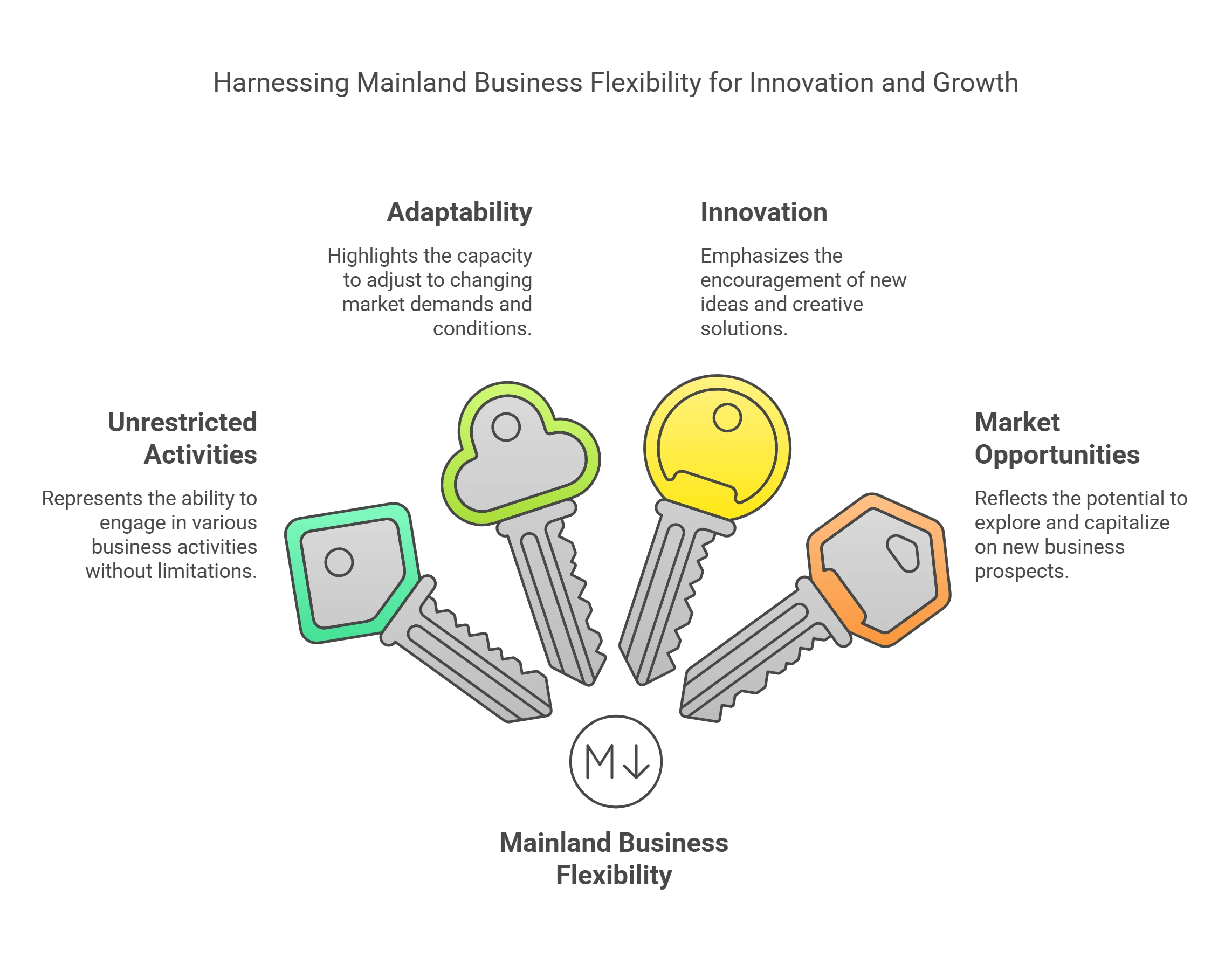
Benefits include operational flexibility, access to a wide range of business activities, eligibility for government contracts, and 100% foreign ownership in most sectors.
What documents are required for mainland company setup?
Documents include a registration application, proof of trade name reservation, passport copies of shareholders, lease agreement, and a Memorandum of Association.
How long does it take to set up a mainland company in Dubai?
The setup process typically takes several weeks to a few months, depending on the complexity of the business activity and the speed of document submission.
Do I need a local sponsor for a mainland company in Dubai?
Recent reforms allow 100% foreign ownership in most sectors, but certain strategic sectors may still require a local partner.