SME accounting and bookkeeping
Accounting Services for SMEs in the UAE
KGRN Chartered Accountants provides accounting services for SMEs in the UAE: bookkeeping, bank reconciliations, management reports and year-end financial statements, kept ready for VAT and Corporate Tax. We support startups, free zone companies and mainland businesses that need dependable books without building a full in-house finance team.
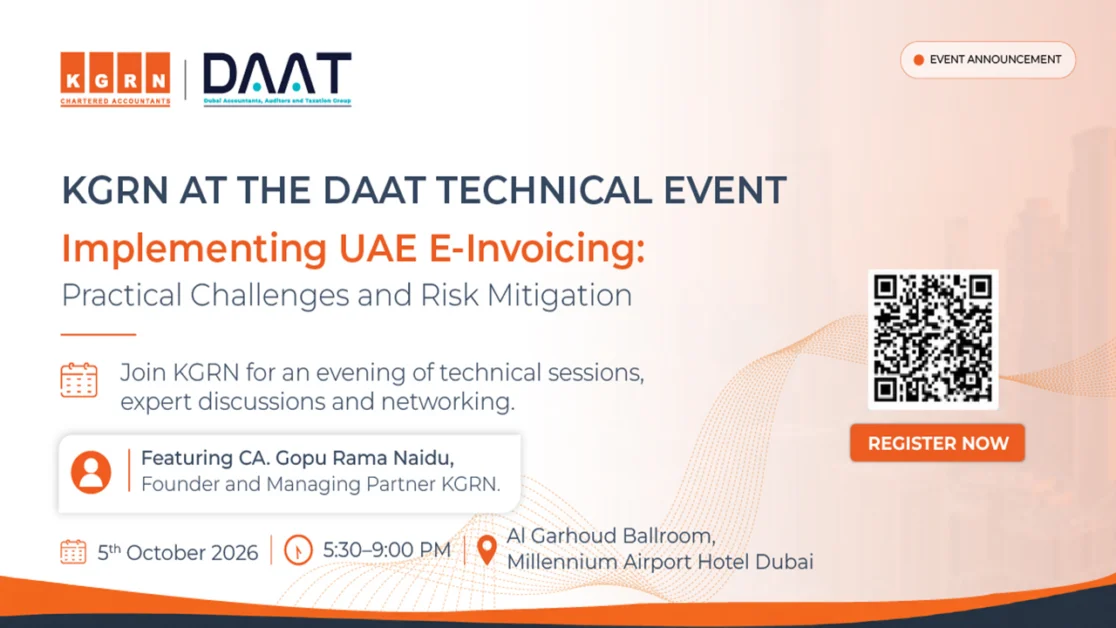
Corporate Tax made financial statements the starting point of every tax return, and businesses below AED 50 million revenue join the UAE's eInvoicing system on 1 July 2027.
- Monthly bookkeeping and reconciliations
- VAT and Corporate Tax-ready records
- Year-end financial statements
- Accountants based in Business Bay, Dubai
Speak with a KGRN accounting advisor on +971 54 586 4906, or send your requirements through our contact page.
- Bank reconciliationDone
- Sales and purchasesDone
- Payroll journalDone
- VAT workingsDone
- Management reportIn review
- VAT return28 days after period
- Corporate Tax return9 months after year end
- eInvoicing for SMEs1 July 2027
SME accounting from a chartered accountancy firm
KGRN Chartered Accountants is a UAE professional services firm providing accounting, audit, tax and advisory services from its office in Business Bay, Dubai.
Chartered accountancy backgroundAccounting from a firm that also prepares and audits financial statements.
UAE tax knowledgeVAT and Corporate Tax rules applied as transactions are recorded.
Dubai-based advisoryMeetings in Business Bay, or by phone and WhatsApp.
Scaled for SMEsScope matched to your transaction volume and reporting needs.
Reporting you can useMonthly figures explained in plain language.
Compliance-focused approachRecords kept to FTA retention rules and filing dates.
Overview
What Are Accounting Services for SMEs?
Accounting services for SMEs are outsourced finance functions that record a small or medium-sized business's transactions, reconcile its accounts, and produce management reports and year-end financial statements. In the UAE, they also maintain the records that VAT and Corporate Tax returns rely on.
Most SMEs do not need a full finance department. They need accurate monthly books, someone who knows UAE tax rules, and financial statements prepared to the right standard. KGRN provides this as an outsourced accounting service, working in your system or a cloud accounting set-up.
Bookkeeping
Records and classifies each transaction: sales, purchases, payroll and payments.
Accounting
Turns those records into reconciled ledgers, reports and financial statements.
Why it matters
Why Accounting Matters More for UAE SMEs Now
UAE SMEs moved from light-touch record keeping to a full tax framework in under a decade. Each change raised the standard of books a small business needs.
- 2018
VAT introduced
From 1 January 2018, registered businesses file VAT returns built from their transaction records.
- 2023
Corporate Tax begins
Financial years starting on or after 1 June 2023 are taxable, and returns start from the financial statements.
- 2026
Five-year VAT limits
From 1 January 2026, VAT refunds and carried-forward credits are limited to five years.
- 2027
eInvoicing for SMEs
Businesses below AED 50 million revenue go live with eInvoicing by 1 July 2027.
- 2029
Small Business Relief ends
The relief covers tax periods ending on or before 31 December 2029.
What reliable books give your business
Returns you can supportVAT and Corporate Tax figures traced to source documents.
Cash flow visibilityReceivables, payables and cash position every month.
Bank and investor confidenceFinancial statements that support finance applications and due diligence.
Better decisionsMargins and costs by product, service or branch.
Suitability
Which SMEs Need Accounting Services?
Any UAE business that files tax returns, renews a licence against financial statements or reports to a bank or investor needs reliable accounts. The businesses listed here most often outsource them.
What counts as an SME in the UAE?
| Size | Trading | Industry | Services |
|---|---|---|---|
| Micro | Up to 5 staff or AED 3m | Up to 9 staff or AED 3m | Up to 5 staff or AED 2m |
| Small | Up to 50 staff or AED 50m | Up to 100 staff or AED 50m | Up to 50 staff or AED 20m |
| Medium | Up to 200 staff or AED 250m | Up to 250 staff or AED 250m | Up to 200 staff or AED 200m |
Cabinet Resolution No. 22 of 2016 classifies by staff numbers or annual revenue. Tax thresholds apply separately.
Startups and new companiesBooks set up correctly from the first invoice
Free zone companiesStatements for licence renewal and the 0% tax conditions
Mainland companiesAnnual accounts behind VAT and Corporate Tax returns
Trading businessesInventory, cost of sales and import VAT
Service and consulting firmsProject income, receivables and expenses
E-commerce businessesPayment gateway and marketplace reconciliations
Family-owned businessesClear lines between personal and business spending
Growing SMEsNearing the VAT or AED 3 million thresholds
Businesses without a full-time accountantOr with one who needs support
Service scope
Our Accounting Services for SMEs
Choose the full monthly service or only the parts you need. Each service has a defined output, so you know what you receive and when.
- 01
Bookkeeping and transaction recording
- Sales, purchases and expenses recorded
- Chart of accounts built for your business
- Source documents filed for FTA review
- 02
Bank and account reconciliations
- Bank, card and payment gateway reconciliations
- Supplier and customer statement checks
- Differences flagged every month
- 03
Receivables, payables and payroll
- Customer ageing and collection reports
- Supplier payment schedules
- Payroll journals and end-of-service accruals
- 04
Management reports
- Monthly or quarterly profit and loss and balance sheet
- Cash flow view and budget comparison
- Short commentary on what changed
- 05
Year-end financial statements
- IFRS, IFRS for SMEs or cash basis, as permitted
- Accruals, depreciation and provisions
- Schedules ready for your auditor
- 06
VAT accounting
- Output and input VAT tracked per transaction
- Return workings reconciled to the ledger
- Tax invoices checked before input VAT is claimed
- 07
Corporate Tax-ready accounts
- Adjustments from accounting profit to taxable income
- Small Business Relief eligibility tracked
- Related-party transactions documented
- 08
Systems, clean-up and eInvoicing
- Cloud accounting set-up or migration
- Backlog and catch-up accounting
- Invoice data prepared for eInvoicing
UAE rules
UAE Accounting and Tax Requirements for SMEs
These rules most shape how a UAE SME keeps its books. Thresholds refer to revenue unless stated otherwise.
| Requirement | What it means for an SME | Legal basis |
|---|---|---|
| Record keeping | Keep accounting records and supporting documents for at least seven years after the end of each tax period. | Corporate Tax Law and FTA guidance |
| Accounting standard | IFRS by default. IFRS for SMEs is allowed up to AED 50 million revenue, and the cash basis up to AED 3 million. | Ministerial Decision No. 114 of 2023 |
| Audited statements | Required for Corporate Tax above AED 50 million revenue and for every Qualifying Free Zone Person. Licence conditions may require an audit regardless. | Ministerial Decision No. 82 of 2023 |
| Corporate Tax registration and return | New companies register within three months of incorporation and file within nine months of the year end. Late registration carries an AED 10,000 penalty. | FTA Decision No. 3 of 2024; Cabinet Decision No. 10 of 2024 |
| Small Business Relief | Available where revenue is AED 3 million or less in the current and every previous tax period, for periods ending by 31 December 2029. It is elected in the return. | Ministerial Decision No. 73 of 2023, as amended by No. 131 of 2026 |
| VAT registration and returns | Register above AED 375,000 of taxable supplies and imports (voluntarily above AED 187,500), then file and pay within 28 days after each tax period. | Federal Decree-Law No. 8 of 2017; FTA |
| VAT credits and refunds | From 1 January 2026, excess recoverable VAT can be carried forward or refunded only within five years. | Federal Decree-Laws No. 16 and 17 of 2025 |
| eInvoicing | Below AED 50 million revenue, appoint an Accredited Service Provider by 31 March 2027 and go live by 1 July 2027. | Ministerial Decision No. 244 of 2025 |
Requirements may vary depending on the business's circumstances. Professional advice should be obtained based on the specific facts and applicable regulations.
Process
How KGRN Delivers Accounting Services for SMEs
Onboarding sets up your books once. After that, the same monthly cycle runs until the year-end close.
Stage 1
Getting started
One-time set-up of scope, systems and balances.
- 01
Consultation and scope
We review your activities, volumes and deadlines, then agree a scope.
- 02
Review of current records
Existing books, balances and systems are checked for gaps.
- 03
Set-up
Chart of accounts, system access and a document routine are agreed.
- 04
Opening balances
Balances are confirmed and any backlog cleared before monthly work starts.
Stage 2
Every month
A fixed routine with agreed dates.
05 Collect
You share invoices, receipts and statements by the agreed date.
06 Record
Transactions are coded and posted, with VAT applied.
07 Reconcile
Bank, receivables and payables are matched to statements.
08 Report
Your management pack and VAT workings are delivered.
Repeats every month, with VAT return workings at the end of each tax period.
Stage 3
Every year
Closing the year and supporting your filings.
- 09
Year-end close
Adjustments are posted and financial statements prepared for your review.
- 10
Tax and audit support
Workings for your Corporate Tax return and schedules for your auditor.
Documentation
Documents and Information Required
We ask for a one-time set of company documents at the start, then a short monthly routine.
To get started
- Trade licence and memorandum of association
- VAT and Corporate Tax registration certificates
- Last financial statements or trial balance
- Bank account list and statements
- Access to your accounting system, if any
- Fixed asset, loan and lease details
Every month
- Bank and card statements
- Sales invoices and credit notes
- Purchase bills and expense receipts
- Payroll records
- Petty cash records
- Stock counts, where you hold inventory
Keep valid tax invoices: input VAT generally cannot be recovered without one.
Exact requirements vary with your activities, VAT position and transaction volume.
Cost
How Much Do Accounting Services for SMEs Cost?
There is no single fixed price. Fees depend on how much work your books need each month, and we quote after reviewing your volumes and records.
What drives the fee
- 01
Transaction volumeInvoices, bills and payments each month
- 02
Accounts and currenciesBank accounts, cards and foreign currency
- 03
VAT positionRegistration and return frequency
- 04
Payroll headcountEmployees and payroll changes
- 05
InventoryStock records and cost of sales
- 06
Reporting needsFrequency and level of detail
- 07
Backlog or clean-upPast periods that need rebuilding
- 08
Entities and branchesSeparate books for each one
How to keep fees predictable
- Send documents on a fixed monthly date
- Use one cloud accounting system
- Connect bank feeds where your bank allows
- Keep personal spending out of company accounts
- Agree reporting needs at the start
Payroll processing, audits and tax filings can be quoted separately or together.
Discuss Your Accounting Needs
Tell us your monthly transaction volume, VAT status and reporting needs, and we will suggest a scope before you commit.
Comparison
Outsourced SME Accounting vs an In-House Accountant
Both can work well. The right choice depends on your transaction volume, complexity and how much day-to-day finance support you need on site.
| Factor | Outsourced accounting | In-house accountant |
|---|---|---|
| Cost structure | A service fee scaled to your volume. | Salary, visa, benefits and end-of-service costs. |
| Expertise | Bookkeeping, VAT, Corporate Tax and IFRS knowledge in one team. | Depends on one person's experience. |
| Continuity | Work continues through leave and staff changes. | Leave or resignation can pause the books. |
| Systems | Experience across common cloud accounting systems. | Usually tied to the system already in place. |
| Day-to-day presence | Remote, on agreed schedules and channels. | On site for daily tasks and questions. |
| Usually suits | SMEs with steady volumes and periodic reporting needs. | Larger or complex operations needing full-time finance staff. |
Many SMEs combine both: an in-house bookkeeper with outsourced review, VAT and year-end work. See our accounting services for every option.
Why KGRN
Why Work With KGRN for SME Accounting?
KGRN approaches SME accounting as chartered accountants: every entry should hold up in a VAT review, a Corporate Tax return and an audit.
Books kept monthly are easier to file, audit and finance than books rebuilt at year end.
Talk to our accounting team- 01
Chartered accountancy standards
Accounts prepared to recognised standards, not just tidied for filing.
- 02
Tax-aware bookkeeping
VAT and Corporate Tax treatment decided as entries are posted.
- 03
Audit-ready records
Schedules and reconciliations your auditor will ask for.
- 04
Clear monthly reporting
Figures and commentary you can act on.
- 05
Scaled scope
From monthly bookkeeping to full reporting, sized to your volume.
- 06
Regulatory awareness
Relief thresholds, eInvoicing and record rules tracked for you.
- 07
Practical advice
Suggestions on systems, controls and costs, not only compliance.
- 08
Confidentiality
Financial data handled under professional confidentiality.
Scope of support
How KGRN Supports Your SME's Finance Function
Outsourced accounting runs smoothly when responsibilities are clear. You keep control of approvals and payments; we handle the recording, checking and reporting.
Your business
What stays with you
- Sharing documents on timeBy the date agreed each month
- Approving payments and journalsControl of your bank accounts stays with you
- Final approval of tax returnsBefore anything is filed with the FTA
- Keeping original recordsContracts, invoices and receipts
- Accounting policy decisionsMade by you, with our advice
KGRN professional assistance
Where KGRN assists
- Bookkeeping and reportingMonthly books through our accounting and bookkeeping services
- PayrollSalary processing with our payroll services
- VATReturns and reviews with our VAT consultancy
- Corporate TaxRegistration, returns and relief elections with our Corporate Tax services
- AuditSchedules for your auditor, or an external audit where independence rules allow
- eInvoicingUAE eInvoicing readiness and data checks
- Business advisoryBudgets and planning with our business advisory team
- ComplianceUBO registers and AML compliance
Avoid rework
Common Accounting Mistakes UAE SMEs Make
Most SME accounting problems start small and surface only when a return, a bank or an auditor asks for evidence.
- 01
Mixing personal and business spending
It distorts profit and makes deductions hard to support.
- 02
Recording everything at year end
Missed input VAT and rushed returns usually follow.
- 03
Claiming input VAT without a tax invoice
The FTA can disallow claims that lack valid tax invoices.
- 04
Skipping monthly bank reconciliations
Errors and missing entries compound over the year.
- 05
Losing sight of the AED 3 million line
Exceed it once and Small Business Relief is lost for later periods.
- 06
Ignoring related-party transactions
Owner loans and group sales must follow the arm's length principle.
- 07
Discarding records too early
Corporate Tax records must be kept for at least seven years.
- 08
Leaving eInvoicing to the last minute
Systems and invoice data need work well before July 2027.
Industries and locations
SME Accounting by Industry and Across the UAE
Requirements vary with your industry, transaction model, regulator, size and systems, so we adapt the chart of accounts and reports to each business.
Industry focus
- Trading and distributionInventory, landed costs and import VAT
- Construction and contractingProject costing, retentions and progress billing
- Real estateRental income, service charges and VAT on property
- Professional servicesTime-based billing, receivables and work in progress
- E-commerceGateway settlements, marketplace fees and refunds
- Hospitality and F&BDaily sales, point-of-sale reconciliations and stock
Across the UAE
We support SMEs across the emirates from our Dubai office. Local accounting pages:
Businesses in Ajman, Fujairah and the free zones are supported through the same service.
FAQs
Frequently Asked Questions About Accounting Services for SMEs
Straight answers to common SME accounting questions. For advice on your own books, speak with our team.
Ask a question through our contact pageThey usually cover bookkeeping, bank reconciliations, receivables and payables, payroll accounting, management reports and year-end financial statements. For UAE SMEs, they should also keep the records behind VAT and Corporate Tax returns, so every filed figure can be traced to source documents.
Yes. Every business needs records that support its tax position: Corporate Tax records must be kept for at least seven years after the end of the tax period, and VAT-registered businesses must hold the invoices behind each return. Licensing authorities and company law add their own requirements.
IFRS is the default. Under Ministerial Decision No. 114 of 2023, a business with revenue up to AED 50 million may use IFRS for SMEs, and one with revenue up to AED 3 million may use the cash basis. Choosing early avoids restating accounts later.
For Corporate Tax, audited statements are required only when revenue exceeds AED 50 million or the business is a Qualifying Free Zone Person. Many free zones and licensing authorities require an annual audit regardless of size, so check your licence conditions.
It lets a UAE resident business with revenue of AED 3 million or less, in the current and every previous tax period, be treated as having no taxable income. Ministerial Decision No. 131 of 2026 extends it to periods ending by 31 December 2029. You still register and elect it in your return.
Registration is mandatory once taxable supplies and imports exceed AED 375,000 over the previous 12 months, or are expected to within the next 30 days. Voluntary registration is available above AED 187,500. Returns are then filed and paid within 28 days after each tax period.
There is no fixed price. Fees depend on transaction volume, bank accounts, VAT and payroll, inventory, reporting frequency and any backlog. KGRN quotes after reviewing your records and volumes, so the scope matches the work your books actually need.
Yes. We review your existing records, agree opening balances and either continue in your current system or move you to a cloud system. A handover checklist covers balances, open items and documents, so nothing is lost in the transition.
Yes. Backlog accounting rebuilds past periods from bank statements and source documents, so overdue VAT and Corporate Tax filings can be supported and financial statements prepared. Where documents are missing, we record the gaps and the assumptions used.
If revenue is below AED 50 million, you must appoint an Accredited Service Provider by 31 March 2027 and issue in-scope B2B and B2G invoices electronically from 1 July 2027. Your accounting system and invoice data need to be ready before then.
It depends on volume and complexity. Outsourcing gives access to bookkeeping, tax and reporting skills for a scaled fee, while an in-house accountant offers daily presence. Many SMEs combine both, with outsourced review, VAT and year-end work.
Yes. KGRN Chartered Accountants provides bookkeeping, reconciliations, management reports, year-end financial statements and VAT and Corporate Tax-ready records for SMEs across the UAE. Call or WhatsApp +971 54 586 4906 to discuss your requirements.
This page provides general information about accounting for SMEs in the UAE and is not legal or tax advice. Requirements and thresholds are set by the UAE authorities and may change.
Next step
Need Reliable Accounting for Your SME?
Speak with KGRN Chartered Accountants about your books, reporting, VAT and Corporate Tax records. We will review how your accounts are kept today and recommend a scope that fits your business.
- Bookkeeping
- Management reports
- Financial statements
- VAT
- Corporate Tax
- eInvoicing
Speak with a KGRN accounting advisor
Tell us about your transaction volume, VAT status and reporting needs, and we will outline the right support.
KGRN Chartered AccountantsOxford Tower 1005, Business Bay, Dubai, UAE
Phone and WhatsApp: +971 54 586 4906
Prefer to write? Use our contact page.