
Your renewal date is visible. Your audit deadline may not be.
If your UAE free zone licence expires in October, November or December, the renewal date is probably already on your operations calendar. The more important question is whether the financial records supporting that renewal, your corporate tax return and any 0% free zone tax position are ready for audit.
These obligations are often treated as one deadline. They are not. A free zone licence is issued and renewed by the relevant free zone authority. Financial statements and audits may be required under that authority’s regulations or renewal process. Corporate tax obligations arise separately under federal law. The dates can overlap, but one does not automatically replace another.
That is why waiting for a renewal notice is risky. By the time it arrives, the company may already be working against a financial reporting deadline, a corporate tax filing date or an auditor’s evidence cut-off.
The three clocks every free zone company should map
1. The licence renewal clock
Your licence expiry date is authority-specific. The renewal documents, submission window, approvals and any financial-statement requirement are also set by the relevant free zone and can vary by entity type, activity and current portal instructions.
There is no single federal rule stating that every UAE free zone company must submit an audit report on the day it renews its licence. Equally, a smooth online renewal does not prove that the company has met its separate audit or corporate tax obligations.
2. The free zone financial-reporting clock
Some free zone company regulations require annual accounts, an audit, filing within a prescribed period after the financial year-end, or the use of an auditor registered or approved by that authority. Others may apply different requirements or request financial information through the member portal.
The only safe calculation is based on the company’s own authority, legal form, financial year and latest renewal checklist. Do not copy the deadline of another free zone, even if both companies renew in Q4.
3. The federal corporate tax clock
For UAE Corporate Tax, a Taxable Person must file its return and pay any Corporate Tax due within nine months from the end of the relevant Tax Period. A company with a 31 December 2026 year-end therefore has a filing and payment deadline of 30 September 2027. A company with a 30 June 2026 year-end ordinarily reaches that deadline on 31 March 2027.
Taxable Persons and relevant Exempt Persons must retain supporting records for at least seven years after the end of the Tax Period to which they relate. An audit is therefore not a substitute for record retention, reconciliations or tax analysis.
Who must maintain audited financial statements for UAE Corporate Tax?
For Tax Periods beginning on or after 1 January 2025, Ministerial Decision No. 84 of 2025 identifies the categories that must prepare and maintain audited financial statements. The key categories include:
- A Taxable Person that is not part of a Tax Group and has revenue exceeding AED 50 million in the relevant Tax Period.
- A Qualifying Free Zone Person, regardless of revenue.
- A Tax Group, which must prepare audited special-purpose aggregated financial statements in the form and manner prescribed by the Federal Tax Authority.
For a non-resident, the AED 50 million test considers revenue attributable to its UAE Permanent Establishment or nexus in the UAE. The 2025 decision applies to Tax Periods starting on or after 1 January 2025; the previous Ministerial Decision No. 82 of 2023 continues to govern earlier-starting Tax Periods.
| Important distinction The law uses “prepare and maintain”. It does not mean every company automatically uploads its audit report with every Corporate Tax return. The report must exist where required and must be available if requested. Separate filing or submission requirements may also arise under the relevant free zone’s rules. |
Why the QFZP audit is more than a licence-renewal document
A free zone company does not receive the 0% Corporate Tax rate merely because its trade licence carries the name of a free zone. The 0% rate applies to Qualifying Income only when the entity meets the conditions for Qualifying Free Zone Person status.
Those conditions include maintaining adequate substance, deriving Qualifying Income, not electing into the standard Corporate Tax regime, applying the arm’s-length principle, meeting the relevant transfer pricing requirements and maintaining audited financial statements. Non-qualifying revenue must also remain within the de minimis limit, which is the lower of AED 5 million or 5% of total revenue, calculated under the applicable rules.
If a business is relying on QFZP treatment, the audit must support the tax position. It should not be treated as a certificate to obtain after the accounting records have already been finalised without reviewing customer status, transaction type, related-party pricing or revenue classification.
KGRN | Q4 Free Zone Licence Renewal and Audit Readiness
What a Q4 renewal means in real dates
Assume a company’s free zone licence expires on 15 November 2026. The correct audit plan depends on its financial year, not the renewal month alone:
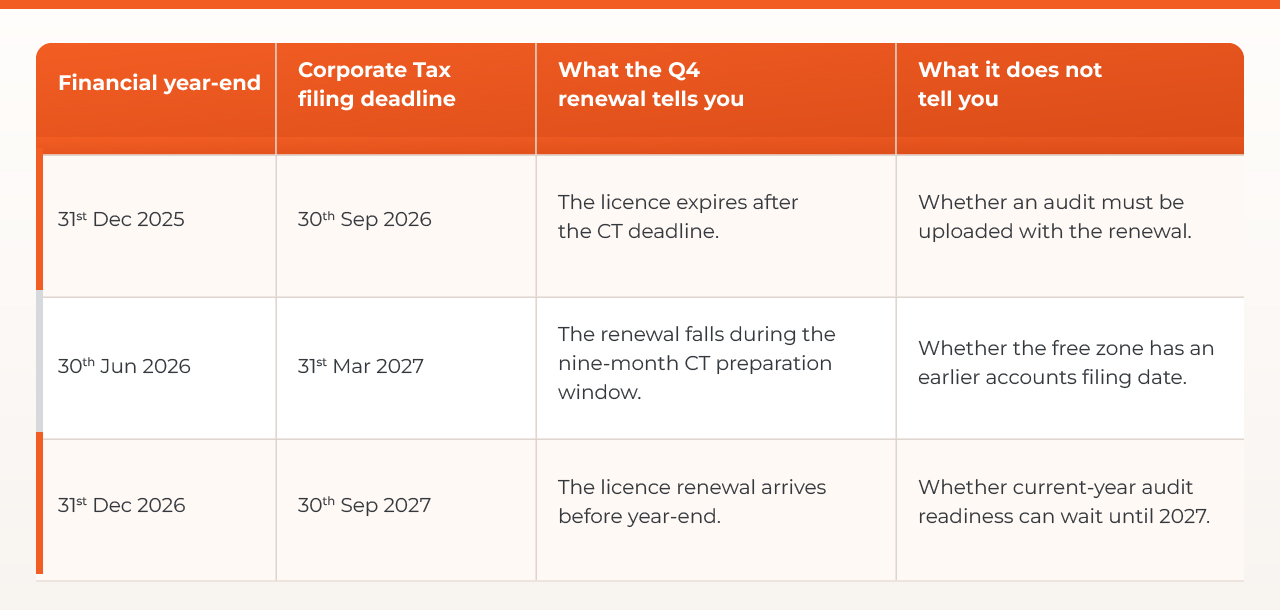
These dates show why “our licence renews in November” is not enough information to set an audit deadline. The company must overlay the authority requirement, the financial year-end and the tax filing date.
The Q4 audit-readiness plan
If your licence renews between October and December, complete the following before the renewal file becomes urgent:
- Confirm the exact legal entity, free zone authority, licence expiry date and financial year-end. Check the current member portal and authority-issued renewal checklist for that entity.
- Document the Corporate Tax position. Confirm whether the company intends to qualify as a QFZP, has elected for standard taxation, belongs to a Tax Group or exceeds the AED 50 million revenue threshold.
- Lock the accounting cut-off. Reconcile every bank account, payment gateway, receivable, payable, loan, shareholder balance, fixed asset and inventory record through the latest closed month.
- Review revenue before year-end. Separate income by counterparty, activity and location so the QFZP qualifying-income and de minimis tests can be assessed from evidence, not reconstructed after filing.
- Resolve related-party balances and pricing. Intercompany charges, management fees, shareholder transactions and cross-border services should be supported by agreements, invoices and transfer pricing analysis where applicable.
- Appoint an acceptable auditor early. Where the free zone requires an approved or registered auditor, confirm eligibility before signing the engagement letter.
- Build one compliance calendar. Include the licence-renewal submission date, financial-statement approval date, authority filing date, Corporate Tax return and payment date, VAT dates and document-retention responsibilities.
Documents that most often slow an audit
Incomplete bank, card or payment-gateway statements and unreconciled transfers
- Customer and supplier balances without confirmations, invoices or settlement evidence
- Contracts that do not match the invoicing entity, activity or revenue classification
- Related-party or shareholder balances without agreements and commercial support
- Inventory records without count sheets, costing support or movement reports
- Fixed-asset additions without invoices, ownership records or depreciation schedules
- VAT returns that do not reconcile to the general ledger and reported revenue
- QFZP revenue mapping prepared after year-end rather than maintained during the year
These are not merely audit inconveniences. They can affect the tax return, the QFZP analysis and the company’s ability to respond if the FTA or free zone authority requests supporting records.
Common mistakes to avoid
“Our licence has been renewed, so we are compliant.”
Licence renewal confirms the status of the licence. It does not, by itself, confirm compliance with every federal tax, accounting or audit obligation.
“We are below AED 50 million, so no audit is needed.”
That conclusion is incomplete. A QFZP must maintain audited financial statements regardless of revenue. A free zone authority may also impose its own audit or accounts requirements.
“The Corporate Tax return is nine months away, so the audit can wait.”
The tax deadline is the final filing date, not an audit workplan. Weak reconciliations, missing evidence and revenue-classification issues take time to correct, especially after staff, systems or counterparties change.
“All free zones follow the same renewal checklist.”
They do not. Requirements can vary by authority, entity and activity, and portals can be updated. Use current instructions issued for the specific company.
Frequently asked questions
Does every UAE free zone company need an audit for licence renewal?
No single federal rule makes an audit report a universal renewal document for every free zone company. The renewal requirement depends on the relevant authority and entity. Separate Corporate Tax rules may still require audited financial statements.
Does every Qualifying Free Zone Person need audited financial statements?
Yes. A QFZP must prepare and maintain audited financial statements regardless of revenue.
Is AED 50 million the audit threshold for every free zone company?
No. The threshold applies to certain Taxable Persons under the Corporate Tax audit rule. It does not remove the audit requirement for a QFZP, a Tax Group or an entity subject to a free zone-specific requirement.
When is the UAE Corporate Tax return due?
Generally, within nine months from the end of the relevant Tax Period. The Corporate Tax payable is due within the same period.
Must the audit report be uploaded with the Corporate Tax return?
The requirement is to prepare and maintain audited financial statements where applicable. Whether documents must be submitted with the return or later provided depends on the prescribed filing requirements and any request from the FTA.
How long must Corporate Tax records be retained?
At least seven years following the end of the Tax Period to which the records relate.
Can a company rely on its free zone licence to claim 0% Corporate Tax?
No. The company must satisfy all QFZP conditions, and the 0% rate applies to Qualifying Income. Free zone registration alone is not enough.
Do not let the renewal reminder start the audit
A Q4 licence expiry should trigger a compliance review, not a last-minute document chase. The right starting point is a dated map of the company’s licence, financial year, free zone requirements and Corporate Tax status. Once those are aligned, the audit becomes a managed process instead of a renewal risk.
KGRN can review the applicable free zone requirements, assess the company’s Corporate Tax and QFZP position, prepare the audit-readiness schedule and coordinate the statutory audit and filing timetable.