

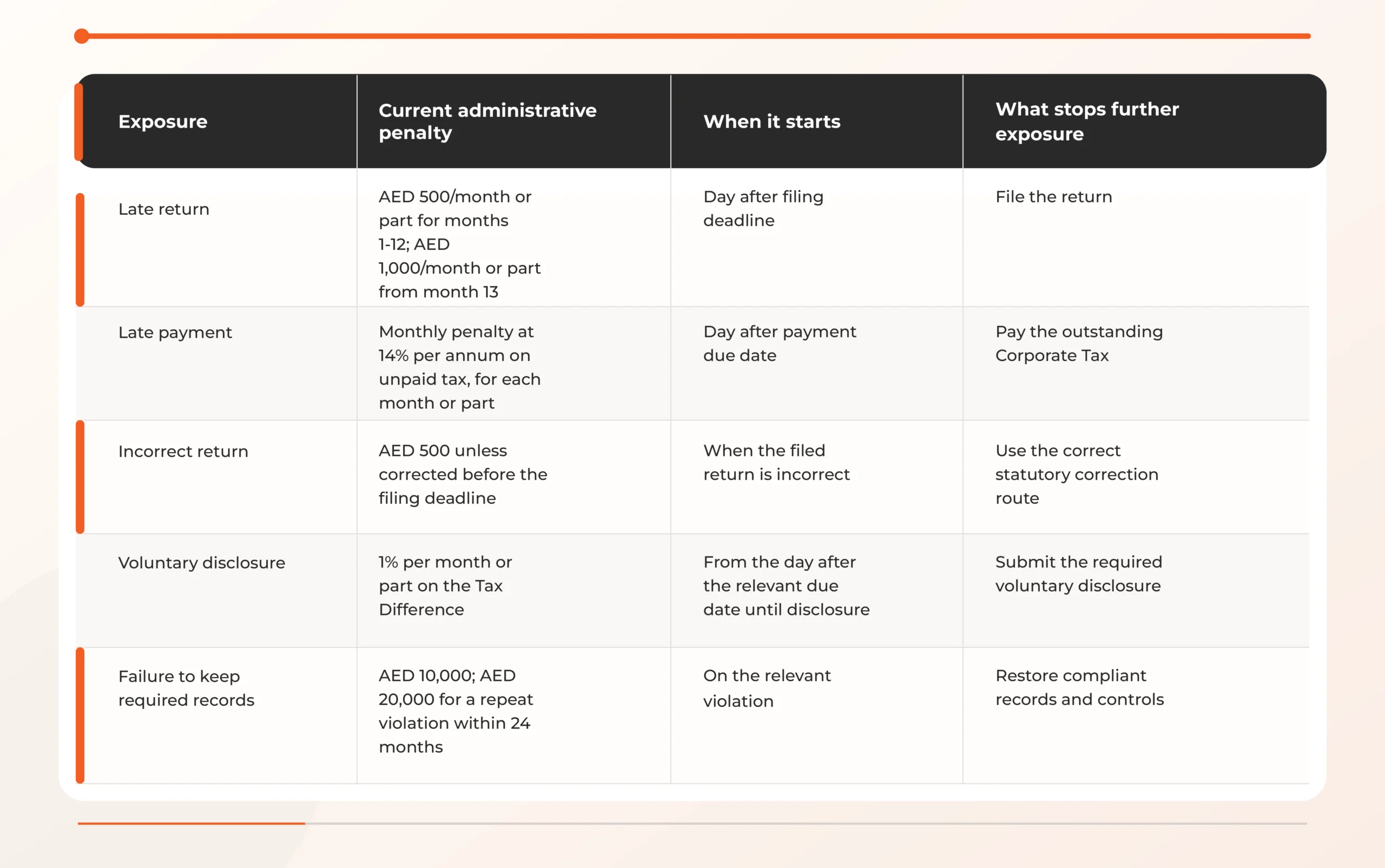
Missing a UAE Corporate Tax deadline does not make the filing obligation disappear. It can create two separate exposures: a penalty for submitting the return late and another penalty if the Corporate Tax due remains unpaid. Additional penalties may arise if the return is incorrect or the records needed to support it are unavailable.
The practical priority is to stop the delay from continuing. Confirm the correct deadline, complete the return using supportable figures, submit it through EmaraTax, settle the tax due and preserve the filing evidence.
If an FTA decision appears incorrect, or there are grounds for formal penalty relief, address that through the appropriate statutory process after the compliance position is brought under control.
UAE Corporate Tax late filing: the essentials
| Question | Current Position |
| Normal return deadline | Within nine months from the end of the relevant Tax Period |
| Normal payment deadline | Within nine months from the end of the relevant Tax Period |
| Late return penalty | AED 500 per month or part for the first 12 months; AED 1,000 per month or part from month 13 |
| Late payment penalty | A monthly penalty calculated at 14% per annum on unpaid Corporate Tax, for each month or part of a month |
| Where to file | EmaraTax, directly or through an authorised representative |
| Immediate priority | Submit the return, pay any tax due, then assess correction or relief routes |
Official basis: the FTA confirms the nine-month filing and payment rule, while the penalty amounts are set out in Cabinet Decision No. 75 of 2023.
How to calculate your Corporate Tax filing deadline
Start with the final day of the Tax Period shown for the Taxable Person, then count nine months. Do not rely only on the commercial licence renewal date, VAT quarter or the date on which the company first generated revenue. Those dates may not be the Corporate Tax return deadline.
| Tax Period ends | Normal filing/payment deadline | Status on 21 September 2026 |
| 31 December 2025 | 30 September 2026 | Due soon |
| 31 March 2026 | 31 December 2026 | Future deadline |
| 30 June 2026 | 31 March 2027 | Future deadline |
The FTA stated in September 2026 that a Taxable Person with a financial year ending on 31 December 2025 must file and pay by 30 September 2026. This is a useful example of the nine-month rule, not a universal deadline for every business.
What is the UAE Corporate Tax late filing penalty?
Under Cabinet Decision No. 75 of 2023, the administrative penalty for failing to file a Corporate Tax Return within the specified timeframe is:
- AED 500 for each month, or part of a month, during the first 12 months of delay.
- AED 1,000 for each month, or part of a month, from the 13th month onwards.
The penalty starts from the day after the filing deadline and is imposed on the corresponding date in each following month. Because a part of a month counts, a short delay can still trigger a full monthly amount.
Illustrative late filing examples
| Illustrative delay | Late filing calculation | Illustrative penalty |
| 20 days | 1 part-month x AED 500 | AED 500 |
| 5 months | 5 months x AED 500 | AED 2,500 |
| 14 months | 12 x AED 500 + 2 x AED 1,000 | AED 8,000 |
These examples isolate the return filing penalty. They do not include any late payment, incorrect return, voluntary disclosure, record-keeping or other penalties that may apply to the facts. The EmaraTax account and FTA assessment remain the authoritative record for the amount imposed.
Late filing and late payment are separate
Submitting the return late and paying Corporate Tax late are different violations. Filing the return does not, by itself, clear an unpaid tax balance. Likewise, paying an estimated amount does not complete the return filing obligation.
How to fix a late UAE Corporate Tax filing
- Confirm the Tax Period and exact deadline. Check the Corporate Tax profile in EmaraTax, the entity’s financial year, any approved change of Tax Period and any specific FTA decision that applies. Do not substitute a VAT or licence date.
- Close the accounts and assemble the support. Finalise the trial balance, financial statements, taxable income adjustments, related-party information, elections, relief claims and tax payment computation that apply to the return.
- Submit the return without avoidable delay. The monthly or part-month filing penalty can continue while the return remains outstanding. Use supportable information and do not invent or force figures simply to submit a form.
- Pay the Corporate Tax due. Settle the outstanding amount through an accepted FTA payment channel and verify the posting in EmaraTax. A separate late payment penalty may continue until the tax is paid.
- Review whether a correction is required. If the filed return is wrong, identify whether the error should be corrected through the return functionality available, a voluntary disclosure, or another FTA procedure. The right route depends on the type and timing of the error.
- Save proof and reconcile the account. Retain the submission confirmation, return copy, payment evidence, penalty notices and the workings supporting every material figure. Reconcile these against the EmaraTax balance.
- Use the correct dispute or relief route. If the FTA decision appears wrong, consider reconsideration within the statutory period. If the penalty is valid but exceptional relief is sought, assess the separate waiver, instalment or refund process.
KGRN’s Corporate Tax consulting and filing team can review the deadline, prepare the return, reconcile taxable income and support communication with the FTA. Businesses with incomplete ledgers may also need outsourced accounting and bookkeeping support before the return can be finalised.
What if the late return is also incorrect?
Do not ignore an error after filing. First determine whether it affects taxable income, Corporate Tax payable, a relief claim, an election or required disclosure. Then use the correction mechanism that applies to the error and timing.
Cabinet Decision No. 75 of 2023 provides an AED 500 penalty for submitting an incorrect Corporate Tax Return unless it is corrected before the filing deadline. Where a voluntary disclosure is required, the decision also provides a penalty of 1% per month or part of a month on the Tax Difference, calculated from the day after the relevant due date until the voluntary disclosure is submitted.
If a voluntary disclosure is not submitted before an FTA tax audit notification, a fixed 15% penalty on the Tax Difference can apply, together with the specified 1% monthly component. This is one reason to review a rushed or late return promptly instead of waiting for an FTA enquiry.
Can a UAE Corporate Tax penalty be waived or challenged?
Possibly, but not automatically. A challenge to an FTA decision and a request for discretionary penalty relief are different processes.
1. Reconsideration of an FTA decision
A person may request reconsideration where there are legal or factual grounds to dispute an official FTA decision. The FTA reconsideration service states that the request should generally be submitted within 40 business days from the date of the decision, supported by documentary evidence and the grounds for reconsideration. An extension request may be available under FTA Decision No. 1 of 2025 where its conditions are met.
-
Administrative penalty instalment, waiver or refund request
The FTA also provides a separate service for installment, waiver and refund of administrative penalties. Approval is discretionary and depends on the applicable conditions and evidence. For a waiver request, the FTA service requires an undertaking that the violation has been corrected and will not be repeated. Instalment requests are subject to their own eligibility conditions, including a stated minimum penalty threshold of AED 50,000, which the committee may amend.
A relief request should not be used as a reason to leave a return unfiled or tax unpaid. Correcting the compliance failure, documenting the cause and preventing recurrence strengthen the factual record, but they do not guarantee that relief will be approved.
For authorised representation and FTA liaison, see KGRN’s FTA tax agent services.
3. Do not confuse late filing with the late registration waiver initiative
The FTA’s Corporate Tax registration initiative concerns the separate AED 10,000 penalty for failing to submit a Corporate Tax registration application on time. Under Public Clarification CTP006, that registration penalty may be waived or refunded if the Taxable Person submits its first Corporate Tax Return within seven months from the end of its first Tax Period and satisfies the initiative’s conditions.
This does not create a general seven-month filing rule, a broad late-return amnesty or an extension of the tax payment deadline. CTP006 expressly states that the Corporate Tax payment remains due within nine months from the end of the Tax Period. Review the FTA’s CTP006 clarification before relying on the initiative.
Special situations that still require attention
Small Business Relief
Small Business Relief can simplify the tax outcome for an eligible Resident Person, but it does not remove the need to comply with Corporate Tax administration. The FTA’s September 2026 reminder states that eligible businesses seeking the relief must still register, elect for the relief in a simplified Tax Return and retain the required records.
No tax payable or a tax loss
A nil tax amount does not, by itself, cancel the return requirement. The late filing penalty is linked to failure to submit the return within the specified timeframe, not only to the amount of Corporate Tax payable. Check the person’s registration and filing status rather than assuming no payment means no return.
Free zone businesses
Free zone status or an expected 0% rate does not automatically remove Corporate Tax filing obligations. A free zone entity should verify its registration, Tax Period, qualifying status and return requirements. It should also preserve the evidence supporting any position on Qualifying Income and non-qualifying income.
Dormant, ceased or liquidating entities
A lack of trading activity does not automatically close the Corporate Tax account. Cessation and deregistration are separate compliance matters, and outstanding returns or liabilities may remain. The entity should check the effective cessation date, pending Tax Periods and deregistration requirements in EmaraTax.
Tax Groups
A Tax Group should confirm the period and filing responsibility of the Parent Company as representative of the group. Late information from one group member can delay the consolidated filing, so intercompany balances, tax adjustments and supporting schedules should be closed early.
How KGRN Chartered Accountants can Help
A late filing requires speed, but it also requires defensible numbers. KGRN can help a business confirm its Tax Period, close accounting gaps, prepare or review the Corporate Tax Return, calculate the tax payable, reconcile EmaraTax balances, assess correction routes and support FTA correspondence through an authorised tax agent where appropriate.
If the deadline has already passed, contact KGRN with the entity name, Corporate Tax registration details, Tax Period, current filing status and any FTA notice received. This allows the recovery work to start with the correct facts.

Related posts:
 Do You Need Audited Financial Statements Under UAE Corporate Tax Law
 IFRS 18 Classification Guide for UAE Companies: Operating, Investing and Financing Income
 UAE Corporate Tax Deadline 2026: 12 Filing Dates & Guide CEOs Cannot Afford to Miss
 Audited Financial Statements for UAE Corporate Tax: MD 84 Rules Explained
 UAE Valuation Rules in 2026: Business Valuation, Property and Transfer Pricing